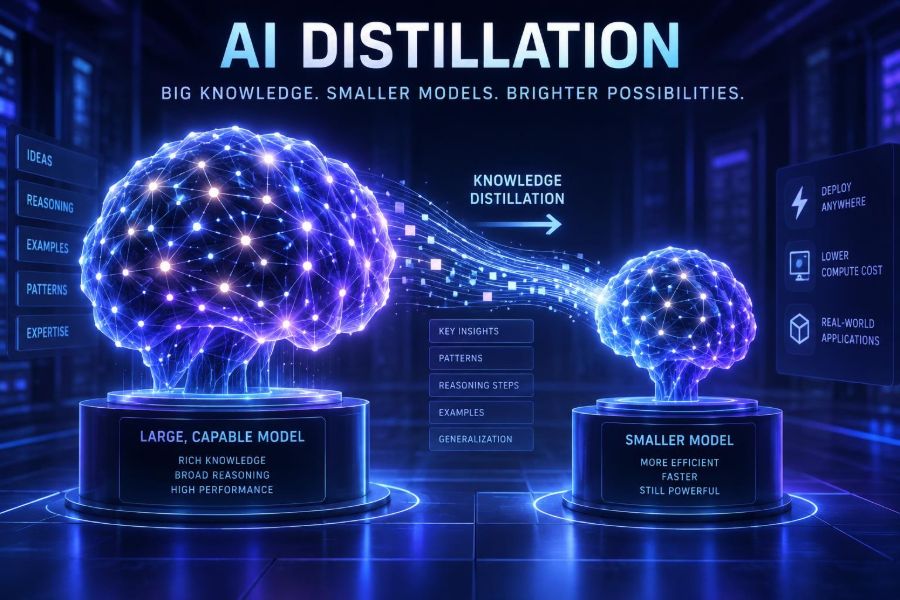

AI models are getting more capable, but the biggest models can still be expensive to run, slow to respond, difficult to deploy on private infrastructure, and unnecessarily powerful for a narrowly defined task. That creates a practical gap between what frontier-scale systems can do and what a product can afford to serve millions of times.
Knowledge distillation is one of the most useful ways to close that gap. It trains a smaller “student” model to imitate the behavior of a larger “teacher” model, preserving useful capabilities while reducing cost, latency, memory use, or all three.
This matters now because teams increasingly need specialized AI: an assistant that follows a company style guide, extracts fields from documents, triages support tickets, writes code in one framework, or works reliably on a device. A general-purpose large model may create the training signal, while a compact model handles routine production traffic.
After reading, you will be able to recognize when distillation is the right strategy, design a teacher-to-student data pipeline, choose an evaluation plan, avoid common quality traps, and build a small practical distillation prototype.
🧠 1. What AI distillation means
In AI, distillation is a training process in which a student model learns from a stronger teacher model. Rather than learning only from human-written labels, the student also learns from the teacher’s outputs, preferences, probabilities, intermediate representations, or generated explanations.
The goal is not to copy every fact stored in the teacher. The goal is to transfer useful behavior for a defined task distribution: the kinds of inputs the student will see in production.
A simple example is a large language model that creates polished product-category labels from messy catalog titles. A smaller model can be trained on thousands of teacher-labeled examples and then classify new titles quickly and cheaply.
🏭 2. Why a smaller model can be valuable
“Smaller” does not automatically mean “better.” It means a team can optimize for constraints that matter in a real system.
| Production need | Why distillation can help | Example |
|---|---|---|
| Lower latency | Fewer computations per request | Real-time autocomplete |
| Lower serving cost | Less accelerator or CPU capacity | High-volume ticket routing |
| Private deployment | Model can run in a controlled environment | Internal document classification |
| Offline operation | Compact model may fit on an edge device | On-device transcription commands |
| Predictable task behavior | Training narrows the task and output format | Structured invoice extraction |
Distillation is especially attractive when a task is frequent, repetitive, and measurable. It is less compelling when every request demands broad world knowledge, difficult reasoning, or constantly changing information.
👩🏫 3. Teacher, student, and the transfer signal
The teacher is usually larger, more accurate, or more specialized. The student is usually smaller, cheaper, or designed for a target device. What connects them is the transfer signal: the information the teacher provides during training.
- Hard labels: a final answer such as “refund,” “shipping,” or “technical support.”
- Soft labels: a distribution of confidence across possible answers.
- Generated responses: high-quality question-and-answer pairs or task completions.
- Preferences: a teacher’s ranking of two candidate responses.
- Features: internal representations, usually used when training compatible model architectures.
For generative AI, the most accessible path is often response distillation: collect representative prompts, use the teacher to produce target answers, filter the results, and fine-tune the student.
🧪 4. The intuition behind soft targets
Traditional supervised learning gives a model one target: the correct class. Distillation can provide more nuance. If an image teacher assigns high likelihood to “husky,” some likelihood to “wolf,” and very little to “bicycle,” the student learns which mistakes are more understandable.
For a classifier, a common objective combines normal label training with teacher imitation:
total_loss = alpha * supervised_loss(student, true_label)
           + (1 - alpha) * distillation_loss(student, teacher)
Many implementations use a temperature value to soften probability distributions before comparing them. Higher temperature makes secondary probabilities more visible. This mathematical form is powerful, but you do not need it to apply response-based distillation to language tasks.
🎯 5. Pick a task before picking a model
The biggest distillation mistake is trying to compress “general intelligence.” Start with a crisp job, a bounded input type, a desired output, and a measurable definition of success.
Write a task card before generating any training data:
Task: Classify incoming support messages
Input: Subject line and message body
Output: one category and one urgency level
Categories: billing, account, delivery, technical, other
Success: at least 95% category accuracy on reviewed test cases
Constraints: no personal data in training exports; response under 200 ms
Good first projects include classification, extraction, translation within a limited domain, intent routing, structured summaries, and style-constrained rewriting. Open-ended expert advice is a much harder first target.
📦 6. Build a representative input set
A student learns what you show it. Gather inputs that reflect production reality, not only clean or easy examples. Include short, long, ambiguous, typo-filled, multilingual, adversarial, and rare cases when they matter.
- Export or author candidate inputs under your privacy policy.
- Remove duplicates and obvious corruption.
- Separate data by source, date, customer segment, or difficulty.
- Reserve a test set before teacher generation or student training.
- Document known gaps, such as missing mobile messages or uncommon languages.
Do not let near-duplicates leak from training into evaluation. A student that memorizes repeated templates can look excellent in testing and fail immediately on fresh inputs.
📝 7. Prompt the teacher like a data generator
A teacher only produces useful examples when the instructions define the job, format, edge cases, and refusal boundaries. Ask for concise, consistent targets that a smaller model can realistically reproduce.
You are creating gold-standard labels for support routing.

Classify the message into exactly one category:
billing, account, delivery, technical, or other.
Assign urgency: low, medium, or high.

Return only this format:
category: <value>
urgency: <value>
reason: <one short sentence>

Message:
My payment went through twice and I need the duplicate charge reversed.
For a generative assistant, demonstrate the desired voice with a few examples. Avoid asking the teacher for lengthy hidden reasoning. Request a short, user-safe rationale only when that rationale has value for your product or evaluation.
🧹 8. Treat synthetic data as draft data
Teacher-generated data is not automatically ground truth. It can be inconsistent, overly verbose, wrong, biased, or shaped by the prompt in ways that do not match your users.
Use a quality gate before training:
- Validate output syntax and required fields programmatically.
- Reject answers that contain placeholders, unsupported claims, or unwanted formatting.
- Check for duplicates and near-duplicates.
- Sample outputs for human review across categories and difficulty levels.
- Use a second evaluator model carefully, then audit its judgments with people.
- Keep the original input, teacher version, prompt version, and filter result.
A small, carefully checked dataset is often more valuable than a huge collection of low-quality synthetic answers.
🔁 9. Use multiple teacher outputs when uncertainty matters
One teacher response can be brittle. For complex prompts, generate several candidate answers using controlled variation, then retain examples where answers agree or where a reviewer selects the best result.
Consensus is useful, but it is not proof of correctness: models can repeat the same misconception. Use external checks for facts, calculations, policy-sensitive content, and structured fields.
for item in candidate_inputs:
    answers = generate_teacher_answers(item, count=3)
    if answers_agree_on_required_fields(answers):
        save_training_example(item, select_best(answers))
    else:
        send_to_review_queue(item, answers)
This approach concentrates human attention on disputed examples, which are often the most informative training and evaluation cases.
⚙️ 10. Choose the right kind of distillation
“Distillation” covers several workflows. The best method depends on your model type, access to teacher internals, and deployment goal.
| Approach | Best fit | Practical note |
|---|---|---|
| Response distillation | Language and multimodal assistants | Train on teacher-generated outputs |
| Logit distillation | Classifiers with probability access | Match softened teacher probabilities |
| Feature distillation | Compatible deep-learning architectures | Match selected internal representations |
| Preference distillation | Helpful, style-sensitive generation | Train on chosen versus rejected outputs |
| Self-distillation | Improving or compressing one model family | Teacher and student may be related sizes |
If you use a hosted teacher, you may have only text outputs and must also follow its applicable terms. Response distillation is then typically the practical starting point.
🛠️ 11. Format examples for supervised fine-tuning
Many training systems expect records with messages or an input-output pair. Keep the schema consistent and preserve the instruction that the deployed model will receive.
{
  "messages": [
    {"role": "system", "content": "Classify support messages. Return category and urgency only."},
    {"role": "user", "content": "I cannot reset my password; the link expires immediately."},
    {"role": "assistant", "content": "category: account\nurgency: medium"}
  ]
}
Do not train on a long production prompt and then deploy a short, different prompt. Prompt wording, output delimiters, and examples are part of the behavior you are transferring.
💻 12. A minimal training pipeline
Exact APIs and libraries change quickly, so consult the official documentation for your chosen training stack. Conceptually, the pipeline remains stable: prepare records, tokenize them, train the student, save checkpoints, and evaluate an untouched test set.
train_data = load_jsonl("train.jsonl")
test_data = load_jsonl("test.jsonl")

student = load_base_model("small-instruction-model")
student = fine_tune(
    model=student,
    examples=train_data,
    learning_rate=chosen_rate,
    epochs=chosen_epochs,
    validation_split=0.1
)

save_model(student, "support-router-student")
report = evaluate(student, test_data)
print(report)
Start with a small pilot dataset and a modest training run. Inspect failure cases before expanding data or changing many hyperparameters at once.
📏 13. Evaluate the student against the real baseline
Do not ask only, “Does the student resemble the teacher?” Ask, “Does it solve the product task safely enough?” The teacher can be a useful reference, but user outcomes and verified labels matter more.
- Task quality: accuracy, exact match, F1, rubric score, or human preference.
- Format reliability: valid JSON, required fields, schema compliance.
- Latency: end-to-end response time at realistic load.
- Cost: training, hosting, tokens, review, and failure handling.
- Safety: harmful-content handling, privacy leakage, and refusal behavior.
- Robustness: typos, prompt injections, long inputs, and unusual cases.
Compare at least four options when possible: the original teacher, the base student without tuning, the distilled student, and a simpler non-AI baseline such as rules or retrieval.
🧮 14. Make an evaluation set that can catch regressions
Build a small “canary” suite of cases that must not break: regulated phrasing, important customers, known edge cases, unsafe requests, and tricky formatting. Run it after every data, prompt, or model change.
Case: duplicate payment
Expected category: billing
Expected urgency: high
Must not contain: account credentials, invented refund confirmation

Case: vague complaint
Expected category: other
Expected behavior: ask one concise clarifying question
For open-ended writing, define a rubric with concrete dimensions such as factual support, completeness, tone, citation policy, and output length. Multiple reviewers and blind comparisons reduce the chance that preference scores merely reflect familiarity with one response style.
🚫 15. Common mistakes and how to fix them
- Mistake: training on everything. Fix: narrow the task and establish a baseline first.
- Mistake: trusting all teacher outputs. Fix: filter, sample, review, and test against verified examples.
- Mistake: optimizing only for similarity. Fix: measure real task success, latency, and safety.
- Mistake: copying chain-of-thought-like text. Fix: train on concise final answers or user-safe rationales.
- Mistake: ignoring hard cases. Fix: oversample important rare failures and ambiguous inputs.
- Mistake: changing data and training settings together. Fix: run controlled experiments and log every change.
- Mistake: assuming fine-tuning adds current facts. Fix: use retrieval or tools for changing information.
A smaller model may also learn a teacher’s stylistic quirks. If it always starts answers with the same phrase or is excessively cautious, diversify prompts and include explicit desired-output examples.
🔐 16. Privacy, licensing, and responsible use
Distillation can multiply sensitive information because source inputs, teacher outputs, training files, checkpoints, and logs may all retain traces of it. Minimize collection, remove direct identifiers where possible, restrict access, and define retention periods.
Never assume a teacher output is safe to redistribute or train on. Review the rights associated with source data, model inputs and outputs, and the terms governing any service or model you use. For regulated or high-impact applications, involve legal, security, domain, and affected-user stakeholders early.
Test for disparate errors across relevant groups and languages. A cheap model that fails more often for one group is not a successful compression.
🧩 17. Distillation works best with other system design choices
Training is not the only way to make AI efficient. A strong production architecture often routes requests: the student handles routine work, while uncertain or high-risk cases go to a larger model, retrieval system, workflow, or human reviewer.
if confidence > 0.92 and input_is_in_scope(request):
    return small_student(request)
else:
    return escalate_to_review_or_stronger_system(request)
Confidence must be calibrated rather than blindly trusted. Consider rules based on input length, missing fields, safety triggers, novelty, and evaluator checks in addition to a model score.
📈 18. When not to distill
Skip or postpone distillation when request volume is low, a large model already meets cost and latency needs, or you lack enough representative data to evaluate the result. Engineering a training pipeline can cost more than simply using the teacher.
Also reconsider when correctness depends on live information, legal or medical expertise, complex multi-step reasoning, or nuanced interaction across many domains. A smaller model can still play a role, but it should not become an unverified substitute for reliable retrieval, tools, and oversight.
✅ 19. Quick-start checklist
- Choose one narrow, high-volume task with a measurable outcome.
- Collect representative inputs and lock an untouched test set.
- Write a clear teacher prompt with strict output formatting.
- Generate a pilot dataset, then validate and review samples.
- Fine-tune or train a small student on clean examples.
- Compare teacher, base student, distilled student, and a simple baseline.
- Measure quality, format reliability, latency, cost, and safety.
- Add routing or escalation for uncertain and out-of-scope requests.
- Monitor fresh production cases and retrain only with reviewed data.
AI distillation is most powerful when it turns a proven capability into a focused, measurable, and responsibly deployed tool—not when it tries to shrink every capability of a giant model at once. 🤖⚡🧠