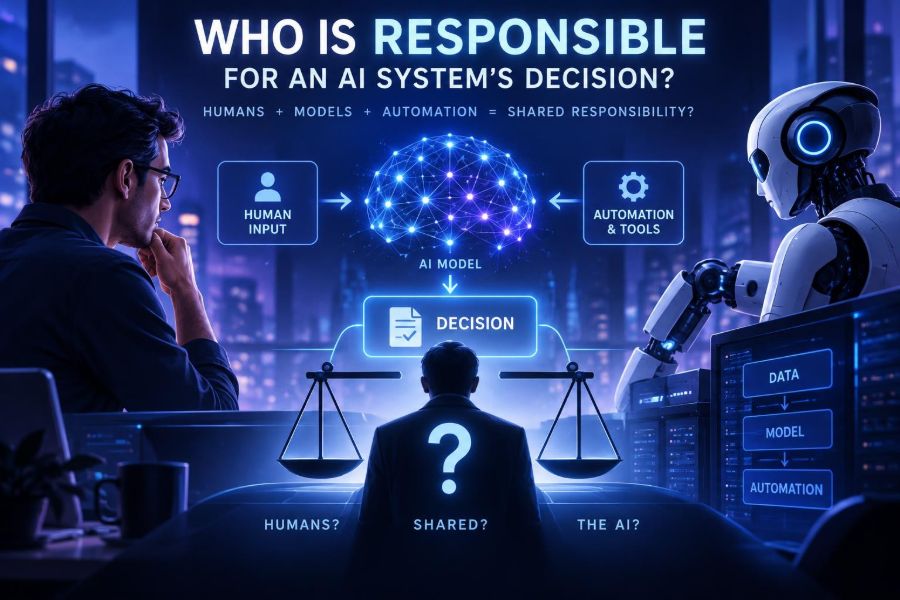

When an AI-assisted system denies a loan, routes a patient for urgent review, blocks a seller, or publishes a marketing message, it is tempting to ask one simple question: who made that decision?
In practice, the answer is rarely “the model.” A modern AI decision is usually a chain of choices made by product teams, data owners, model builders, operators, managers, users, and automated workflows. The model produces an output, but people and systems decide what data reaches it, what it is allowed to do, and whether its output becomes action.
This matters now because AI is moving from chat windows into business processes. Agentic workflows can retrieve records, call tools, trigger tickets, approve routine requests, and escalate exceptions at machine speed. Responsibility must be just as deliberate as automation.
After reading, you will be able to map responsibility across an AI workflow, assign decision rights, design meaningful human oversight, document incidents, and build technical controls that make accountability practical rather than ceremonial.
🧭 1. Start with the real meaning of responsibility
Responsibility is not one thing. Teams often collapse several distinct duties into the vague phrase “the AI team owns it,” which makes failures difficult to investigate and fix.
Separate at least four concepts. They can belong to different people or teams, and that is normal.
- Decision authority: who is permitted to make or approve the final decision.
- Operational accountability: who must ensure the process runs safely and correctly day to day.
- Technical responsibility: who builds, tests, deploys, monitors, and repairs the system.
- Business and legal accountability: who owns the outcome, customer impact, policy compliance, and remedy.
An AI model does not hold moral, contractual, or legal responsibility. It is a component. But calling it “just a tool” should not become an excuse to ignore its distinctive risks: probabilistic outputs, hidden failure modes, data dependence, and rapid scaling.
🔗 2. Treat every AI outcome as a decision chain
A useful mental model is a decision chain. An outcome happens only after a sequence of inputs, rules, model inferences, human actions, and downstream automations.
- A team defines an objective, such as detecting suspicious claims.
- Someone selects data sources and eligibility rules.
- A model or rules engine produces a score, classification, or recommendation.
- A workflow applies thresholds, policies, and permissions.
- A person, service, or agent takes an action.
- The organization observes the result, handles appeals, and updates the system.
If a legitimate customer is incorrectly blocked, the fault might be poor source data, an unsuitable threshold, a flawed integration, an operator override, or a policy that chose unacceptable trade-offs. “The model was wrong” is only the first clue.
🗺️ 3. Map the system before assigning blame
Do not begin with names in a spreadsheet. First map how a decision actually travels through the system. The architecture diagram should include people and manual handoffs, not only APIs.
Run a short mapping workshop with the product owner, domain expert, data owner, engineering lead, security or privacy representative, and frontline operators. Ask: what enters, what is transformed, who can change it, and what action can leave the system?
Decision: Flag a transaction for review

Inputs: transaction data, account history, risk rules
Model: risk score and reason codes
Policy: auto-hold above threshold; otherwise queue for analyst
Human: analyst confirms, releases, or escalates
Automation: sends notice and creates case record
Outcome: hold, release, or investigation
Feedback: appeal result and confirmed fraud label
Include vendor models, retrieval systems, prompt templates, feature stores, external tools, and fallback paths. An undocumented “temporary” spreadsheet or automation is often where accountability disappears.
👥 4. Identify the actors behind an AI decision
Most important AI systems have more actors than teams expect. Name roles rather than assuming “engineering” or “the business” is a sufficient owner.
| Actor | Typical responsibility | Question to ask |
|---|---|---|
| Business owner | Defines acceptable outcomes and risk appetite | What harms are unacceptable? |
| Domain expert | Validates policy and edge cases | Does this match real-world practice? |
| Data owner | Controls data quality, access, and meaning | Can this data be used for this purpose? |
| ML or AI engineer | Builds evaluation, integration, monitoring, and safeguards | What does the system do under uncertainty? |
| Workflow owner | Owns thresholds, routing, and automated action | When does a recommendation become action? |
| Human reviewer | Reviews cases and records rationale | Can they meaningfully disagree? |
| Governance function | Sets controls, audits evidence, and challenges assumptions | Who can pause the system? |
| Executive sponsor | Accepts residual organizational risk | Who answers for material harm? |
For a vendor-provided model, your organization still owns decisions about use, configuration, inputs, output handling, and customer impact. Contract terms may distribute obligations, but they do not eliminate operational responsibility.
📋 5. Use a RACI matrix, but make it decision-specific
A RACI matrix clarifies who is Responsible, Accountable, Consulted, and Informed. It is useful only when rows describe concrete decisions, not vague activities such as “AI governance.”
Activity: Change the auto-approval threshold
Responsible: Workflow owner
Accountable: Business owner
Consulted: Domain expert, risk lead, ML engineer
Informed: Operations, support, compliance

Activity: Disable the system after severe incident
Responsible: On-call engineering lead
Accountable: Executive risk owner
Consulted: Security, legal, product owner
Informed: Operations and affected stakeholders
Assign exactly one Accountable role for each material decision. Multiple accountable owners commonly means no one has authority when urgency and disagreement arrive together.
Review the matrix whenever a new tool, model, automation, geography, data source, or decision consequence is introduced. A workflow may begin as a drafting assistant and become a decision system after one small integration.
⚖️ 6. Match oversight to the consequence, not the novelty
Not every AI output needs the same level of review. A spelling suggestion and a recommendation that affects housing, employment, healthcare, finance, safety, or access to essential services are fundamentally different.
Classify the use case by the harm a wrong outcome could cause, how reversible it is, how often it acts, and whether people can challenge it.
| Use case level | Example | Appropriate control |
|---|---|---|
| Low consequence | Internal meeting summary | User review, disclosure, basic quality checks |
| Moderate consequence | Support-ticket routing | Confidence routing, sampled review, monitoring |
| High consequence | Eligibility recommendation | Qualified reviewer, evidence record, appeal path, strict change control |
| Critical consequence | Safety-sensitive automated action | Strong safeguards, independent validation, limited autonomy, tested shutdown process |
The label “human in the loop” is not enough. A reviewer who has 10 seconds, no context, and no ability to override is performing rubber-stamp oversight, not meaningful control.
🧑⚖️ 7. Design humans to make real decisions
Effective human oversight means a person has authority, information, time, competence, and a safe way to disagree. Give reviewers the inputs relevant to the decision, the system’s rationale or evidence where available, and a clear escalation route.
Use these design rules:
- Show uncertainty, conflicts, missing data, and tool failures.
- Require a reason when a reviewer accepts or overrides high-impact recommendations.
- Randomize or blind some reviews to detect automation bias.
- Measure reviewer agreement and outcomes, not just review speed.
- Protect staff from punitive metrics that pressure them to accept AI outputs.
Consider human-on-the-loop for bounded, reversible actions: automation acts within limits while humans monitor and can intervene. Reserve human-in-the-loop for cases where review must occur before action.
🎚️ 8. Make automation boundaries explicit
Automation is not binary. Write down exactly which actions the system may take without approval, which require review, and which it must never take.
IF confidence >= 0.95 AND amount <= 100
  THEN auto-route to standard queue
ELSE IF confidence >= 0.70
  THEN request human review
ELSE
  THEN ask for more information or use manual workflow

NEVER auto-close cases involving safety, protected access,
or irreversible customer penalties.
Thresholds should be based on observed performance in the actual workflow, not a vendor demo or an intuition that a score “looks high.” Test the cost of false positives and false negatives separately. In many settings, one is much more harmful than the other.
Also define rate limits, permission scopes, monetary caps, geographic restrictions, and a kill switch. These are responsibility controls because they limit what an error can become.
🧪 9. Test the whole sociotechnical system
Model quality testing alone does not tell you whether the deployed decision process is safe. Evaluate the full system: prompts, retrieval, tools, policies, user interface, reviewer behavior, integrations, and fallbacks.
Create a test set that includes normal cases, rare but serious cases, missing data, conflicting records, adversarial inputs, and cases affecting different populations or contexts. For generative systems, test factual grounding, instruction conflicts, unsafe tool use, and unsupported certainty.
Test case: Customer record contains two conflicting addresses
Expected behavior:
- Do not infer which address is correct
- Flag the conflict for review
- Do not trigger an irreversible action
Evidence to retain:
- Input version, model output, policy path, reviewer decision
Red-team the system with people who understand both the domain and abuse patterns. Ask them to find ways to manipulate the model, bypass a threshold, or make an operator trust a confident but wrong recommendation.
🧾 10. Build an evidence trail that answers “why?”
When an incident happens, you need more than a final answer. You need a reconstructable record of what the system saw, did, and was permitted to do at that moment.
Log enough information to support investigation without collecting unnecessary sensitive data. The exact retention period and disclosure obligations depend on your sector and jurisdiction, so confirm requirements with appropriate privacy, security, and legal experts.
- Decision ID, time, workflow and policy version
- Input provenance and relevant data-quality flags
- Model or service identifier, prompt or configuration version
- Retrieved sources, tool calls, and permission decisions
- Output, confidence or uncertainty signals where meaningful
- Human reviewer, override, rationale, and escalation
- Final action, notification, correction, and appeal outcome
Do not log secrets, full payment details, or more personal data than necessary. Use access controls and tamper-evident logging practices appropriate to the system’s risk.
🔍 11. Explain decisions at the right level
An explanation is useful when it helps someone act: a customer can understand what to challenge, an operator can correct a case, and an auditor can assess whether policy was followed.
Do not confuse a model-generated explanation with proof of the model’s internal reasoning. A fluent narrative can be incomplete or false. Prefer explanations grounded in recorded inputs, policy rules, evidence sources, and observed workflow steps.
Customer-facing explanation:
“Your request was sent for manual review because the submitted
identity information did not match the record available to us.
You can provide corrected information or request a review.”

Internal explanation:
“Policy ID-17 routed this case after a data mismatch flag.
No automatic denial occurred. Analyst review is pending.”
Use plain language externally and detailed evidence internally. Avoid exposing security-sensitive detection rules that would make fraud or abuse easier.
🚨 12. Plan for incidents before the first incident
Responsibility is tested under pressure. Predefine what counts as an incident, who has authority to stop automation, how affected people are protected, and when leaders must be notified.
- Detect unusual outcomes through alerts, complaints, sampling, or monitoring.
- Contain harm by pausing a model, disabling a tool, lowering autonomy, or reverting to manual work.
- Preserve evidence and identify affected decisions.
- Correct outcomes where possible and communicate through approved channels.
- Find contributing causes across data, model, workflow, people, and policy.
- Change controls, test the fix, and document the learning.
A common mistake is treating the incident as an individual reviewer’s error because that is easiest to see. Investigate system pressures too: unclear guidance, poor interface design, impossible workloads, stale data, or incentives that rewarded speed over care.
📈 13. Monitor outcomes, not only model metrics
A model can appear stable while the overall decision process degrades. Data distributions change, policies shift, user behavior adapts, retrieval sources become stale, and operators learn to work around a frustrating interface.
Monitor technical signals alongside real-world outcomes.
- Technical: error rates, latency, tool failures, missing fields, drift, and fallback usage.
- Decision: approval rates, override rates, escalation rates, repeat decisions, and time to resolution.
- Harm: complaints, appeals, correction rates, disparate outcomes, and severity of errors.
- Human factors: reviewer workload, agreement, calibration, and evidence of automation bias.
Set alert thresholds and assign an owner for each dashboard. A metric without an owner, response playbook, and review cadence is reporting, not governance.
🔄 14. Control changes to prompts, models, and workflows
AI systems change in many places. A new prompt, different retrieval source, revised tool permission, altered threshold, updated vendor service, or changed user interface can materially alter behavior.
Treat high-impact changes as releases. Record the hypothesis, expected benefit, risks, approver, evaluation results, rollout scope, and rollback plan. Use staged deployment when possible, beginning with internal users or a limited traffic slice.
Change record
Change: Add account-history retrieval to review assistant
Risk: Older records may be inaccurate or reveal irrelevant data
Controls: Source freshness check, access filtering, sampled review
Approval: Business owner and privacy reviewer
Rollback: Disable retrieval feature flag; use prior workflow
Do not let prompt edits bypass ordinary engineering discipline because they appear small. In a generative workflow, a few words can change tool use, tone, data exposure, and the decisions a reviewer sees.
🔒 15. Protect privacy, security, and human dignity
Responsible accountability includes deciding what the system must not know, infer, retain, or do. Minimize data, define purpose boundaries, and restrict access based on real job needs.
Before sending information to an external AI service or connecting an agent to internal tools, verify approved data handling, retention, access controls, contractual terms, and security review according to your organization’s policies. Details change, so use the provider’s official documentation and your internal security guidance rather than assumptions.
- Remove or mask sensitive fields where they are not necessary.
- Use least-privilege credentials for every tool an agent can call.
- Defend against prompt injection in retrieved content and external messages.
- Validate tool parameters server-side; never trust model output as authorization.
- Provide a route for people to question, correct, or appeal consequential outcomes.
A technically accurate system can still be irresponsible if it surveils excessively, humiliates users, or makes it impractical to obtain a correction.
🧰 16. Add technical guardrails around model outputs
Developers should design as if model output is untrusted input. Parse it, validate it, constrain it, and authorize actions independently. This is especially important for agents that can call APIs or modify records.
allowed_actions = {"create_draft", "route_case"}

if response.action not in allowed_actions:
    raise ValueError("Action is not permitted")

if response.action == "route_case":
    if response.confidence < 0.80:
        route_to_human_reviewer(case_id)
    else:
        create_review_task(case_id, response.reason)

# The model never directly approves, pays, deletes, or changes access.
Keep policy enforcement outside the prompt. Prompts can tell a model what you want; deterministic code, permissions, schemas, and workflow engines should enforce what it is actually allowed to do.
For high-impact actions, require structured outputs, validate fields against schemas, bind tool calls to an authenticated user or service identity, and record the policy decision that permitted the call.
🧩 17. Avoid the most common accountability failures
Many failures are organizational design problems, not exotic AI failures. Recognizing them early is one of the fastest ways to improve a system.
- “The vendor owns the model.” The deployer still owns the use case and its effects.
- “A human reviews everything.” Review that lacks time, context, or authority is not a safeguard.
- “The score is objective.” Scores encode choices about labels, data, objectives, and thresholds.
- “We can fix it after launch.” Without logs and baselines, you may not know whom to remediate.
- “The model is only advisory.” Recommendations can strongly shape human decisions through automation bias.
- “Compliance approved it once.” Ongoing changes and drift require continuing oversight.
Another mistake is assigning responsibility too low in the organization. Frontline staff can be responsible for following procedures, but leaders must remain accountable for the resources, incentives, policy, and system design those staff inherit.
✅ 18. Use this quick-start accountability checklist
Pick one AI workflow this week and complete this checklist before expanding its scope.
- Write the specific decision, affected people, and potential harms.
- Map the complete decision chain, including vendors and fallback paths.
- Name one accountable business owner and one operational owner.
- Create a decision-specific RACI for thresholds, overrides, changes, incidents, and appeals.
- Define actions that are automated, reviewed, prohibited, and reversible.
- Give reviewers authority, context, time, and an escalation path.
- Test realistic edge cases and the full workflow, not just the model.
- Log evidence needed to reconstruct outcomes while minimizing sensitive data.
- Set outcome, harm, and human-oversight metrics with owners and response plans.
- Test a pause or rollback procedure and document how people receive correction.
When humans, models, and automation work together, responsibility belongs to the people and organizations that design, authorize, operate, and benefit from the system—not to the model alone. Make that ownership visible before an automated decision makes it urgent. 🤖⚖️🛡️