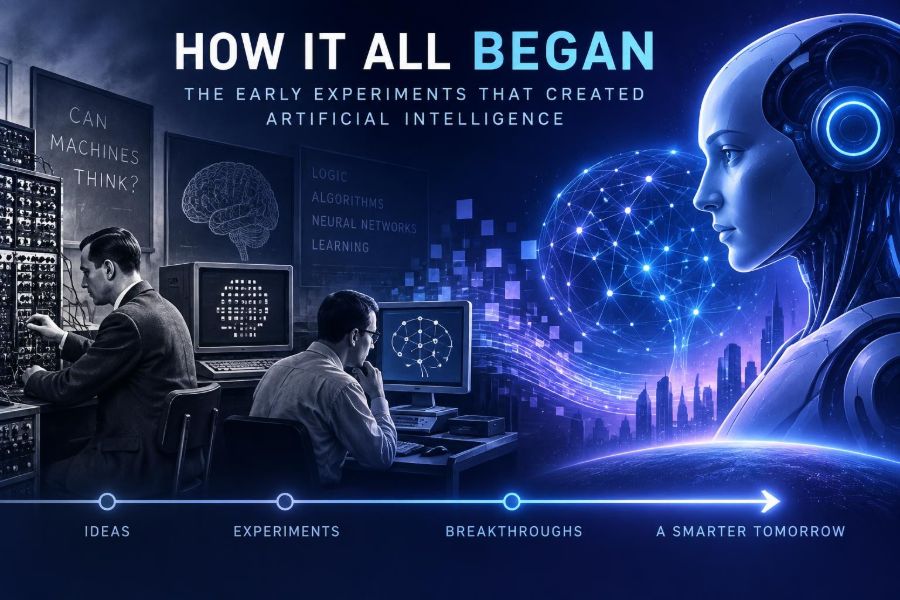

Today’s AI can draft code, recognize speech, generate images, and help scientists search enormous spaces of possibilities. Those systems can feel unprecedented, but their central questions are remarkably old: Can reasoning be represented as rules? Can a machine learn from examples? What does it mean to solve a problem?
The early experiments that shaped artificial intelligence were not simply a march toward modern chatbots. They were a collection of bold, sometimes flawed attempts to turn ideas from logic, psychology, neuroscience, mathematics, and engineering into working machines. Their successes established enduring methods; their failures explain many current limitations.
Understanding this origin story makes you a better AI user and builder. You will be able to recognize whether a system is using symbolic search, learned patterns, feedback, or a hybrid; choose an appropriate approach for a small project; and avoid treating a convincing output as proof of genuine understanding.
You do not need advanced mathematics to follow along. Where the history becomes technical, this article includes small experiments and code sketches that let you recreate the essential idea with modern tools.
🧭 1. Start with the question, not the machine
Artificial intelligence is the effort to make machines perform tasks associated with perception, learning, reasoning, planning, communication, or action. It is a moving target: when a capability becomes common, people often stop calling it AI.
Early researchers did not begin with a single definition. They began with testable questions: can a program prove a theorem, play a game, navigate a route, or improve after receiving feedback?
- Symbolic AI represents facts and rules explicitly.
- Machine learning adjusts a model using data or experience.
- Search and planning explore possible action sequences.
- Neural networks use interconnected numeric units to map inputs to outputs.
Modern AI products often combine these ideas. A language model is learned from data, while an agent around it may use explicit tools, search, rules, and memory.
🔢 2. Logic supplied the first practical language of thought
Long before electronic computers, formal logic showed that some reasoning can be written as transformations of symbols. If “all humans are mortal” and “Ada is human,” then “Ada is mortal” follows through a repeatable rule.
This mattered because it separated a reasoning procedure from the person performing it. A machine does not need intuition to apply a valid inference rule; it needs a representation and a procedure.
Try stating a tiny domain as facts and rules before asking an AI system about it:
Facts:
- robin is a bird
- birds have wings

Rule:
- if X is a bird, then X has wings

Question:
- does robin have wings?
The important design lesson is still useful: define terms, inputs, and permitted inferences. Ambiguous labels make both rule engines and learned models less reliable.
⚙️ 3. The stored-program computer made experiments possible
Early computing pioneers demonstrated that a general-purpose machine could follow a sequence of stored instructions rather than being physically rewired for every new task. That capability made “thinking machinery” an engineering proposition rather than only a philosophical one.
A program could now manipulate numbers, letters, and logical symbols. This was a crucial shift: if symbols could stand for objects and relations, a computer could potentially operate on descriptions of a world.
For developers, the historical takeaway is simple: representation determines what can be computed easily. A grid makes route finding natural; a graph makes relationships natural; a vector embedding makes similarity search natural.
🧪 4. The imitation game reframed intelligence as behavior
One influential proposal avoided trying to settle whether a machine has an inner mind. Instead, it asked whether a conversational evaluator could reliably distinguish a machine from a person under controlled conditions.
This reframing was valuable because it turned a vague debate into an observable experiment. It also created a misunderstanding that persists today: humanlike conversation is not the same as dependable reasoning, knowledge, consciousness, or agency.
When evaluating a conversational AI, test behavior beyond fluent prose:
- Give it a constrained task with a verifiable answer.
- Ask it to cite the assumptions it used.
- Change one important fact and see whether its conclusion changes correctly.
- Request uncertainty rather than a forced answer.
A polished explanation can conceal a wrong result. Treat dialogue as an interface, not as proof of competence.
🧠 5. Artificial neurons connected brains to computation
Early mathematical neuron models proposed a simple unit: receive several binary inputs, combine them, and activate when a threshold is reached. Individually these units were simple; connected together, they suggested that computation could emerge from networks.
A threshold unit can express basic logic. Here is a compact illustration of an AND gate:
def threshold(inputs, weights, bias):
    total = sum(x * w for x, w in zip(inputs, weights)) + bias
    return 1 if total >= 0 else 0

# Returns 1 only when both inputs are 1
print(threshold([1, 1], [1, 1], -1.5))
This is not a modern deep-learning system, but it reveals a foundational idea: behavior can be produced by numeric parameters. Learning then becomes the problem of finding good parameters.
🎛️ 6. Feedback made learning an engineering problem
Another influential early idea was that a connection should strengthen when activity on one unit consistently helps predict activity on another. More broadly, it framed learning as changing a system based on experience.
Modern training differs greatly in scale and technique, but the feedback loop remains central:
- Make a prediction or take an action.
- Measure an error, reward, or other signal.
- Adjust internal parameters.
- Repeat across many examples.
Do not confuse repetition with learning. The quality of the feedback signal matters more than raw volume. If labels are inconsistent or success is measured poorly, optimization can amplify the wrong behavior.
🏛️ 7. A summer workshop gave the field its name
In the middle of the twentieth century, a small group of researchers proposed a focused research program around the idea that aspects of intelligence could be described precisely enough for machines to simulate. The term artificial intelligence became a durable umbrella for that ambition.
The proposal was optimistic, and the optimism was productive: it encouraged researchers from different disciplines to share methods. Yet the hardest problems turned out to require more data, computation, knowledge, and robustness than many expected.
The lesson for teams today is to write a narrow research claim. Replace “build an intelligent assistant” with “reduce support-ticket routing errors on these categories, with human review for uncertain cases.”
🧩 8. Symbolic programs proved that machines could reason
Some of the first celebrated AI programs manipulated symbols to derive results in logic and mathematics. Their importance was not that they solved every hard problem. It was that they demonstrated a program could produce a chain of intermediate reasoning steps rather than merely calculate a fixed formula.
Symbolic systems typically contain a knowledge base, an inference mechanism, and a goal. A simplified rule engine might look like this:
facts = {"bird(robin)"}
rules = [("bird(X)", "has_wings(X)")]

# Conceptually: match X=robin, then add has_wings(robin)
# Real rule engines need parsing, variable binding, and repeated inference.
These systems are attractive when explanations, policies, and constraints matter. They struggle when rules are incomplete or when inputs arrive as messy images, language, audio, or sensor readings.
🔎 9. Search turned problem solving into exploration
Many early AI projects treated intelligence as search through a space of possible states. In chess, states are board positions. In route planning, they are locations. In scheduling, they are partial calendars.
A search method needs four ingredients:
- An initial state.
- Available actions that create next states.
- A goal test.
- A cost or priority rule.
For a small puzzle, start by writing these four pieces before choosing an algorithm. Breadth-first search is useful when every action has equal cost. Heuristic search is useful when you can estimate how far a state is from the goal.
frontier = [start]
visited = {start}
while frontier:
    state = frontier.pop(0)
    if is_goal(state):
        break
    for next_state in neighbors(state):
        if next_state not in visited:
            visited.add(next_state)
            frontier.append(next_state)
A common mistake is assuming search means trying everything. Good representations and heuristics are what make meaningful problems tractable.
♟️ 10. Games became laboratories for intelligence
Games offered clearly defined rules, measurable outcomes, and repeatable experiments. Early programs for games such as checkers and chess were ideal test beds for search, evaluation functions, and learning from outcomes.
Game competence does not automatically transfer to the open world. Still, game experiments taught researchers how to balance immediate gains against future consequences.
| Approach | Core idea | Useful today for | Main weakness |
|---|---|---|---|
| Rules | Apply explicit knowledge | Policies, validations, workflows | Brittle outside encoded cases |
| Search | Explore alternatives | Routing, planning, games | Can grow exponentially |
| Learning | Fit patterns from examples | Vision, language, forecasting | Needs representative data |
| Feedback learning | Improve from outcomes | Control and sequential choices | Reward design is difficult |
Use games in your own learning projects because you can build a reliable evaluator. A system that wins according to unambiguous rules is easier to assess than one judged only by a vague impression.
🧱 11. The perceptron made pattern learning tangible
The perceptron was an early trainable classifier inspired by neuron-like units. It adjusted weights so that inputs could be separated into categories, such as simple visual patterns.
Its core update rule is easy to reproduce. For each labeled example, compare prediction and target, then move weights slightly in a direction that reduces the error:
for features, target in training_data:
    prediction = 1 if sum(w*x for w, x in zip(weights, features)) + bias >= 0 else 0
    error = target - prediction
    weights = [w + learning_rate * error * x for w, x in zip(weights, features)]
    bias += learning_rate * error
Try it first on two numeric features and two categories. Plotting the points will show when one straight decision boundary can separate them.
Common mistake: expecting a single linear classifier to solve patterns that are not linearly separable. This limitation helped motivate networks with additional layers and nonlinear transformations.
🗺️ 12. World knowledge was harder than anyone expected
Researchers soon found that solving a seemingly ordinary task requires a vast amount of background knowledge. “Put the cup on the table” involves objects, locations, physical constraints, goals, language ambiguity, and social expectations.
This challenge is often called common-sense reasoning. It explains why impressive performance in a narrow task can coexist with surprising failures in everyday situations.
For practical AI work, specify what the system may assume. In a prompt or product requirement, include the audience, environment, source of truth, exceptions, and action boundaries.
Role: classify incoming maintenance requests.
Use only the categories below.
If a request lacks a location or safety detail, return NEEDS_REVIEW.
Do not invent equipment names or urgency levels.
Constraints do not create common sense, but they reduce avoidable ambiguity.
🗣️ 13. Language revealed the gap between words and meaning
Early language programs could create striking conversational effects by matching patterns in a user’s text and responding with templates. They showed that people readily attribute understanding to fluent language.
Pattern matching remains useful for controlled interfaces, but it does not guarantee grounding in facts or the physical world. Today’s generative models are far more flexible, yet they can still produce plausible statements that are unsupported or false.
Use this review pattern for consequential text:
- Extract every factual claim.
- Check each claim against primary or trusted sources.
- Separate sourced facts from generated suggestions.
- Have a domain expert approve high-impact outputs.
Never use a model’s confident tone as your verification method.
🌦️ 14. Early success created unrealistic expectations
When programs solved demonstrations in logic, games, or constrained language, it was tempting to predict rapid progress toward general intelligence. But laboratory tasks often hid the complexity of real environments.
When promises outpaced practical results, funding and public attention periodically cooled. These periods are commonly described as AI winters. They were not empty time; researchers continued developing algorithms, hardware, statistics, and specialized applications.
The modern product lesson is to distinguish a demo from deployment. Test with varied real inputs, operational constraints, adversarial cases, monitoring, and fallback procedures before claiming a capability is reliable.
📊 15. Data shifted the center of gravity
Over time, many AI successes came less from hand-writing every rule and more from combining statistical methods with larger datasets and stronger computation. Instead of encoding every visual feature of a cat, for example, a model can learn useful features from labeled examples.
This did not eliminate the earlier traditions. Training data is a representation choice; optimization is a form of search; tool use and guardrails often reintroduce symbolic structure.
Before collecting data, make a simple dataset card:
- What decision will this data support?
- Who and what does it represent?
- Which groups or conditions are missing?
- Who created labels, and what do labels mean?
- What harmful use is out of scope?
Good data work is not administrative overhead. It is core model design.
🔗 16. Modern systems are usually hybrids
The most useful question is rarely “rules or learning?” A practical system may use a learned model to extract information, deterministic code to validate it, retrieval to supply current documents, and a human to approve risky actions.
Build a small hybrid workflow step by step:
- Define one narrow input and output.
- Use a model or classifier to propose a result.
- Validate required fields and allowed values in code.
- Route low-confidence or high-impact cases to a person.
- Log outcomes and use mistakes to improve prompts, data, or rules.
result = model_extract(ticket_text)
if result.category not in ALLOWED_CATEGORIES:
    return "REVIEW"
if result.confidence < 0.8 or result.safety_related:
    return "REVIEW"
return result.category
The numeric threshold is only illustrative. Choose thresholds from your own error tolerance and evaluate them on representative cases.
🛡️ 17. Responsible use begins with the earliest lesson
Early AI history teaches humility: a system can be impressive within a test and unreliable beyond it. That principle should shape privacy, safety, and fairness decisions.
- Do not paste confidential customer, health, legal, security, or source-code data into a service unless your organization has approved the handling terms.
- Minimize collected data and remove identifiers where feasible.
- Test performance across relevant populations, languages, and edge cases.
- Keep a human decision-maker for hiring, healthcare, finance, safety, and other high-impact uses.
- Document what the system can do, cannot do, and who owns escalation.
Check the official documentation and contractual terms for any AI tool you use, because data retention, controls, and capabilities can change.
🚀 18. Quick-start checklist: recreate the history in a weekend
- Pick one toy problem: a grid route, a two-class dataset, or a rule-based diagnosis game.
- Write the representation: states and moves, features and labels, or facts and rules.
- Build a baseline: a manual rule or simple search before using a large model.
- Define evaluation: accuracy, path cost, task completion, or human-reviewed correctness.
- Make a failure set: ambiguous, missing, unusual, and adversarial inputs.
- Add one safeguard: validation, refusal, human review, or a data-minimization rule.
- Record what happened: inputs, outputs, assumptions, and failure causes.
The early experiments that created AI still provide the best builder’s mindset: represent the problem clearly, test a concrete behavior, measure failure honestly, and improve the system through evidence. 🤖🔬✨