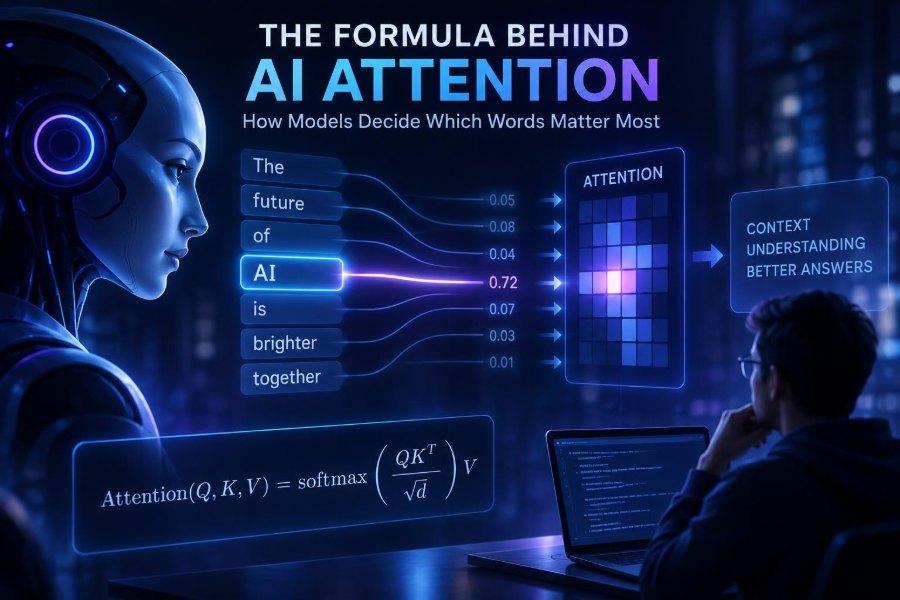

When an AI model writes an answer, translates a sentence, summarizes a report, or generates code, it does not simply read every earlier word with equal importance. It continually decides what deserves focus at that exact moment. That mechanism is called attention, and it is one of the central ideas behind modern transformer-based AI.
Attention matters now because it shapes the behavior of the tools people use every day: chat assistants, coding copilots, image systems conditioned on text, speech models, and document-analysis workflows. Understanding it makes model outputs less mysterious and helps you design better prompts, cleaner retrieval systems, and more reliable AI features.
You do not need advanced calculus to grasp the core formula. By the end of this article, you will be able to explain queries, keys, and values; calculate a small attention example; recognize why long context can fail; and apply attention-aware tactics in both prompting and software.
For developers, we will also connect the math to practical tensor operations, masking, multi-head attention, and the performance costs of long inputs. The goal is not to memorize jargon. It is to gain a usable mental model.
🧭 1. Attention Is Selective Context, Not Human Thought
In everyday language, attention means concentrating on what matters. In a transformer, attention is a numerical operation that lets each token build a context-aware representation by mixing information from other tokens.
A token is a unit a model processes. A token may be a word, part of a word, punctuation, whitespace, or code fragment; the exact split depends on the model’s tokenizer.
Consider the sentence: “The animal did not cross the road because it was tired.” To interpret “it,” the model should give substantial weight to “animal,” not “road.” Attention supplies a learned way to make that connection.
- Each token asks: what information do I need?
- Other tokens advertise: what kind of information do I contain?
- The model assigns weights, then combines the most relevant available content.
This is not a hard-coded grammar rule. The model learns useful patterns from training data, then uses those learned patterns during inference.
🧩 2. Start With Token Vectors, Not Raw Words
Models cannot multiply plain text. First, token IDs are converted into lists of numbers called embeddings. A vector might represent many learned features at once: spelling patterns, semantic associations, position, syntax, domain clues, and more.
Position also matters. Without positional information, “dog bites man” and “man bites dog” would look like the same unordered collection. Transformer architectures add or inject positional signals so sequence order can influence attention.
At an early layer, a token vector is a broad starting representation. As it moves through layers, attention and other neural operations refine it according to the surrounding context.
Text:        “A robot fixes code”
Tokens:      [A] [robot] [fixes] [code]
Embeddings:  x1  x2      x3      x4

Each x is a vector, not a single number.
A useful caution: vectors do not contain a tidy, human-readable dictionary entry. Individual dimensions usually work together, so it is rarely meaningful to label one dimension “the sarcasm number” or “the Python number.”
🔑 3. The Three Roles: Query, Key, and Value
Every token representation is transformed into three new vectors: a query, a key, and a value. These roles are the heart of attention.
- Query (Q): what this current token is looking for.
- Key (K): what a candidate token can be matched on.
- Value (V): the information that candidate token contributes if selected.
For a token vector x, learned matrices create the three roles:
q = xWQ
k = xWK
v = xWV
The matrices WQ, WK, and WV are learned during training. They let the network use different projections of the same token for searching, matching, and carrying content.
Think of a library search. Your query describes the book you need. A catalog entry is a key that helps determine relevance. The book’s contents are the value you take away. The analogy is imperfect, but it captures the separate jobs.
🧮 4. The Formula: Scaled Dot-Product Attention
Attention first measures how well each query matches each key. The standard formula is:
Attention(Q, K, V) = softmax((QKᵀ) / √dk) VRead it from left to right:
- Multiply queries by transposed keys to create a table of match scores.
- Divide by
√dk, wheredkis the key-vector width. - Apply softmax to turn scores into non-negative weights that sum to 1.
- Use those weights to take a weighted combination of the value vectors.
The output is a new vector for each token. It contains selected information from the sequence, tailored to that token’s current needs.
The word “attention” can make the operation sound magical. At its core, it is a learned similarity calculation followed by a weighted average.
📏 5. Why Divide by the Square Root of the Key Size?
The scaling term √dk prevents dot products from becoming too large as vector dimensions grow. Large raw scores can make softmax extremely peaked: one item gets nearly all the weight while the rest get almost none.
That can produce weak learning signals during training because tiny probability changes may have little effect. Scaling keeps scores in a more workable numerical range.
You can remember the division as a stabilizer, not as an arbitrary decoration. The exact behavior depends on training and implementation details, but its purpose is to make optimization more reliable.
🌡️ 6. Softmax Turns Scores Into a Decision Distribution
Dot products are unbounded scores. Softmax converts a list of scores into weights between 0 and 1 whose total is 1.
scores:  [2.0, 1.0, 0.0]
softmax: [0.67, 0.24, 0.09]
The highest score becomes the largest weight, but lower-scoring tokens can still contribute. This is important: attention is usually soft selection, not a single winner-take-all lookup.
Softmax is sensitive to differences. If one score rises relative to another, its weight can increase quickly. This is one reason wording, placement, and formatting can change a model’s response even when the overall meaning seems similar.
🧪 7. Calculate a Tiny Attention Example by Hand
Suppose a current token has one query and there are three candidate tokens. For simplicity, assume the dot-product scores are already scaled.
| Candidate token | Match score | Softmax weight | Simple value |
|---|---|---|---|
| animal | 2.0 | 0.67 | 10 |
| road | 1.0 | 0.24 | 4 |
| tired | 0.0 | 0.09 | 2 |
The output is the weighted sum:
output = (0.67 × 10) + (0.24 × 4) + (0.09 × 2)
output = 7.84
Real value vectors contain many dimensions, so the model performs this weighted sum for every dimension at once. The principle remains identical: stronger matches contribute more to the updated representation.
Do not overinterpret an attention weight as a complete explanation of a model’s reasoning. It is one routing signal inside a much larger computation.
👀 8. Self-Attention Lets Tokens Consult Their Neighbors
When queries, keys, and values all come from the same input sequence, the operation is called self-attention. Each token can use information from other tokens in that sequence.
In “The server crashed after the update,” the representation of “crashed” can attend to “server” and “update.” In code, a function call can attend to its definition, parameters, imported names, and related comments if they are included in context.
Self-attention gives transformers a direct path between distant positions. Older sequence architectures often had to carry information step by step through a chain, which could make long-range relationships harder to preserve.
🚧 9. Causal Masks Stop a Text Generator From Seeing the Future
A next-token generator must not inspect words that have not been generated yet. During training, a causal mask blocks attention from a position to later positions.
Tokens:      [The] [model] [writes]
“The” may attend to:       [The]
“model” may attend to:     [The] [model]
“writes” may attend to:    [The] [model] [writes]
Implementation-wise, forbidden score positions are assigned a very negative value before softmax. Their resulting weights become effectively zero.
masked_scores = scores + mask
weights = softmax(masked_scores)
This is why a language model can be trained on full text efficiently while still learning the valid next-token prediction task. It calculates many positions in parallel, but the mask enforces the appropriate information boundary.
🔄 10. Cross-Attention Connects One Source to Another
Cross-attention uses queries from one sequence and keys and values from another. This is useful whenever one data source needs to consult another.
- A translation decoder can query representations of the source-language sentence.
- A text-conditioned image model can let image features consult text features.
- A question-answering system can let a question query an encoded document.
- An AI agent can query retrieved passages, tool results, or structured records.
Self-attention answers, “What in my own sequence matters?” Cross-attention answers, “What in this other source matters to my current task?” Both rely on the same matching-and-weighting idea.
🎛️ 11. Multi-Head Attention Looks Through Several Lenses
A single attention calculation may capture one useful relationship, but language and code contain many relationships at once. Multi-head attention runs several attention heads with separate learned projections, then combines their outputs.
One head may become sensitive to nearby syntax, another to subject-verb relationships, another to repeated entities, and another to formatting patterns. These are tendencies learned from data, not roles assigned by an engineer.
for each head:
    head_output = Attention(Qh, Kh, Vh)

combined = Concat(head_outputs) WO
“Many heads” does not mean each head is a clean, interpretable expert. Heads can overlap, and useful behavior may emerge only across layers and components. Still, multiple heads give the model more representational flexibility.
🏗️ 12. Attention Is One Block in a Larger Transformer
Attention is essential, but it is not the entire model. A typical transformer layer also includes residual connections, normalization, and a position-wise feed-forward network. The details vary by architecture.
The feed-forward part transforms each token representation independently after attention has mixed context. Residual paths help preserve and refine information across many layers.
context = Attention(normalize(x))
x = x + context
features = FeedForward(normalize(x))
x = x + features
Stacking layers matters. Early layers may encode local patterns, while later layers can assemble richer context-dependent features. Avoid the simplistic picture that a model “reads once” and produces an answer from a single attention map.
🧠 13. What Attention Weights Can and Cannot Explain
Attention visualizations can be useful diagnostics. They may reveal whether a token connects strongly to a name, a prior instruction, a delimiter, or a relevant section of source text.
But an attention map is not a full explanation of why the final model output occurred. Information also flows through values, feed-forward layers, residual streams, later attention layers, output projections, and token sampling.
- Useful claim: a head assigned high weight to these positions at this layer.
- Unsafe claim: those positions alone caused the model’s final answer.
- Better practice: pair visual inspection with controlled input changes and output evaluation.
For production systems, test behavior rather than relying on attractive heat maps. Remove a source passage, alter a term, rerun the task, and measure whether the expected behavior changes.
📝 14. Prompting With Attention in Mind
You cannot directly set a hosted model’s attention weights with a prompt. You can, however, make important information easier to locate, distinguish, and use.
- State the task before providing large reference material.
- Separate instructions, source text, and desired output with clear labels.
- Put non-negotiable constraints near the task and repeat them briefly at the end when appropriate.
- Use explicit headings and stable field names in long inputs.
- Ask the model to cite or quote the supplied section it used when accuracy matters.
TASK
Extract the three contract renewal dates.

RULES
Use only the REFERENCE TEXT. If a date is absent, write “not stated.”
Return a three-row table.

REFERENCE TEXT
[document content]

FINAL CHECK
Do not infer dates from surrounding context.
Clear structure reduces ambiguity. It also helps human reviewers inspect what the model was told and what evidence it should have used.
📚 15. Long Context Does Not Guarantee Perfect Recall
A model may accept a long input yet still miss a critical fact. Relevance is learned and distributed, and performance can vary with document structure, repeated material, distractors, position, and the task itself.
A common failure is burying one decisive requirement inside a massive, loosely organized prompt. Another is pasting several near-duplicate documents without identifying which is authoritative.
| Situation | Better approach | Why it helps |
|---|---|---|
| One large manual | Retrieve relevant sections first | Reduces distractors |
| Many policy rules | Use numbered, labeled rules | Creates explicit anchors |
| Conflicting sources | Declare source priority | Prevents arbitrary mixing |
| Critical detail in a long file | Quote it in the task brief | Makes it salient and testable |
Do not solve every problem by adding more text. Often the better move is selection, compression, structure, and retrieval.
🔎 16. Build Retrieval Around Relevance, Not Maximum Context
Retrieval-augmented generation, often called RAG, gives a model selected external information at answer time. Attention then helps the model use what you supplied, but retrieval determines what becomes available in the first place.
A practical pipeline looks like this:
- Split source material into coherent chunks with titles and metadata.
- Search for candidate chunks using semantic, keyword, or hybrid retrieval.
- Optionally rerank candidates against the user’s exact question.
- Pass the best evidence in a labeled context block.
- Require an answer grounded in that evidence, then evaluate failure cases.
Question: “What is the retention period for audit logs?”

Context 1: Security Policy, section 4.2
Context 2: Operations Handbook, section 9.1

Instruction: Answer only from the context. Name the section
that supports your answer. If the sources disagree, report the conflict.
Keep chunks meaningful. Splitting mid-table, mid-function, or mid-sentence can separate a claim from its conditions and make attention’s job harder.
💻 17. Implement the Core Operation in Minimal Python
The following illustrative example uses plain arrays conceptually. Production frameworks add batching, efficient kernels, numerical safeguards, device placement, and automatic differentiation.
import numpy as np

def softmax(x):
    x = x - np.max(x, axis=-1, keepdims=True)
    exp_x = np.exp(x)
    return exp_x / exp_x.sum(axis=-1, keepdims=True)

def scaled_dot_product_attention(Q, K, V, mask=None):
    dk = K.shape[-1]
    scores = (Q @ K.T) / np.sqrt(dk)
    if mask is not None:
        scores = np.where(mask, scores, -1e9)
    weights = softmax(scores)
    output = weights @ V
    return output, weights
Here, rows of Q represent query vectors, rows of K represent keys, and rows of V represent values. The result includes both the context-aware outputs and the attention weights for inspection.
For a causal mask of length n, allow the diagonal and entries below it:
n = 4
causal_mask = np.tril(np.ones((n, n), dtype=bool))
Common implementation mistakes include applying softmax across the wrong axis, using an inverted mask convention, forgetting the scaling factor, or masking after softmax instead of before it.
⚙️ 18. Why Long Attention Can Be Expensive
Standard self-attention compares many token pairs. For a sequence length of n, the score matrix has roughly n × n entries. That quadratic growth can make very long contexts expensive in memory and computation.
Modern systems use a range of engineering strategies, such as optimized kernels, caching past key/value states during generation, local or sparse patterns, chunking, compression, and retrieval. The best choice depends on latency, quality, hardware, and workload.
- Short interactive chat: key/value caching can reduce repeated work during token-by-token generation.
- Large document collections: retrieval can avoid sending everything at once.
- Structured records: pre-filter by metadata before semantic search.
- Code repositories: retrieve dependency-aware files and symbols, not just nearby text.
Check your model provider’s and framework’s official documentation for current context limits, API behavior, and optimization support. These details change frequently.
🛡️ 19. Privacy, Security, and Responsible Context Use
Attention can connect sensitive details across a prompt, which is useful for analysis but risky when the input contains personal, confidential, or regulated information. Treat context sent to an AI system as data that needs governance.
- Minimize inputs: send only the fields needed for the task.
- Redact identifiers, secrets, access tokens, and unnecessary personal details.
- Use approved storage, retention, access-control, and logging practices.
- Defend retrieval systems against untrusted text that tries to override instructions.
- Require human review for high-impact decisions involving people, money, safety, or legal rights.
Also distinguish a fluent answer from a verified answer. Attention helps a model route available information; it does not guarantee that sources are true, current, complete, or correctly interpreted.
✅ 20. Quick-Start Checklist
- Describe attention as matching queries to keys and mixing values.
- Remember the core expression:
softmax(QKᵀ / √dk)V. - Use causal masking when reasoning about next-token text generation.
- Use cross-attention as the mental model for one source consulting another.
- Structure prompts with a task, rules, labeled evidence, and output format.
- Retrieve focused evidence instead of blindly maximizing context.
- Test important workflows with adversarially long, conflicting, and incomplete inputs.
- Protect sensitive data and verify consequential outputs against trustworthy sources.
Attention is the model’s learned routing system: it does not make AI infallible, but understanding it lets you supply better context, build stronger applications, and diagnose failures with far more precision. 🤖✨🧠