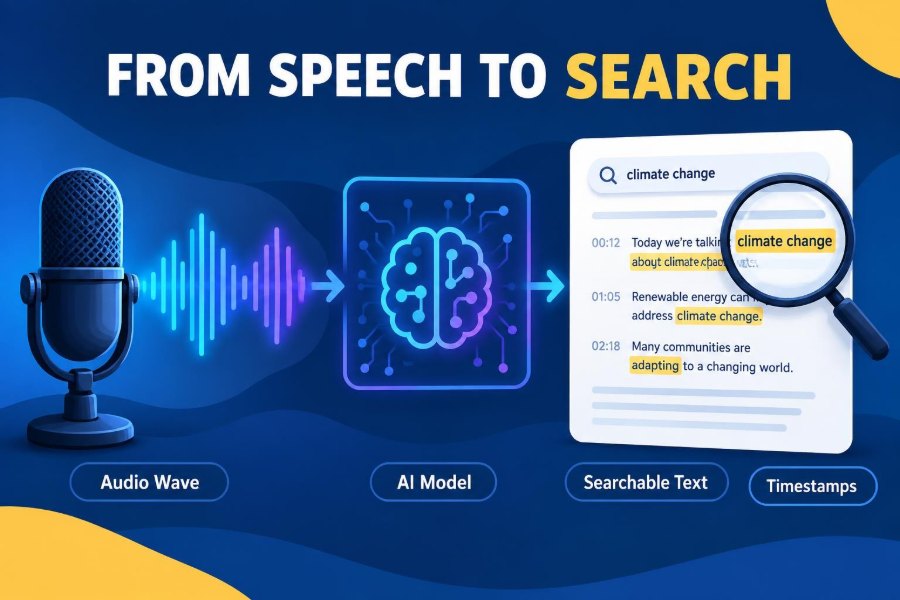

A project team finishes a long meeting, a student records a lecture, and a journalist returns with an hour of interviews. The important ideas are all present—but trapped inside audio files.
Listening from start to finish can work for one short recording. It becomes slow when people need to locate a decision, quote, name, topic, or action item across dozens of hours of speech.
Speech recognition changes that situation by converting spoken language into written text. Once speech becomes text, it can be searched, copied, summarized, translated, indexed, and analyzed with many of the same tools used for documents.
The process may look like magic: upload audio, receive a transcript. In reality, it is a chain of signal processing, machine learning, language modeling, decoding, and quality checking. Understanding that chain helps users choose better tools and use transcripts responsibly. 🎧
🎙️ 1. The Core Goal of Speech Recognition
Speech recognition, often called automatic speech recognition or ASR, is the task of turning an audio signal into a sequence of words or text tokens. The input is not language in a written form; it is a changing waveform created by sound pressure over time.
An ASR system estimates what was said by finding the most likely text for the audio it receives. It does not simply “hear” words in the human sense. It uses patterns learned from examples and constraints about how language is usually formed.
🔎 2. Why Searchable Audio Matters
Text makes recordings easier to navigate. A person can search for “budget approval,” jump to a matching moment, and listen to the surrounding context instead of replaying an entire meeting.
- Students can locate concepts mentioned in lectures.
- Researchers can organize interview material.
- Teams can review decisions and follow-up tasks.
- Media archives can make spoken material discoverable.
- Support teams can analyze recurring customer issues.
Search is useful only when it leads people back to meaningful evidence. Good systems therefore preserve timestamps and, when possible, identify who said what.
🌊 3. Audio Begins as a Waveform
A microphone converts changes in air pressure into an electrical signal. Digital recording represents that signal as a sequence of numeric samples taken at regular intervals.
The waveform contains far more than words. It includes pauses, breathing, pitch, emphasis, room echo, music, background noise, and sometimes multiple voices. ASR must extract language-relevant information while coping with everything else.
Recording settings affect what is available to the model. If a voice is distant, clipped, or covered by noise, missing acoustic detail cannot always be reconstructed later.
📏 4. Sampling Makes Sound Digital
Sample rate describes how often the signal is measured each second. A higher rate can represent a wider range of frequencies, although more data does not automatically mean a better transcript.
Bit depth affects how precisely each sample’s amplitude is represented. In practical transcription work, clear speech, sensible microphone placement, and limited distortion are often more important than technical settings alone.
Before recognition, audio may be converted into a format expected by the service or model. This preparation should avoid unnecessary repeated compression, which can introduce artifacts that make speech less clear.
🧹 5. Preparing the Recording
Many pipelines apply preprocessing before recognition. The goal is not to make audio sound artistically polished; it is to make speech easier for a model to interpret.
- Converting channels or sample rates when required
- Normalizing excessively quiet or loud recordings
- Detecting speech and silent regions
- Reducing steady background noise in some workflows
- Splitting very long recordings into manageable pieces
Processing can also cause harm. Aggressive noise suppression may remove parts of speech, and automatic level changes can distort already weak audio. The best approach depends on the recording.
🔇 6. Voice Activity Detection Finds Speech
Voice activity detection, or VAD, estimates whether a segment contains speech. It helps systems skip long silences, divide recordings into chunks, and avoid treating every sound as language.
VAD is not the same as speech recognition. It may identify a region as speech without knowing the words, and it can be confused by music, laughter, television audio, or unusual vocal sounds.
Careful segmentation matters because language has context across sentence boundaries. Chunks that are too short can lose useful context, while chunks that are too long can be harder to process efficiently.
🪟 7. Turning Sound Into Features
Rather than inspect a raw waveform sample by sample over an entire recording, many systems transform short windows of audio into features that summarize frequency patterns over time.
A common representation is a spectrogram: a time-frequency view showing how energy is distributed across frequencies. Speech sounds produce recognizable evolving patterns, such as vowel-like bands and brief consonant bursts.
Modern neural systems may learn useful representations directly or from lightly processed inputs. Even then, the essential problem remains: map changing acoustic patterns to language units.
🧠 8. Acoustic Patterns Become Language Clues
An acoustic component estimates which speech units, characters, subword pieces, or words are compatible with each part of the signal. It learns from paired examples of recordings and correct transcripts.
Speech is variable. The same word sounds different across speakers, accents, emotions, speaking rates, microphones, and rooms. A useful model must learn patterns that generalize beyond the exact voices it encountered during training.
This is why broad and relevant training data matter. A model trained on clean, carefully read speech may struggle with an informal group conversation.
🧩 9. Why Systems Use Tokens
Many ASR systems produce tokens rather than selecting whole dictionary words one at a time. A token may be a character, a syllable-like piece, a word fragment, or a complete common word.
Subword tokenization helps systems handle unfamiliar terms. Instead of failing entirely on a new product name or surname, a model can assemble it from smaller learned pieces.
This does not guarantee correct spelling. Rare names, specialized terminology, and code-switching remain difficult because the model has less evidence about the intended sequence.
📚 10. Language Models Resolve Ambiguity
Sound alone is ambiguous. “I scream” and “ice cream” can have similar acoustic patterns, yet surrounding words usually make one interpretation much more plausible.
A language model estimates which sequences of tokens are likely in context. It can help a recognizer prefer a grammatical or meaningful sentence when several acoustic interpretations are possible.
Language expectations must be balanced with audio evidence. If the language model is too influential, it may replace an unusual but correctly spoken phrase with a more familiar one.
🧮 11. Recognition Is a Probability Problem
At a high level, recognition searches for the transcript that best explains the audio while also fitting likely language patterns. Engineers often describe this as combining acoustic likelihood with language likelihood.
The system considers many possible partial transcripts, not just one. It scores alternatives as audio arrives or as it processes a complete segment, then keeps promising candidates.
The final transcript is therefore an inference, not a direct measurement. This is important whenever the text will support legal, medical, academic, or workplace decisions.
🚦 12. Decoding Chooses the Best Sequence
Decoding is the search procedure that turns model scores into a text sequence. A decoder must explore alternatives without attempting every imaginable sentence, which would be computationally impractical.
One common strategy maintains a limited set of strong partial hypotheses as recognition progresses. This approach is often called beam search, although actual implementations differ across systems.
Decoder settings can affect output. A wider search may consider more alternatives, while constraints such as a known vocabulary can improve results in a narrow domain—or create errors when the constraint is wrong.
📝 13. Raw Transcripts Need Formatting
The first output may be a stream of lowercase words with few marks: “we should review the proposal next friday”. This is readable enough for search, but less useful for people.
Post-processing adds features such as capitalization, punctuation, paragraph breaks, and number formatting. Some systems predict these directly; others apply additional models or rules afterward.
Formatting improves comprehension, but it can also imply certainty that the audio does not justify. A question mark, comma, or paragraph boundary is an interpretation of spoken delivery and context.
⏱️ 14. Timestamps Connect Text Back to Audio
A searchable transcript becomes much more valuable when each word, phrase, or segment has a time reference. Clicking a result can then open the recording near the spoken moment.
Timestamp precision varies. Segment-level times are often sufficient for meeting notes, while subtitles, research annotation, and media editing may require finer alignment.
Alignment can be produced during decoding or estimated afterward by matching known text to audio. In either case, timestamps should be treated as approximate when the recording contains interruptions or overlapping voices.
👥 15. Speaker Diarization Answers “Who Spoke?”
Speaker diarization divides audio by speaker and assigns labels such as Speaker 1 and Speaker 2. It answers “when did each speaker talk?” rather than “what words were said?”
Diarization and ASR can be combined to create a conversational transcript. The labels become useful names only if a person or another reliable process maps them to actual participants.
It is easy to confuse two related tasks. Speaker identification attempts to recognize a known person, while diarization separates distinct voices without necessarily knowing their identities.
🗣️ 16. Overlapping Speech Is Especially Hard
Human conversations often contain interruptions, agreement noises, laughter, and simultaneous talk. When two people speak at once, a single microphone records a mixed signal rather than two clean voices.
Some methods attempt speech separation, estimating individual sources from a mixture. These methods can help, but separation errors may alter or omit words, particularly in crowded or noisy conditions.
For important recordings, practical prevention is powerful: ask people to avoid talking over one another, use individual microphones when possible, and preserve separate audio tracks.
🌍 17. Languages, Accents, and Code-Switching
A strong ASR system must account for pronunciation variation within a language as well as differences between languages. Accent is not noise or a defect; it is a normal feature of speech shaped by linguistic and personal history.
Code-switching occurs when a speaker uses more than one language in the same conversation. Recognition may become difficult if the model expects only one language or lacks training on the particular language combination.
Users should test tools with the communities and language varieties that matter in their setting. Reported performance on a generic benchmark cannot prove equal performance for every group.
🏷️ 18. Domain Vocabulary Changes the Challenge
Every field has specialized terms: medication names, legal phrases, scientific labels, product codes, acronyms, and organizational names. These terms may be rare in general speech data and easy to confuse acoustically.
Some systems allow vocabulary hints, custom pronunciation information, or adaptation using domain-specific examples. These can improve recognition when used carefully.
Hints should not become assumptions. If an ASR system is pushed toward a list of expected names, it may select one even when the audio refers to something else.
📊 19. Measuring Accuracy With Word Error Rate
Word error rate, usually shortened to WER, compares a generated transcript with a reference transcript. It counts substitutions, deletions, and insertions relative to the number of words in the reference.
A lower WER generally indicates closer word-level agreement, but it does not tell the whole story. Misrecognizing a person’s name or a negation such as “not” can be more damaging than several errors in filler words.
| Evaluation view | What it helps reveal |
|---|---|
| Word error rate | Overall word-level mismatch |
| Named-term review | Accuracy of names, jargon, and critical entities |
| Timestamp check | Whether search results lead to the right audio moment |
| Human task test | Whether people can complete the intended work correctly |
🧪 20. Evaluate on Realistic Recordings
A transcript tool should be tested on recordings similar to the ones it will handle in practice. Clean single-speaker samples are useful, but they do not represent every classroom, call center, clinic, workshop, or public event.
Build a small, consented evaluation set with reliable human transcripts. Include typical background conditions, speakers, terminology, and recording devices.
Review errors by category rather than relying on one score. This reveals whether the main problem is punctuation, speaker labels, technical terms, accents, noise, or missing short words.
⚠️ 21. Confidence Scores Are Helpful, Not Proof
Some systems attach confidence values to words or segments. These values estimate how certain the model is about its prediction under its own scoring process.
A high score is not a guarantee of truth, and a low score does not always mean the word is wrong. Confidence can be poorly calibrated for unfamiliar audio conditions or rare vocabulary.
Use confidence to prioritize review. For example, a workflow can flag low-confidence passages, dates, names, numbers, and other information where a small error may have large consequences.
🔐 22. Privacy Starts Before Uploading Audio
Recordings can contain voices, personal details, confidential discussions, health information, financial information, or private locations. Transcription choices therefore involve data governance as well as technical convenience.
Before using a service, teams should understand where audio and transcripts are processed, who can access them, how long they are retained, and whether they may be used for model improvement.
Permission and notice requirements vary by context and location. When in doubt, organizations should follow applicable rules and seek appropriate guidance rather than assuming that recording is harmless.
🛡️ 23. Security and Access Controls Matter
Searchable text can expose information more easily than an unindexed audio file because it can be scanned, copied, and retrieved quickly. That usefulness also increases the need for thoughtful access controls.
- Limit access to people with a legitimate need.
- Use strong account protection and sensible sharing settings.
- Define retention and deletion practices.
- Protect exports, backups, and downloaded transcripts.
- Review permissions when projects or staff change.
Security is a workflow property, not a box checked by a transcription model. A technically accurate transcript can still be mishandled.
⚖️ 24. Bias Can Appear in Uneven Error Rates
ASR performance can differ across accents, dialects, languages, age groups, speaking styles, and acoustic environments. Uneven errors may exclude some speakers from search, documentation, or automated services.
Bias is not solved simply by saying a model was trained on “lots of data.” Developers need representative evaluation, transparent limitations, and continuing tests after deployment.
Users also have a role: avoid treating generated text as a definitive record when the system has not been evaluated for the people and contexts involved.
🧑⚖️ 25. Human Review Belongs in High-Stakes Work
For informal notes, users may accept minor transcription errors. For disciplinary actions, medical documentation, legal evidence, official records, or consequential decisions, human verification is essential.
Reviewers should listen to the original audio around important claims rather than correcting text from memory alone. They should also preserve uncertainty when a phrase cannot be confidently understood.
A transcript is often best viewed as a navigational and drafting aid. The recording, relevant documents, and qualified human judgment may remain the authoritative evidence.
⚡ 26. Batch and Real-Time Recognition Serve Different Needs
Batch transcription processes a completed recording. It can use future context from later in the audio, making it well suited to archives, interviews, and meeting recordings.
Streaming recognition produces text while someone speaks. It supports live captions and voice interfaces, but early words may be revised as more context arrives.
The choice involves trade-offs among delay, cost, accuracy, interface design, and privacy. A live captioning experience needs responsive partial results; an archival transcript can prioritize careful processing.
🔧 27. Building a Responsible Searchable-Audio Workflow
A practical workflow begins with the purpose: search, captions, notes, analytics, accessibility, or an official record. That purpose determines the needed accuracy, timing detail, review level, and security controls.
- Capture the clearest audio possible and obtain appropriate permission.
- Transcribe with a tool suited to the language and domain.
- Keep timestamps and speaker boundaries when they add value.
- Review critical names, numbers, decisions, and uncertain passages.
- Index the approved transcript while retaining a connection to the source audio.
- Apply retention, access, and deletion rules throughout the lifecycle.
The core principle is simple: speech recognition makes audio searchable by estimating text from sound, but trustworthy use depends on audio quality, context, evaluation, and human oversight. When people treat transcripts as useful probabilistic tools rather than infallible records, they can unlock recordings without losing sight of the voices behind them. 🎙️🔎🧠