
Artificial intelligence used to be divided into relatively separate worlds. One system processed text, another recognized objects in photographs, another transcribed speech, and yet another analyzed video. Modern multimodal AI brings these capabilities together. 🧠🌐
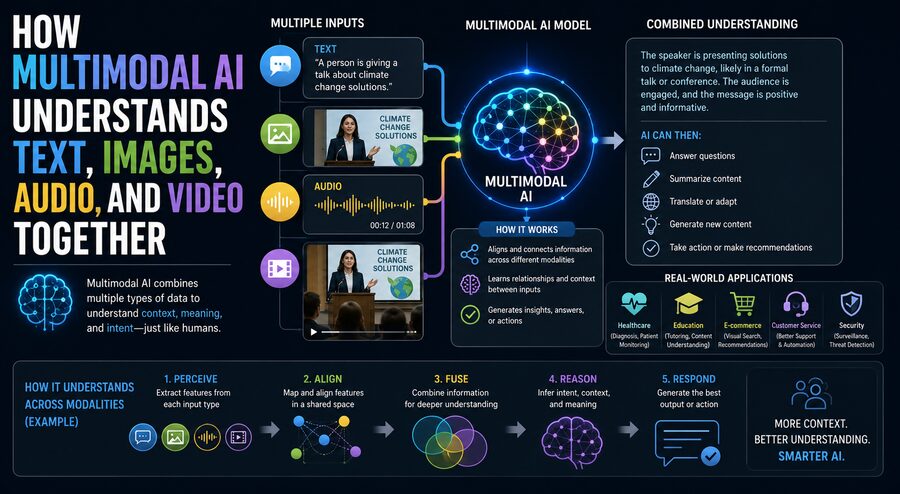
A multimodal AI system can work with more than one type of information—such as text, images, audio, and video—and relate them to one another.
For example, a system might look at a photograph 📷, read a written question about it 📝, listen to spoken instructions 🎤, and then produce a useful answer. More advanced systems can analyze video by combining visual frames, spoken dialogue, environmental sounds, subtitles, and temporal context.
The important idea is not simply that one AI can accept several file types. The real challenge is learning how different forms of information correspond to one another.
A picture of a barking dog, the written word “dog,” and the sound of barking are completely different physical signals. Yet they may all refer to the same real-world concept. Multimodal AI attempts to create internal representations that allow these signals to be connected.
🧩 What Does “Multimodal” Mean?
In AI, a modality is a particular type or channel of information.
Common modalities include:
- 📝 text,
- 🖼️ images,
- 🎤 audio,
- 🎥 video,
- 📊 structured data,
- 📡 sensor measurements.
A text-only model processes words and symbols.
An image model processes pixels.
An audio model processes sound waves or derived acoustic features.
A multimodal model combines two or more of these.
For example:
Image + Text → Visual Question Answering
Audio + Text → Speech Understanding
Video + Audio + Text → Video Analysis
The goal is to make these different inputs useful together rather than treating each one as an unrelated task.
🔤 How AI Represents Text
Computers do not naturally understand words.
Before text enters a modern AI model, it is typically divided into smaller units called tokens.
A sentence such as:
“The airplane is landing.”
might be converted into a sequence of token identifiers.
Those identifiers are then transformed into numerical vectors called embeddings.
An embedding represents information in a high-dimensional numerical space.
Words or phrases with related meanings can develop related internal representations.
For example:
airplane ✈️
may be represented closer to concepts such as:
aircraft, runway, pilot, airport
than to unrelated concepts such as:
banana or violin.
These vector representations allow neural networks to perform mathematical operations on language.
🖼️ How AI Represents Images
Images begin as grids of pixel values.
A photograph might contain millions of individual values representing brightness and color.
Feeding raw pixels directly into a reasoning system would be inefficient, so vision models transform the image into more useful internal features.
Many modern systems divide an image into small regions or patches.
Each patch is converted into a numerical representation.
The model can then learn patterns corresponding to:
- edges,
- textures,
- shapes,
- objects,
- spatial relationships,
- scenes.
For example, an image encoder might detect features that together strongly correspond to:
wheel + window + body shape + road → car 🚗
Modern vision architectures can also consider relationships between distant parts of an image, helping them understand that several visual elements belong to the same object or scene.
🎤 How AI Represents Audio
Audio is fundamentally a changing waveform.
A microphone records variations in air pressure and converts them into an electrical or digital signal.
AI systems often transform audio into representations that make patterns easier to recognize.
One common representation is a spectrogram.
A spectrogram shows how sound energy is distributed across frequencies over time.
Speech, music, alarms, engines, and animal sounds produce different acoustic patterns.
Audio models can learn to identify:
- spoken words,
- speakers,
- emotion-related cues,
- music,
- environmental noises,
- timing patterns.
🎧 A speech model might recognize that a particular sequence of acoustic features corresponds to the spoken phrase:
“Turn on the lights.”
It can then connect the sound to linguistic meaning.
🎥 Why Video Is More Complicated
Video contains both visual information and time.
A single image shows what exists at one moment.
A video shows how the scene changes.
That means a video model may need to understand:
- objects,
- actions,
- motion,
- scene transitions,
- spoken dialogue,
- background sounds,
- event order.
Consider a short video of someone pouring coffee into a cup.
One frame may show the kettle.
Another shows liquid flowing.
Another shows the cup becoming full.
Understanding the action requires connecting those frames over time. ☕🎥
If audio is included, the model may also hear:
“I’m making coffee.”
Now visual, temporal, and linguistic information all reinforce the same interpretation.
🔗 The Central Challenge: Connecting Different Modalities
Text, images, audio, and video are extremely different at the raw-data level.
The word “cat” consists of characters.
A photograph of a cat consists of pixels.
A meow consists of changing sound pressure.
Yet humans immediately connect all three with the same concept. 🐈
Multimodal AI tries to learn similar cross-modal associations.
A simplified training relationship might look like:
Image of cat ↔ Text “cat” ↔ Audio of meowing
Through very large numbers of examples, the model learns statistical relationships between representations from different modalities.
This allows it to answer questions such as:
“What animal is shown?”
or:
“What sound would this animal typically make?”
The model is not literally experiencing a cat as a human does. Instead, it has learned highly complex relationships among patterns in data.
🌐 Shared Representation Spaces
One important multimodal technique is to map different inputs into a shared representation space.
Imagine converting both an image and its caption into vectors.
If the image shows a bicycle and the text says:
“A person riding a bicycle.”
the training process encourages those representations to become similar.
An unrelated caption such as:
“A bowl of strawberries.”
should have a less similar representation.
This allows the system to learn that certain visual patterns correspond to certain linguistic concepts.
Conceptually:
Image of dog ───┐
                ├── Similar internal concept
Text "dog" ─────┘
These shared spaces are useful for:
- image search,
- captioning,
- visual retrieval,
- classification,
- multimodal reasoning.
🧠 Encoders Turn Inputs Into Machine-Readable Features
Multimodal systems often use specialized components called encoders.
An encoder transforms raw input into a compact numerical representation.
For example:
Text → Text Encoder → Embeddings
Image → Vision Encoder → Embeddings
Audio → Audio Encoder → Embeddings
These embeddings can then be passed into a shared model.
The architecture may contain separate front-end components for each modality while using a more general reasoning system afterward.
This resembles translating several languages into a common internal format before performing the main computation. 🔄
👀 Cross-Attention Helps Modalities Influence One Another
Another important mechanism is attention.
Attention allows a neural network to determine which parts of an input are most relevant to other parts.
In multimodal systems, cross-attention can connect information from different modalities.
Suppose an image contains:
- a dog,
- a ball,
- a tree.
The user asks:
“What is the animal holding?”
The word “animal” helps direct attention toward the dog.
The phrase “holding” encourages the model to examine the dog’s mouth.
The model may then focus on the ball and answer:
“A ball.” 🎾
This is more sophisticated than simply recognizing every object independently.
The text guides how the visual information is interpreted.
🔄 Early Fusion and Late Fusion
Multimodal systems can combine information at different stages.
🔀 Early Fusion
Different modalities are combined relatively early in the processing pipeline.
The model can learn detailed interactions among modalities from the beginning.
🧩 Late Fusion
Each modality is processed mostly separately at first.
The resulting high-level representations are combined later.
🔗 Intermediate Fusion
Many systems combine modalities at several points.
There is no single architecture that is best for every application.
The ideal design depends on the task, data volume, computing budget, and required response speed.
📚 How Multimodal Models Are Trained
Training a multimodal model often requires large datasets containing related information across modalities.
Examples might include:
- image-caption pairs,
- videos with subtitles,
- audio with transcripts,
- diagrams with explanations,
- screenshots with interface descriptions.
The model receives examples and learns statistical relationships.
One training task might ask:
Which caption belongs to this image?
Another might ask:
Predict the next text token based on this image and question.
Another might require:
Transcribe this audio.
By learning many related tasks, the model becomes more capable of connecting modalities.
🎯 Contrastive Learning
A commonly used multimodal training idea is contrastive learning.
The model is shown matching and nonmatching examples.
For instance:
Image: golden retriever 🐕
Correct text: “A dog running through grass.”
Incorrect text: “A train arriving at a station.”
The training objective encourages the model to place the correct image-text pair closer together in representation space while pushing unrelated pairs farther apart.
Across millions or billions of examples, this can create powerful cross-modal associations.
📝 Image Captioning
One of the most familiar multimodal tasks is image captioning.
The model receives an image and generates a textual description.
For example:
Input: 📷 Photo of a child flying a kite on a beach
Output:
“A child is flying a colorful kite near the ocean.”
To do this, the system must extract visual features and convert them into meaningful language.
Captioning combines computer vision with language generation.
❓ Visual Question Answering
Visual Question Answering, or VQA, goes one step further.
The user supplies both an image and a question.
For example:
Image: A kitchen counter containing apples and bananas.
Question:
“How many bananas are visible?”
The system must understand the question, find the relevant objects, and produce an answer.
This requires coordination between language and vision. 🍌🔍
🎧 Speech and Language Understanding
Multimodal AI can also connect speech directly with language understanding.
A traditional pipeline might look like:
Speech → Transcript → Language Model
More integrated architectures can process speech representations alongside textual information.
This can be useful when the sound itself provides information beyond words.
For example:
- tone of voice,
- pauses,
- background noise,
- speaker changes.
A system analyzing a customer-support call may therefore use both what was said and how the conversation unfolded acoustically. ☎️
🎥 Understanding Video Events
Video understanding requires more than analyzing independent images.
Suppose a video shows:
- a person enters a kitchen,
- opens a refrigerator,
- takes out milk,
- pours it into a glass.
If asked:
“What did the person do after opening the refrigerator?”
the model must understand temporal order.
The correct answer depends on knowing what happened before and after specific events.
This requires temporal modeling. ⏱️
Long videos are particularly challenging because they may contain thousands of frames and many minutes or hours of audio.
🧮 Why AI Cannot Analyze Every Video Frame Equally
A one-hour video at 30 frames per second contains:
30 × 60 × 60 = 108,000 frames
Processing every pixel in every frame at maximum detail would require enormous computation.
Multimodal systems therefore often use strategies such as:
- sampling selected frames,
- compressing visual information,
- identifying scene changes,
- extracting key moments,
- summarizing temporal segments.
This reduces the amount of information the system must process while attempting to preserve the important content. ⚡
📄 Understanding Charts, Documents, and Screenshots
Multimodal AI is especially useful for documents.
A business document may contain:
- written paragraphs,
- tables,
- charts,
- diagrams,
- page layout,
- images.
A text-only system might understand the extracted words but miss relationships created by layout.
For example, a value inside a table gains meaning from its row and column.
A multimodal model can use both visual structure and language to interpret the document more effectively. 📊📄
This can help with:
- invoice processing,
- document summarization,
- chart interpretation,
- form understanding,
- visual search.
🩻 Medical Imaging Applications
Multimodal AI is also being explored in medicine.
A medical system might combine:
- radiology images,
- clinical notes,
- laboratory results,
- patient history.
For example, an imaging model could analyze a chest scan while a language component interprets relevant medical context.
Combining modalities may help surface useful patterns that would be harder to identify from one source alone. 🩺
However, medical applications require careful validation because errors can have serious consequences. AI outputs should not be treated as substitutes for qualified clinical judgment.
🚗 Multimodal AI in Vehicles and Robotics
Robots and autonomous machines interact with environments containing many simultaneous signals.
A robot may receive:
- camera images,
- depth information,
- microphone input,
- position sensors,
- written or spoken instructions.
To act effectively, it must combine these signals.
For example, a warehouse robot might hear:
“Pick up the red box beside the conveyor.”
The system must connect language with visual perception and spatial reasoning.
This is a practical form of multimodal understanding. 🤖📦
🛍️ Multimodal Search and Shopping
Traditional search engines relied heavily on keywords.
Multimodal search can combine images and language.
A user could upload a photo of a chair and ask:
“Find something similar but in black.”
The system must understand:
- the object category,
- visual style,
- requested color change.
This creates more natural ways to search product catalogs. 🪑🔍
The same principle can be used for fashion, home design, travel, manufacturing parts, and many other applications.
🧠 Does Multimodal AI “Understand” Like a Human?
The word understand should be used carefully.
Multimodal AI can learn sophisticated relationships among text, visual patterns, audio, and temporal information.
It can often perform tasks that look remarkably similar to human interpretation.
However, this does not necessarily mean it experiences the world or forms concepts in exactly the same way humans do.
AI models work through learned numerical representations and statistical computation.
They can also make confident mistakes.
It is therefore more accurate to say that multimodal systems build powerful learned representations that allow them to interpret and relate multiple data types.
⚠️ Multimodal AI Can Still Hallucinate
Adding more modalities does not eliminate AI errors.
A multimodal system may:
- misidentify an object,
- incorrectly describe a chart,
- invent visual details,
- mishear speech,
- misunderstand video order,
- connect unrelated evidence.
These errors are sometimes called hallucinations.
For example, a model might claim that a photograph contains a stop sign even when no stop sign is present.
Users should verify important outputs, especially in areas such as medicine, law, finance, security, and industrial operations. 🔍⚠️
🔐 Privacy Becomes More Important With More Modalities
Multimodal systems may process highly sensitive information.
An uploaded image could reveal:
- someone’s face,
- home interior,
- location details,
- documents,
- personal information.
Audio can contain private conversations.
Video can contain identities, behaviors, and surroundings.
Organizations deploying multimodal AI therefore need strong policies involving:
- consent,
- access control,
- data retention,
- secure storage,
- privacy protection.
More input types can create more opportunities for useful AI—but also more kinds of sensitive data that must be protected. 🔐
📏 Evaluating Multimodal Systems Is Difficult
Testing a text-only model is already challenging.
Evaluating a multimodal model can be even more complicated.
Researchers may need to test:
- object recognition,
- spatial reasoning,
- audio transcription,
- temporal reasoning,
- cross-modal consistency,
- factual accuracy,
- instruction following.
A model might perform well on individual images but struggle when required to connect several pieces of evidence across video and audio.
Reliable multimodal evaluation therefore requires many different benchmarks and real-world tests.
⚡ Why Multimodal AI Requires Significant Computing Power
Images and video contain much more raw information than short text passages.
High-resolution images contain millions of pixels.
Audio may contain tens of thousands of measurements every second.
Video combines large numbers of images with time and often audio.
Processing all this information can require substantial:
- GPU capacity,
- memory,
- storage,
- network bandwidth.
Engineers therefore work on efficient encoders, compression methods, selective attention, and token reduction to make multimodal AI faster and less expensive. 🖥️⚡
🌐 Why Combining Modalities Can Be Better Than Using One Alone
Different modalities can compensate for one another.
Imagine a video where the camera view is partially blocked but the audio clearly captures a car horn.
The visual signal is weak, but the audio provides useful evidence. 🚗📢
Alternatively, noisy audio may be difficult to understand, but visible subtitles can clarify what was said.
Text can also tell the model what information matters in a complex image.
Combining modalities can therefore make interpretation more robust because each information source provides additional context.
🔮 The Future of Multimodal AI
Multimodal AI is moving toward systems that can work with richer combinations of information in a single interaction.
Future applications may increasingly combine:
- live video,
- voice conversation,
- documents,
- computer interfaces,
- sensor streams,
- environmental context.
A user might point a camera at a machine and ask:
“Why is this part vibrating?”
The system could potentially analyze the visual motion, listen to the sound, read the equipment label, compare technical documentation, and explain likely causes. 🏭🤖
That kind of interaction illustrates why multimodal AI is so important: real-world problems rarely arrive in only one format.
🧠 From Separate Signals to a Unified Representation
The central challenge of multimodal AI is converting very different kinds of information into representations that can interact.
Text begins as tokens. 📝
Images begin as pixels. 🖼️
Audio begins as waveforms. 🎤
Video combines visual information with time. 🎥
Specialized encoders transform these raw signals into numerical representations. Attention mechanisms and shared models then connect relevant concepts across modalities.
That is how an AI system can relate a spoken question to an object in a photograph, connect a video action with a written description, or interpret a chart while reading the surrounding text.
Multimodal AI does not simply place separate text, vision, and audio tools beside one another. The most capable systems attempt to build shared computational representations that let information from one modality influence the interpretation of another.
The core idea can be summarized simply:
Multimodal AI works by translating text, images, audio, and video into machine-readable representations, then learning the relationships among those representations so different kinds of information can be interpreted together. 🤖📝🖼️🎤🎥
As these systems improve, interacting with computers may increasingly resemble interacting with the world itself—through words, sights, sounds, and motion rather than through text alone. 🌍✨