
Modern AI systems can read paragraphs, translate languages, summarize documents, write code, answer questions, and analyze long sequences of information. One of the key ideas that made these capabilities possible is a mechanism called attention. 🔍🤖
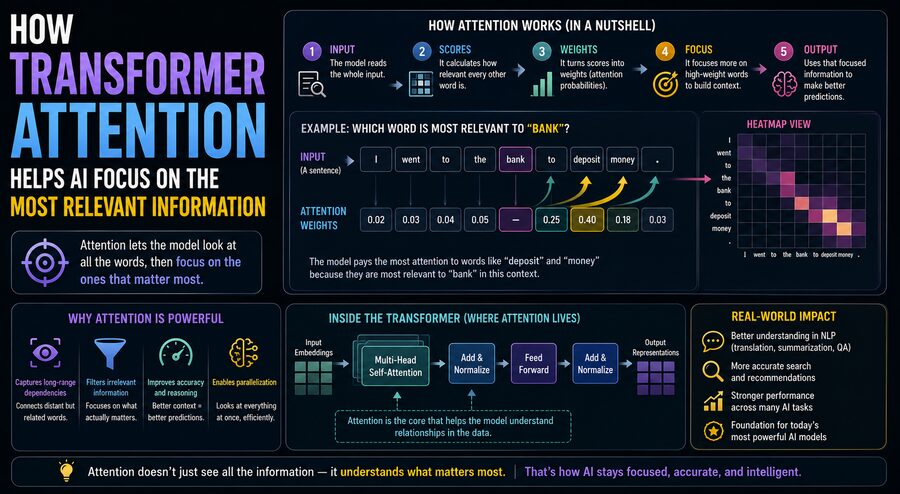
Attention is a mathematical method that helps an AI model decide which parts of its input are most relevant to each other.
Instead of treating every word in a sentence as equally important, an attention mechanism allows the model to assign different amounts of importance to different words or tokens while processing information.
For example, consider the sentence:
“The dog chased the ball because it was rolling.”
To understand what “it” refers to, an AI system needs to recognize that “ball” is more relevant than many of the other words.
Transformer attention allows the model to calculate these relationships automatically.
The basic idea is:
Current token ➡️ Compare with other tokens ➡️ Assign relevance scores ➡️ Combine important information
This ability to dynamically focus on useful context is one of the central reasons Transformer models became so influential in modern artificial intelligence. ⚡
🧩 What Is a Transformer?
A Transformer is a neural-network architecture designed to process sequences of information.
It was introduced in the 2017 research paper Attention Is All You Need and became the foundation for many later language, vision, audio, and multimodal AI systems.
Transformers are especially powerful because they can examine relationships between many parts of an input sequence without processing the sequence strictly one element at a time.
Older recurrent neural networks often processed text sequentially:
Word 1 ➡️ Word 2 ➡️ Word 3 ➡️ Word 4
A Transformer can instead analyze relationships among many tokens more directly.
This makes it easier to capture connections between words that may be far apart in a sentence or document.
🔤 What Is a Token?
Before a Transformer processes text, the text is usually divided into smaller units called tokens.
A token might represent:
- A whole word
- Part of a word
- Punctuation
- A symbol
- A number
For example, a tokenizer might break:
“Transformers are powerful.”
into something conceptually like:
"Transform"
"ers"
" are"
" powerful"
"."
Each token is converted into a numerical representation called an embedding.
The Transformer then processes those numerical vectors rather than the raw text itself.
🔍 Why Does AI Need Attention?
Suppose the model reads:
“Maria gave the book to Sarah because she had finished reading it.”
Several relationships matter.
The model may need to determine:
- Who finished reading?
- What does “it” refer to?
- Which person gave the book?
- Which object changed ownership?
The word “it” should strongly relate to “book”.
The word “she” may relate more strongly to Maria or Sarah depending on context.
Attention helps the model represent these relationships.
Rather than storing only a vague summary of the previous sentence, the model can calculate which tokens deserve the most weight for the current computation.
🎯 The Core Idea: Relevance Scores
For each token, the attention system creates a set of relevance scores describing how strongly it should consider other tokens.
Imagine the model is processing:
“The scientist examined the sample because it was contaminated.”
When processing “it”, the model might assign conceptual attention weights such as:
The           0.02
scientist     0.08
examined      0.03
the           0.01
sample        0.68
because       0.04
it            0.09
was           0.03
contaminated  0.02
These exact numbers are only illustrative.
The important point is that the token “sample” could receive much more attention than less relevant words.
The resulting representation for “it” can therefore incorporate information strongly associated with “sample.”
🧮 Query, Key, and Value Vectors
Transformer attention is often explained using three vectors:
- Query
- Key
- Value
These are generated from each token’s representation.
A useful analogy is a search system. 🔎
The query represents:
“What information am I looking for?”
The key represents:
“What kind of information does this token contain?”
The value represents:
“What information should I contribute if I am relevant?”
Every token produces its own query, key, and value vectors.
The Transformer’s attention mechanism compares queries with keys to determine relevance.
🔑 How Queries and Keys Determine Importance
Suppose token A is trying to determine which other tokens matter.
Its query vector is compared with the key vectors of the other tokens.
This is usually done with a mathematical operation called a dot product.
Conceptually:
Query of current token · Key of another token = relevance score
A larger score means the tokens are more compatible according to what the model has learned.
If the query for “it” matches the key for “sample” strongly, the attention score between them becomes high.
If it matches an unrelated word poorly, the score becomes low.
📊 The Attention Formula
A common form of Transformer attention is called scaled dot-product attention.
It is often written as:
Attention(Q, K, V) = softmax(QKᵀ / √dₖ)V
where:
Qrepresents queriesKrepresents keysVrepresents valuesdₖis the dimension of the key vectorssoftmaxconverts scores into normalized weights
Although the formula looks complicated, its purpose is straightforward:
Compare ➡️ Score ➡️ Normalize ➡️ Combine
First, queries are compared with keys.
Then the resulting scores are scaled.
Softmax converts them into attention weights.
Finally, those weights determine how much of each value vector contributes to the output.
📐 Why Are the Scores Scaled?
The dot products between high-dimensional vectors can become large.
If the values become too extreme, the softmax operation may produce very sharp distributions and make training less stable.
Transformers therefore divide the score by:
√dₖ
This scaling keeps the values in a more manageable range.
It is a small mathematical detail, but it helps the attention mechanism train effectively.
🎛️ What Does Softmax Do?
Suppose raw attention scores are:
Token A: 1.2
Token B: 4.8
Token C: 0.6
Softmax transforms these into positive weights that add approximately to 1.
Conceptually:
Token A: 0.03
Token B: 0.95
Token C: 0.02
Now the model can interpret Token B as being much more relevant.
The output becomes a weighted combination of the corresponding value vectors.
This is how attention creates a representation that emphasizes important information.
🧠 Self-Attention
When the queries, keys, and values all come from the same sequence, the mechanism is called self-attention.
Suppose the sentence is:
“The bank approved the loan because the applicant had strong credit.”
Each token can examine the others.
The token “loan” may attend strongly to:
- bank
- approved
- applicant
- credit
depending on what features a particular attention head has learned.
Self-attention helps every token build a context-aware representation.
The meaning of a word is therefore not treated as fixed.
It depends on its surrounding context.
🏦 Context Helps Resolve Ambiguous Words
Consider the word:
“bank”
In:
“She deposited money at the bank.”
the surrounding words suggest a financial institution.
But in:
“They sat on the bank of the river.”
the same word refers to land beside water.
Attention helps the model use nearby and distant context to produce different internal representations for the same token.
This is a major improvement over simpler methods that assign each word only one fixed representation.
🎯 Multi-Head Attention
Transformers do not normally use just one attention calculation.
They use multi-head attention.
This means several attention mechanisms operate in parallel.
Each attention head can learn to focus on different relationships.
One head might learn patterns related to:
- Grammar
Another might focus on:
- Pronoun references
Another might detect:
- Semantic similarity
Another might emphasize:
- Long-distance dependencies
Conceptually:
Input ➡️ Head 1 🔍 + Head 2 🔎 + Head 3 🎯 + Head 4 🧠 ➡️ Combined representation
The outputs of these heads are combined and transformed before being passed to later layers.
🌐 Why Multiple Heads Are Useful
Consider:
“The engineer who designed the bridge said it would survive the storm.”
To understand the sentence, a model may need several relationships simultaneously.
It may need to connect:
engineer ↔ designed
bridge ↔ it
bridge ↔ survive
survive ↔ storm
A single attention pattern might struggle to represent all of these relationships simultaneously.
Multiple heads allow the network to capture several kinds of structure at once.
🧱 Attention Happens in Layers
A Transformer usually contains many layers.
Each layer refines the representations created by the previous layer.
Early layers may learn relatively local relationships such as punctuation, word combinations, or basic syntax.
Later layers can potentially represent more abstract patterns involving:
- Meaning
- Topic
- Entity relationships
- Reasoning structure
- Long-range context
The process resembles repeated refinement:
Raw tokens ➡️ Contextual relationships ➡️ Richer representations ➡️ Higher-level patterns
This stacked architecture helps Transformers learn very complicated functions.
📍 How Does the Transformer Know Word Order?
Self-attention by itself does not inherently know whether one token came before or after another.
If all token representations were simply placed into attention without any positional information, the model could lose important information about sequence order.
Transformers therefore use positional information.
Depending on the architecture, this may involve:
- Positional encodings
- Learned positional embeddings
- Relative position representations
- Rotary positional embeddings
These mechanisms help the model understand that:
“Dog bites man”
is different from:
“Man bites dog.” 🐕😮
The words are similar, but their order dramatically changes the meaning.
⏩ Causal Attention in Language Generation
When a language model generates text, it must not look at future tokens that have not been generated yet.
For this reason, generative Transformers often use causal attention.
A mask prevents each token from attending to future positions.
For example:
Token 1 → can see Token 1
Token 2 → can see Tokens 1–2
Token 3 → can see Tokens 1–3
Token 4 → can see Tokens 1–4
But Token 2 cannot look ahead at Token 4.
This preserves the left-to-right generation process.
The model predicts the next token using only information available so far.
🎭 What Is an Attention Mask?
An attention mask controls which tokens are allowed to interact.
Masks can be used for several reasons.
🚫 Future-Token Masking
Prevents generative models from looking ahead.
🧱 Padding Masks
Ignore placeholder tokens added to make sequences the same length.
🎯 Specialized Attention Patterns
Some Transformer architectures restrict attention to local windows or selected regions to improve efficiency.
Masks therefore influence the information flow inside the network.
📚 Long-Range Dependencies
One of the most important advantages of attention is its ability to connect information over long distances.
Consider:
“The report that the committee published after several months of investigation was surprisingly short.”
The word “was” relates to “report”, even though many words appear between them.
Traditional sequential models could struggle to preserve such relationships over long distances.
Self-attention creates a more direct connection.
A token can, in principle, attend to another token many positions away without information passing through every intermediate token one by one.
⚡ Why Transformers Can Train Efficiently
Older recurrent models typically processed sequences sequentially.
The output for one position depended on computation from the previous position.
This limited parallel processing.
During Transformer training, self-attention can calculate many token relationships simultaneously using large matrix operations.
Modern GPUs and specialized AI accelerators are particularly good at these operations. 🖥️⚡
This parallelism helped make it practical to train extremely large models on vast datasets.
🧮 The Cost of Attention
Standard self-attention has an important limitation.
If a sequence contains N tokens, the model may calculate relationships among roughly:
N × N
token pairs.
This means attention computation and memory usage can grow approximately quadratically with sequence length.
If the context grows from:
1,000 tokens ➡️ 10,000 tokens
the number of potential pairwise relationships grows dramatically.
This is one reason very long-context processing can be computationally expensive.
🚀 Making Attention More Efficient
Researchers have developed many approaches to reduce attention costs.
These may include:
- Sparse attention
- Sliding-window attention
- Local attention
- Memory-efficient implementations
- FlashAttention-style algorithms
- Grouped-query attention
- Retrieval systems
Different approaches optimize different parts of the problem.
Some reduce mathematical operations, while others reduce memory movement or allow models to focus only on selected regions of the context.
🔦 Does Attention Mean AI “Pays Attention” Like a Human?
The term attention can be misleading if interpreted too literally.
Transformer attention is a mathematical mechanism.
It does not necessarily imply human-like awareness, intention, or conscious focus.
An attention score indicates how strongly certain learned representations interact during a computation.
It is therefore better to think of attention as:
Dynamic information weighting
rather than human-style concentration.
This distinction is important when discussing how AI systems operate.
📄 Example: Summarizing a Document
Imagine a Transformer processing an article about a company’s earnings.
The document contains:
- Revenue figures
- Executive comments
- Product announcements
- Historical background
- Repeated company names
When generating a summary sentence about profit, attention mechanisms can help the model draw information from tokens related to:
- Profit
- Expenses
- Revenue
- Growth
- Relevant time periods
The model does not need to treat every word as equally relevant to that specific output.
Attention allows contextual information to be weighted dynamically.
🌍 Attention in Translation
Machine translation provides another excellent example.
Consider translating:
“The cat sat on the chair.”
When generating a translated word corresponding to “cat”, the system may focus heavily on the original token “cat.”
When generating the translation of “chair,” attention shifts toward “chair.”
Different output positions therefore draw on different input information.
This flexible alignment is one reason attention became so effective for machine translation.
💻 Attention in Code Models
Attention is also useful for programming languages.
In code such as:
total = price * quantity
print(total)
a model processing total on the second line may need to relate it to the earlier definition.
In a much larger program, relevant definitions may occur dozens or hundreds of lines away.
Attention can help connect:
- Variable uses to definitions
- Function calls to declarations
- Opening and closing structures
- Comments to code
- Related data structures
This makes Transformer models useful for code completion and analysis.
🖼️ Attention Beyond Text
Transformers are not limited to language.
In computer vision, an image can be divided into patches that are treated somewhat like tokens.
Attention mechanisms can model relationships among different image regions.
For example, a model may connect:
Face ➡️ Body
Wheel ➡️ Vehicle
Object ➡️ Background
Transformers are also used in:
- Audio processing
- Speech recognition
- Protein modeling
- Robotics
- Multimodal AI
The underlying principle remains similar: identify which pieces of information are relevant to one another.
🔀 Cross-Attention
Another important mechanism is cross-attention.
In self-attention, queries, keys, and values come from the same sequence.
In cross-attention, they can come from different sources.
For example, in an image-captioning system:
Text queries ➡️ Attend to image features
The model generating a word such as “dog” may place strong weight on visual regions containing the dog.
Cross-attention is useful whenever one type of representation needs to retrieve information from another.
🧠 Attention and Retrieval Are Not Identical
A Transformer can focus on relevant information already present within its context.
But attention does not automatically give the model access to every fact in the world.
If required information is not present in the model’s learned parameters or current input, attention alone cannot retrieve it from an external database.
Systems can therefore combine Transformers with external retrieval mechanisms.
A simplified retrieval-augmented workflow might be:
Question ➡️ Search relevant documents ➡️ Add documents to context ➡️ Transformer attention processes them ➡️ Generate answer
Attention and retrieval can complement each other.
🔬 Are Attention Weights Perfect Explanations?
Attention maps can sometimes provide useful clues about what information a model is using.
However, an attention weight should not automatically be interpreted as a complete explanation of why the model produced an output.
Transformer behavior emerges from:
- Many attention heads
- Many layers
- Feed-forward networks
- Residual connections
- Learned embeddings
- Nonlinear transformations
A single attention map represents only one part of a much larger computation.
Researchers therefore use many interpretability methods beyond simply viewing attention weights.
🧱 The Feed-Forward Networks Matter Too
A Transformer layer does more than attention.
After attention combines contextual information, the representation usually passes through a feed-forward neural network.
Conceptually:
Attention ➡️ Context gathering
Feed-forward network ➡️ Feature transformation
Residual connections and normalization mechanisms also help information flow through the network.
The success of Transformers therefore comes from the interaction of several components, not from attention alone.
📚 A Simple Step-by-Step Example
Suppose a Transformer processes:
“The robot picked up the box because it was heavy.”
When processing the token “it”:
- 🔢 The token is represented as a numerical vector.
- 🔑 A query vector is created.
- 🗂️ Keys and values exist for surrounding tokens.
- 🧮 The query is compared with the keys.
- 📊 Relevance scores are calculated.
- 🎛️ Softmax converts them into attention weights.
- 📦 “Box” may receive a large weight.
- 🔄 Value vectors are combined according to those weights.
- 🧠 The resulting representation contains stronger contextual information linking “it” with “box.”
- ⬆️ Later Transformer layers continue refining that representation.
The AI has not been given an explicit grammar rule saying:
“In this exact sentence, ‘it’ means ‘box.'”
Instead, the relationship is learned statistically during training.
🎓 How Does Attention Learn Useful Patterns?
At the beginning of training, the model’s attention patterns are not useful.
Its parameters are initially set to numerical values that do not yet encode sophisticated language relationships.
During training, the model makes predictions and receives an error signal.
An optimization algorithm adjusts the network’s parameters to reduce future errors.
Across enormous numbers of training examples, the model can learn that certain patterns of token relationships are useful.
Attention mechanisms therefore learn through the same broad optimization process as the rest of the neural network.
🧩 Why Attention Was Such an Important Breakthrough
Attention solved several important problems simultaneously.
It allowed models to:
- Connect distant pieces of information
- Create context-dependent token representations
- Process training sequences in parallel
- Learn multiple types of relationships
- Scale effectively with modern computing hardware
- Apply similar architectures across many data types
These advantages made Transformers exceptionally flexible.
The architecture could be scaled to larger datasets, larger models, and increasingly complex tasks.
⚠️ Attention Does Not Guarantee Perfect Understanding
Even powerful Transformer models can still make mistakes.
Attention does not guarantee:
- Correct reasoning
- Accurate facts
- Perfect long-context recall
- Reliable causal understanding
- Freedom from bias
- Human-level comprehension
A model may assign useful relationships while still generating an incorrect conclusion.
Good performance depends on training data, model architecture, optimization, context, system design, and many other factors.
Attention is a powerful computational mechanism, not a guarantee of intelligence or truth.
🌟 The Bigger Picture
Transformer attention helps AI process complex information by dynamically deciding which pieces of context matter most for each computation.
For every token, the model creates queries, keys, and values.
Queries are compared with keys to produce relevance scores.
Those scores become attention weights, which determine how strongly different value vectors contribute to the resulting representation.
The process can be summarized as:
Tokens 🔤 ➡️ Queries, Keys, Values 🔑 ➡️ Relevance Scores 📊 ➡️ Attention Weights 🎯 ➡️ Contextual Representation 🧠
Multi-head attention allows several kinds of relationships to be analyzed simultaneously, while many stacked Transformer layers progressively build richer representations.
This mechanism helps models resolve ambiguous words, connect distant ideas, translate sentences, interpret code, analyze images, and generate context-sensitive responses.
Perhaps the most important insight is that attention gives AI a flexible alternative to treating information uniformly.
When processing a sentence, document, image, or other sequence, not every piece of information matters equally at every moment.
Transformer attention gives the model a learned mathematical way to decide what deserves more weight—and that simple principle became one of the foundations of modern artificial intelligence. 🤖🔍⚡