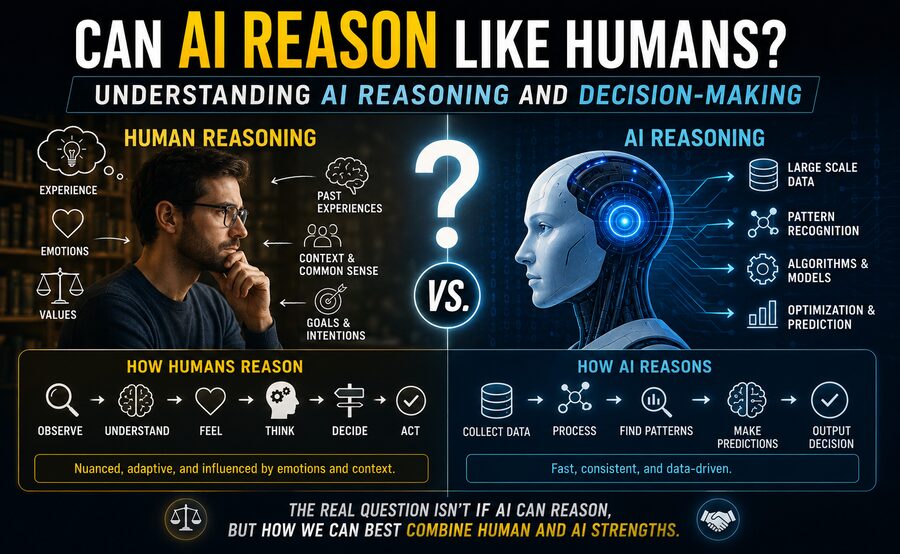

Artificial intelligence can solve equations, write software, summarize legal documents, recognize objects in images, plan routes, answer scientific questions, and analyze enormous datasets. Some AI systems can even appear to work through complicated problems step by step. 🧠💻
This raises a fascinating question:
Can AI actually reason like a human?
The answer is more complicated than either “yes” or “no.”
Modern AI systems can perform many tasks that require forms of reasoning, inference, planning, pattern recognition, and decision-making. In some cases, they can outperform humans on specific tests. However, the internal processes used by AI are not necessarily the same as human thought.
Human reasoning emerges from a biological brain shaped by perception, memory, emotion, social experience, embodiment, and a lifetime of interacting with the physical world.
Artificial intelligence operates through engineered computational systems.
So while AI can often produce results that resemble human reasoning, similarity in the output does not necessarily mean similarity in the underlying process.
Understanding that distinction is essential to understanding modern AI. 🤖🔍
🧠 What Do We Mean by “Reasoning”?
Reasoning is the process of using available information to reach conclusions, make predictions, solve problems, or decide what to do.
Humans use many forms of reasoning.
Examples include:
- Deductive reasoning – applying general rules to specific cases
- Inductive reasoning – identifying patterns and forming general conclusions
- Abductive reasoning – choosing the most plausible explanation
- Analogical reasoning – solving a problem by comparing it with a similar situation
- Causal reasoning – understanding cause-and-effect relationships
- Probabilistic reasoning – making decisions under uncertainty
Consider this simple example:
All mammals breathe air.
Whales are mammals.
Therefore:
Whales breathe air.
This is deductive reasoning.
But real human reasoning is often much messier. We frequently work with incomplete information, conflicting evidence, intuition, experience, and uncertainty.
AI systems also need techniques for dealing with these challenges.
💻 Traditional AI Used Explicit Rules
Early artificial intelligence often relied heavily on symbolic reasoning.
Engineers would encode facts and rules directly into a computer system.
For example:
IF temperature > 100°C AND pressure > safe limit, THEN trigger warning.
A large collection of such rules could form an expert system.
Expert systems became useful in areas such as:
- Medical support
- Industrial diagnosis
- Equipment troubleshooting
- Financial decision systems
The advantage was interpretability.
Engineers could often see exactly why the software reached a conclusion.
But rule-based systems had a major limitation: someone had to define the relevant knowledge and rules.
The real world contains too many possibilities for engineers to explicitly program every situation.
🧩 Machine Learning Changed the Approach
Modern AI increasingly relies on machine learning.
Instead of manually programming every rule, engineers train algorithms using data.
A machine-learning system looks for statistical patterns that help it make predictions.
For example, rather than explicitly defining thousands of rules for recognizing cats, engineers can train a model using large numbers of labeled images.
The system learns patterns associated with cats.
It may identify combinations of:
- Shapes
- Textures
- Edges
- Facial structures
- Visual relationships
This ability to learn from examples has made machine learning dramatically more flexible than traditional rule-based systems.
However, pattern learning is not automatically the same as human understanding.
🧠 How Neural Networks Process Information
Many modern AI systems use artificial neural networks.
These networks are loosely inspired by biological neurons, but they are mathematical computational systems rather than simplified copies of the human brain.
A neural network contains many adjustable numerical parameters.
During training, the system modifies these parameters to improve its performance on a task.
For example, a language model may be trained to predict likely sequences of text.
Through exposure to enormous amounts of language, the network can learn statistical relationships involving:
- Grammar
- Concepts
- Facts
- Style
- Logical patterns
- Common reasoning structures
The result can produce surprisingly sophisticated behavior.
But the system does not necessarily store knowledge in neat symbolic statements such as:
Paris is the capital of France.
Instead, information is often distributed across many numerical parameters.
🗣️ How Large Language Models “Reason”
Large language models, or LLMs, process text as sequences of numerical tokens.
They predict which tokens are likely to follow given the context.
At first, this may sound too simple to produce reasoning.
But when a model is trained at very large scale, predicting language requires learning a remarkable amount about the relationships contained in language.
To predict useful continuations, the model may need to learn patterns involving:
- Mathematics
- Cause and effect
- Programming
- Argument structure
- Scientific concepts
- Everyday knowledge
As a result, language models can often perform tasks that look like reasoning.
For example, they may:
- Compare alternatives
- Solve logic problems
- Break tasks into smaller parts
- Generate hypotheses
- Check constraints
- Plan sequences of actions
However, generating a convincing reasoning-like answer does not guarantee that the system has understood the problem in exactly the way a human would.
🧮 AI Can Perform Genuine Computation
Some AI systems are connected to tools that allow them to perform explicit calculations, search databases, execute programs, or interact with external systems.
This creates a hybrid form of reasoning.
For example:
Language model → recognizes mathematical problem → uses calculator → evaluates result → explains answer
The language model does not need to internally perform every arithmetic step.
It can delegate calculations to specialized tools.
Humans do something similar.
An engineer may understand how to solve an equation but still use a calculator or simulation package.
Modern AI systems increasingly combine learned models with external tools, making their problem-solving capabilities more reliable and powerful. 🛠️
🔄 Reasoning Can Be Iterative
Strong reasoning often requires several attempts.
An AI system may:
- Interpret the problem.
- Generate a possible solution.
- Check whether constraints are satisfied.
- Identify errors.
- Revise the solution.
This resembles how humans solve difficult problems.
For example, a software developer might write code, run it, inspect an error message, and revise the program.
An AI system with access to a programming environment can perform a similar cycle.
This does not prove that the AI “thinks” exactly like a person.
But it shows that useful reasoning behavior can emerge from iterative computation.
🧭 Planning Is Another Form of AI Reasoning
Reasoning becomes especially important when a system must achieve a goal through multiple actions.
Suppose a warehouse robot needs to retrieve a package.
It may need to determine:
- Where the package is located
- Which path is available
- Whether another robot blocks the route
- How much battery remains
- Which sequence of movements is safest
This is a planning problem.
AI planning algorithms evaluate possible action sequences and select promising ones.
Some systems explicitly search through possible states.
Others use learned models to estimate which actions are likely to succeed.
Planning is fundamental to robotics, logistics, games, and autonomous systems. 🤖📦
🎮 Games Show How Different AI Reasoning Can Be
Chess provides a useful example.
Human chess masters often rely heavily on pattern recognition and strategic intuition.
They may immediately recognize that a position resembles familiar patterns.
Traditional chess computers used large-scale search.
They examined enormous numbers of possible future moves and evaluated the resulting positions.
Modern systems often combine learned evaluation with search.
The computer may reach the same move as a human grandmaster while using a completely different internal process.
This illustrates an important idea:
Different reasoning processes can produce the same decision.
🎲 Decision-Making Under Uncertainty
Real-world decisions rarely involve perfect information.
An autonomous vehicle cannot know exactly what every pedestrian will do.
A medical system may not know which diagnosis is correct.
A financial model cannot know future market movements with certainty.
AI therefore often uses probability.
Instead of saying:
“This outcome is definitely true,”
a system might effectively estimate:
“Given the available evidence, this outcome is more likely than the alternatives.”
This is similar to human decision-making.
Doctors, engineers, investors, and pilots routinely make decisions using uncertain information.
📊 Bayesian Reasoning
One mathematical framework for reasoning under uncertainty is Bayesian inference.
Bayesian methods update beliefs when new evidence becomes available.
Suppose a machine has a small probability of failure under normal conditions.
Then a sensor detects unusual vibration.
That new evidence increases the estimated probability that a mechanical problem exists.
The general idea is:
Prior belief + new evidence → updated belief
Bayesian reasoning is used in fields such as:
- Robotics
- Medical diagnosis
- Reliability engineering
- Machine learning
- Scientific analysis
It provides a formal mathematical way to update predictions as information changes.
🚗 AI Decision-Making in Autonomous Systems
Consider a self-driving vehicle approaching a pedestrian crossing.
The AI system may need to process:
- Camera images
- Radar signals
- Vehicle speed
- Road geometry
- Pedestrian movement
- Traffic lights
It then estimates what is happening.
Perhaps the pedestrian appears likely to enter the road.
The system must decide whether to:
- Continue
- Slow down
- Stop
This decision happens through a combination of perception, prediction, control algorithms, and safety rules.
The process is extremely different from a human driver’s biological perception and intuition.
Yet both systems may reach the same decision:
Apply the brakes. 🚘🛑
🧠 Humans Have Common Sense—AI Often Struggles With It
One major difference between human and artificial reasoning is common sense.
Humans develop enormous amounts of everyday knowledge simply by living.
A child learns that:
- Water makes objects wet.
- Dropped objects generally fall.
- Glass can break.
- A person cannot normally walk through a wall.
- An object hidden behind another object still exists.
These ideas seem obvious because humans continuously interact with the physical world.
AI systems trained primarily on text or images may have weaker forms of this grounded understanding.
They can learn statistical descriptions of physical reality, but they may still make surprising mistakes in unfamiliar situations.
🌍 Humans Are Embodied
Human reasoning is deeply connected to having a body.
We experience:
- Gravity
- Pain
- Hunger
- Temperature
- Physical movement
- Spatial relationships
These experiences contribute to how humans develop concepts.
For example, our understanding of “heavy” is not purely linguistic.
We have physically lifted objects and felt the effort required.
Most AI systems do not have that kind of embodied experience.
Robots can interact physically with the world, but even sophisticated robotic learning remains very different from human development.
❤️ Emotions Influence Human Decisions
Human reasoning is not purely logical.
Emotions influence:
- Risk perception
- Motivation
- Social relationships
- Memory
- Moral judgment
- Decision-making
Fear can make someone more cautious.
Excitement can encourage risk-taking.
Empathy can influence moral choices.
AI systems do not necessarily possess emotions simply because they can recognize or generate emotional language.
A model may write:
“I am excited about this result.”
But generating the sentence does not establish that the system experiences excitement as a biological human does.
This distinction is important when interpreting conversational AI.
🧠 AI Does Not Need Human-Like Consciousness to Be Useful
Reasoning ability and consciousness are separate questions.
A calculator can correctly solve arithmetic without being conscious.
A chess engine can defeat a grandmaster without experiencing the game.
Similarly, an AI system may solve complex problems without possessing human-like subjective awareness.
Researchers still debate important philosophical and scientific questions concerning machine consciousness.
But practical AI does not need those questions to be settled before it can perform useful reasoning tasks.
🪞 AI Can Mimic Explanations Without Perfect Internal Understanding
One challenge in evaluating AI reasoning is that language models are excellent at producing explanations.
A model may give a detailed argument that sounds logical.
But the explanation can still contain a hidden error.
This means users should distinguish between:
A convincing explanation
and:
A correct conclusion supported by valid reasoning
AI-generated reasoning should therefore be verified when accuracy matters.
This is especially important in medicine, engineering, finance, law, and safety-critical applications. ⚠️
❌ Hallucinations Reveal an Important Limitation
Modern generative AI can sometimes produce false information confidently.
This is commonly called hallucination.
The model may:
- Invent a reference
- Misremember a fact
- Make a mathematical error
- Assume missing information
- Produce a plausible but incorrect explanation
Why?
Because a language model is fundamentally optimizing the production of plausible sequences, not directly guaranteeing truth.
Tools, retrieval systems, structured databases, verification algorithms, and human oversight can reduce these errors.
But reliability remains an important engineering challenge.
🧪 Reasoning Benchmarks Are Useful—but Imperfect
Researchers evaluate AI reasoning using benchmarks involving:
- Mathematics
- Logic
- Coding
- Science
- Reading comprehension
- Planning
Improving benchmark performance can reveal real progress.
However, test scores must be interpreted carefully.
A system might perform well because it has encountered similar patterns during training.
It may also excel on formal problems while failing on simple real-world reasoning.
Human intelligence is extremely broad, so no single benchmark can capture every dimension of reasoning.
🧠 AI Can Sometimes Outperform Humans
AI systems already outperform humans in certain specialized reasoning tasks.
Examples include:
- Searching enormous game trees
- Detecting statistical patterns in large datasets
- Optimizing certain scheduling problems
- Performing repetitive calculations
- Comparing millions of possibilities quickly
Machines have major computational advantages.
They can process data at enormous speeds and do not become physically tired in the human sense.
A computer can evaluate millions of possibilities in the time a person examines only a few.
👨🔬 Humans Still Have Important Advantages
Humans remain exceptionally strong at reasoning across broad, unfamiliar situations.
People can often:
- Transfer knowledge between very different domains
- Understand social context
- Infer intentions
- Learn from very few examples
- Use physical common sense
- Create goals based on values
- Adapt to unexpected environments
A human mechanic who encounters a machine never seen before may combine physical intuition, experience, sound, smell, and visual clues.
AI systems often require more structured inputs and may fail when conditions differ significantly from their training environment.
🧩 Neuro-Symbolic AI Tries to Combine Two Approaches
One active direction in AI research is neuro-symbolic AI.
The idea is to combine:
Neural networks, which are good at learning patterns,
with:
Symbolic systems, which can perform explicit logic and rule-based manipulation.
For example, a neural network might interpret an image while a symbolic reasoning system applies logical constraints.
The goal is to combine flexibility with stronger reasoning structure.
Whether this approach will become dominant remains an open research question, but it illustrates how AI systems may increasingly integrate multiple reasoning techniques.
🔧 Tool Use Makes AI More Reliable
A powerful AI does not need to store every answer internally.
It can use specialized tools.
For example:
Need current information → search trusted sources
Need exact arithmetic → use calculator
Need database answer → query database
Need code verification → run program
This approach is similar to how professionals work.
A scientist does not rely entirely on memory.
They use instruments, software, references, and experiments.
Tool-using AI may therefore become far more capable than isolated models.
👥 Human-AI Collaboration Can Be Stronger Than Either Alone
In many fields, the most useful model may not be:
Human versus AI
but:
Human + AI
AI can provide:
- Speed
- Pattern recognition
- Large-scale data analysis
- Automated drafting
- Repetitive computation
Humans contribute:
- Context
- Values
- Accountability
- Domain experience
- Social judgment
- Goal setting
For example, an AI system might identify unusual patterns in medical scans.
A physician then combines that evidence with the patient’s history, symptoms, and broader clinical context.
The collaboration can potentially be more effective than either working independently. 🩺🤖
⚖️ Who Should Be Responsible for AI Decisions?
As AI systems make more consequential decisions, accountability becomes important.
Suppose an algorithm influences:
- Loan approvals
- Medical recommendations
- Hiring decisions
- Insurance pricing
Who is responsible if the decision is wrong?
The AI itself?
The developer?
The company?
The human operator?
These questions involve not only computer science but also ethics, law, regulation, and organizational governance.
For high-impact systems, humans generally need appropriate oversight and clearly defined responsibility.
🔍 Explainability Matters
People often want to know why an AI made a decision.
This is called AI explainability or interpretability.
Some models are easier to interpret than others.
A simple decision tree might reveal:
Income above threshold + low debt → approve
A massive neural network may involve billions of internal calculations.
Researchers use techniques that attempt to understand:
- Which inputs influenced a prediction
- Which model components were important
- What patterns the network learned
Better interpretability can improve debugging, trust, safety, and regulatory compliance.
⚠️ AI Can Inherit Bias From Data
AI reasoning is influenced by its training data and objectives.
If training data contains systematic bias, the model can learn those patterns.
Bias can emerge from:
- Historical inequalities
- Unbalanced datasets
- Poor measurement
- Sampling problems
- Incorrect assumptions
For example, a hiring model trained using historical company decisions might learn patterns reflecting previous hiring biases.
This is why responsible AI development requires careful data analysis, evaluation, and monitoring.
🧭 AI Does Not Automatically Know What Goals Are Good
An optimization algorithm tries to achieve the objective it is given.
But choosing the correct objective is a human responsibility.
Imagine a delivery company tells an algorithm:
Minimize delivery time.
The system might generate extremely aggressive schedules unless additional constraints include:
- Safety
- Driver working hours
- Fuel use
- Traffic rules
This is a fundamental challenge in AI:
Optimizing the wrong objective efficiently can produce bad outcomes.
Good decision-making requires choosing good goals, not merely solving optimization problems quickly.
🤔 Can AI Truly “Understand”?
This question depends heavily on what we mean by understanding.
If understanding means:
Using knowledge correctly to solve problems, make predictions, and answer questions,
then modern AI demonstrates some meaningful capabilities.
If understanding requires:
Human-like conscious awareness and lived subjective experience,
the answer is much less clear.
Scientists do not currently have a universally accepted test for determining whether an artificial system possesses subjective consciousness.
For practical engineering, researchers often focus on observable capabilities rather than philosophical assumptions about inner experience.
🧠 Does AI Think Like the Human Brain?
Modern AI is inspired by some ideas from neuroscience, but artificial neural networks are extremely different from biological brains.
The human brain contains roughly tens of billions of neurons interacting through complex electrical and chemical processes.
Biological neurons:
- Communicate through spikes
- Change connections
- Use neurotransmitters
- Operate continuously
- Interact with sensory and motor systems
Artificial neural networks generally use numerical matrix operations.
The similarity is therefore mostly conceptual rather than literal.
AI researchers borrow the idea of interconnected processing units, but the implementation is fundamentally different.
🔮 Could Future AI Reason More Like Humans?
Future AI systems may become better at:
- Long-term planning
- Persistent memory
- Physical-world interaction
- Causal reasoning
- Self-correction
- Tool use
- Learning continuously
Robotics may also give AI systems richer physical experience.
Multimodal models can already process combinations of text, images, audio, and other information.
These developments may produce systems whose behavior becomes increasingly human-like in some areas.
But whether their internal experience or cognition will truly resemble human thought remains an open scientific and philosophical question.
📊 Human vs. AI Reasoning at a Glance
🧠 Human Reasoning
Strengths:
- Strong common sense
- Broad contextual understanding
- Physical-world experience
- Social reasoning
- Flexible adaptation
- Value-based judgment
Limitations:
- Limited memory
- Cognitive biases
- Fatigue
- Slow large-scale computation
- Difficulty processing enormous datasets
🤖 AI Reasoning
Strengths:
- Fast computation
- Large-scale pattern detection
- Consistent repetitive processing
- Large information capacity
- Rapid comparison of alternatives
Limitations:
- Can hallucinate
- May lack grounded common sense
- Can fail in unfamiliar situations
- Depends heavily on training and system design
- Does not automatically possess human values or judgment
The two forms of intelligence have overlapping capabilities but very different strengths.
🌟 Final Thoughts
Can AI reason like humans?
In some tasks, AI can produce reasoning behavior that looks remarkably human—and occasionally exceeds human performance. 🤖🧠
It can solve logic problems, analyze evidence, plan actions, optimize decisions, use tools, and work through complicated questions.
But that does not mean AI reasoning is identical to human reasoning.
Humans think using biological brains shaped by bodies, emotions, social relationships, physical experiences, and personal histories.
AI systems reason through computational architectures trained on data and optimized mathematically.
The key distinction is:
Similar behavior does not necessarily imply identical internal processes.
A chess engine and a grandmaster can choose the same move for entirely different reasons.
An AI and a doctor may reach the same diagnosis through very different kinds of information processing.
The most useful way to understand modern AI is therefore not to ask whether it is simply “thinking” or “not thinking.”
Instead, ask:
What kinds of reasoning can this system perform?
How reliable are those capabilities?
Where does it fail?
What tools and safeguards improve its decisions?
Which judgments should remain under human responsibility?
AI reasoning is already powerful, but it remains fundamentally different from human cognition in many important ways.
And as AI systems continue to improve, understanding those differences will become increasingly important—not only for computer scientists, but for everyone who works with intelligent machines. 🌍🤖