
Artificial intelligence is increasingly moving beyond systems that simply answer questions. Newer AI applications can sometimes plan a sequence of actions, use software tools, retrieve information, interact with external systems, monitor progress, and continue working toward a goal with limited human intervention.
Systems designed to operate this way are commonly called AI agents.
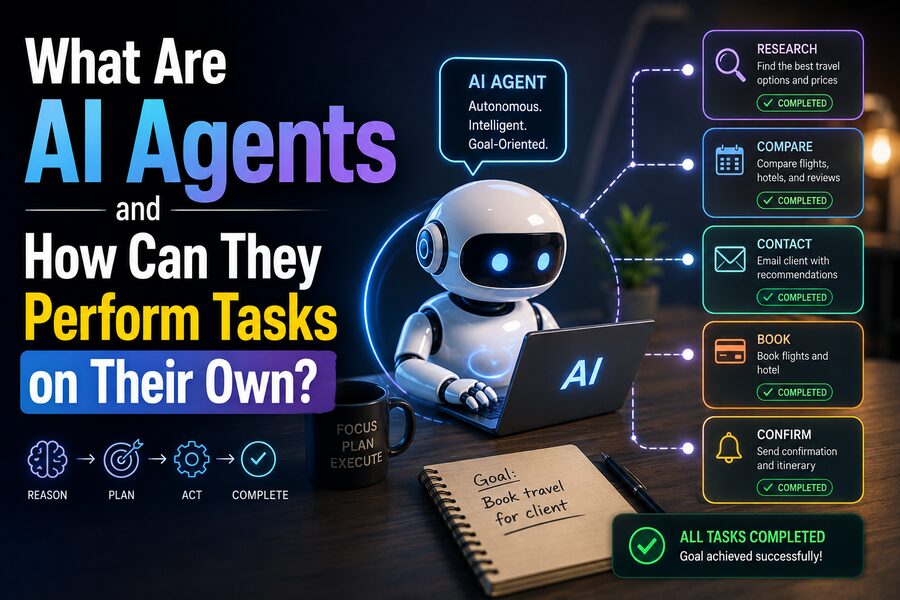
An AI agent can be thought of as a software system that receives a goal, observes relevant information, decides what action to take, performs that action through available tools, evaluates the result, and then determines what should happen next.
Instead of only responding once to a prompt such as:
“What are the best ways to organize my project?”
an agentic system might be designed to handle a broader request such as:
“Review the project tasks, identify overdue work, prepare a progress summary, and create an updated action list.”
To accomplish that goal, the system may need to complete several steps rather than produce a single answer.
This ability to reason over multiple steps and interact with tools is what makes AI agents an important development in modern computing. 🤖🔄
🧠 What Exactly Is an AI Agent?
In computer science, the word agent has been used for decades.
At a basic level, an agent is something that:
- Observes an environment.
- Makes decisions.
- Takes actions.
- Tries to achieve a goal.
An AI agent follows the same general idea but uses artificial intelligence to help determine what actions should be taken.
A modern AI agent may combine several components, including:
- 🧠 An AI model
- 🎯 A goal or set of instructions
- 🛠️ Access to software tools
- 💾 Memory or stored context
- 🔄 A planning and execution loop
- 🔐 Permissions and safety controls
The AI model provides much of the reasoning capability, while the surrounding software determines what the agent can actually do.
That distinction is important.
An AI model by itself may only generate text. An AI agent is usually a larger system that connects the model to tools and an execution framework.
💬 AI Assistant vs. AI Agent
An ordinary AI assistant often works in a simple pattern:
User asks → AI responds
An agent can operate in a more extended pattern:
User gives goal → AI plans → AI uses tool → AI observes result → AI adjusts plan → AI takes another action → task completes
For example, imagine asking an AI assistant:
“How should I organize a business trip?”
It might provide recommendations.
An appropriately connected travel-planning agent could potentially perform additional authorized steps such as:
- Check calendar constraints
- Search available options
- Compare alternatives
- Create an itinerary
- Prepare information for approval
Whether it can actually book or purchase anything depends on the permissions and tools it has been given.
AI agents are therefore not defined simply by being “smarter.” Their key difference is their ability to participate in a multi-step action process. 🔄
🎯 Agents Start With a Goal
Most agentic systems begin with some form of objective.
The goal might be simple:
“Organize these files by project.”
Or more complex:
“Analyze this week’s support tickets, identify the most common customer complaints, summarize the findings, and draft recommended responses.”
The agent must translate that high-level goal into smaller tasks.
For example:
- Retrieve the support tickets.
- Read their contents.
- Categorize each issue.
- Count recurring problems.
- Rank the categories.
- Produce a summary.
- Draft suggested responses.
This process is often called task decomposition.
Breaking a large objective into smaller actions is one of the fundamental capabilities required for useful AI agents.
🧩 Planning: Turning Goals Into Steps
A traditional computer program normally follows instructions explicitly written by a programmer.
For example:
Step 1 → Open file
Step 2 → Read row
Step 3 → Calculate value
Step 4 → Save result
An AI agent may be given a higher-level objective and generate at least part of the plan dynamically.
Suppose the goal is:
“Find out why product returns increased last month.”
The agent might determine that it should:
- Retrieve sales data
- Retrieve return records
- Compare return rates by product
- Examine customer comments
- Identify unusual patterns
- Create a report
The programmer does not necessarily have to predefine every exact step for every possible request.
The AI model helps decide which actions are appropriate.
This flexibility is powerful, but it also means agent systems require careful monitoring and guardrails because generated plans can sometimes be incomplete or incorrect.
🛠️ Tools Give Agents the Ability to Act
An AI agent becomes much more useful when it can interact with tools.
Possible tools include:
- 🔎 Search systems
- 📧 Email services
- 📅 Calendars
- 📊 Databases
- 📁 File systems
- 💻 Code execution environments
- 🌐 APIs
- 🧮 Calculators
- 🏢 Business software
The AI model does not usually operate these systems in the same way a human physically moves a mouse.
Instead, software tools expose structured functions.
For example, a calendar tool might provide commands conceptually similar to:
get_available_times()
create_event()
update_event()
The agent chooses an appropriate operation, supplies the required information, and receives a result.
That result becomes new information for the next decision.
🔄 The Agent Loop
One of the most important concepts in agentic AI is the agent loop.
A simplified loop looks like this:
Observe → Think/Plan → Act → Observe Result → Adjust → Continue
Imagine an agent has been asked to analyze a spreadsheet.
It might proceed like this:
1. Observe 👀
The agent inspects the spreadsheet structure.
2. Reason 🧠
It determines which columns contain relevant information.
3. Act ⚙️
It runs a calculation.
4. Observe Again 🔍
It checks the calculated results.
5. Adjust 🔄
It realizes some rows contain missing data and changes its analysis.
6. Complete ✅
It produces the final report.
This feedback cycle allows the system to respond to information it discovers while working.
🧠 Why Large Language Models Are Useful for Agents
Large language models, or LLMs, are particularly useful inside AI agents because they can interpret flexible human instructions.
Traditional software performs best when input is highly structured.
An LLM can often understand requests such as:
“Review these customer complaints and tell me what is going wrong.”
It can then reason about text, classify information, create summaries, and decide which available tool may help.
This ability makes LLMs useful as a kind of decision-making and language-processing layer inside an agent.
However, the language model is only one part of the system.
The agent framework still needs to manage:
- Tool calls
- Permissions
- State
- Error handling
- Execution limits
- Memory
- Security
💾 How Do AI Agents Remember Things?
Agents often need to preserve information between steps.
This can happen through different types of memory.
🧠 Working Memory
Working memory contains information needed for the current task.
For example:
- The user’s request
- Tool results
- Current plan
- Partial calculations
📚 Long-Term Memory
Some systems can also store information for later use.
For example, an agent might store:
- Previous project decisions
- Frequently used preferences
- Historical task results
Long-term memory is usually implemented through databases or other storage systems rather than the AI model literally remembering everything permanently.
Memory design is important because unnecessary or incorrect stored information can influence future decisions.
📋 Example: An AI Agent Managing Email
Imagine an AI agent designed to assist with an email inbox.
The goal could be:
“Identify urgent customer emails and prepare draft replies.”
The agent might:
- Access authorized messages.
- Read their contents.
- Determine which relate to customer issues.
- Estimate urgency.
- Retrieve relevant account information.
- Draft responses.
- Place the drafts into an approval queue.
Notice that the agent does not necessarily need permission to send messages automatically.
A company could require a human to approve every draft.
This is an example of human-in-the-loop automation. 👩💻🤖
📊 Example: An Agent Analyzing Business Data
Suppose a manager asks:
“Why did revenue decrease this month?”
A data-analysis agent might:
- Query a sales database
- Compare current and previous periods
- Segment sales by region
- Identify products with declining revenue
- Calculate changes
- Produce charts
- Draft an explanation
Instead of the manager manually running every query, the agent coordinates several analytical steps.
The agent still needs access to accurate data and must use correct calculations.
If it interprets the data incorrectly, the resulting conclusion can also be wrong.
💻 AI Agents for Software Development
AI agents can also assist programmers.
A coding agent may be able to:
- Read a repository
- Search for relevant files
- Identify bugs
- Edit code
- Run tests
- Examine failures
- Revise the implementation
This creates a powerful feedback loop.
For example:
Write fix → run test → test fails → inspect error → modify code → run test again
A human programmer might perform exactly the same cycle manually.
An agent can automate parts of it.
However, code generated by an agent still requires careful review, especially for security-critical or production systems.
🛒 Agents in E-Commerce
AI agents can potentially automate parts of online business operations.
An e-commerce support agent might:
- Answer product questions
- Check order status
- Explain return policies
- Recommend suitable products
- Escalate unusual cases
A merchandising agent might:
- Analyze sales trends
- Identify low-stock items
- Recommend inventory changes
- Draft product descriptions
The important principle is that the agent works through authorized business systems rather than possessing unlimited access.
🏭 AI Agents in Industrial Environments
Agents can also be connected to industrial data.
For example, a maintenance agent might monitor equipment telemetry.
If a motor begins displaying unusual vibration, the system could:
- Detect the abnormal pattern.
- Compare it with historical records.
- Check maintenance logs.
- Estimate likely causes.
- Recommend an inspection.
- Create a maintenance ticket.
In safety-critical environments, autonomous actions are usually constrained much more carefully.
AI might assist decision-making without being allowed to directly control dangerous machinery.
🤝 Multi-Agent Systems
Some AI systems use multiple specialized agents.
Instead of one agent handling an entire task, different agents may perform different roles.
For example:
- 🔎 Research agent
- 📊 Data-analysis agent
- ✍️ Writing agent
- ✅ Review agent
A coordinating system distributes work among them.
Imagine producing a market report.
A research agent collects information.
An analysis agent identifies patterns.
A writing agent creates the report.
A review agent checks it for inconsistencies.
This approach is known as a multi-agent system.
However, adding more agents does not automatically make a system better.
More agents can increase cost, latency, complexity, and the possibility of mistakes.
🦾 How Autonomous Are AI Agents Really?
The word autonomous can sometimes create the wrong impression.
Most practical AI agents are not independent digital beings making unrestricted decisions.
Their autonomy usually exists inside boundaries established by software developers and users.
An agent may be restricted by:
- Available tools
- User permissions
- Spending limits
- Time limits
- Approved actions
- Security policies
- Human confirmation requirements
For example, an agent might be allowed to find potential suppliers but prohibited from signing a contract.
It might prepare an invoice but require approval before sending it.
Well-designed systems carefully control what actions an agent is permitted to perform.
🔐 Permissions Are Essential
Agents can become risky when they have access to sensitive tools.
Imagine an AI agent that can:
- Delete files
- Send emails
- Transfer money
- Change databases
A simple misunderstanding could have significant consequences.
Good agent design therefore follows the principle of least privilege.
This means giving the agent only the permissions required for its task.
For example, an analytics agent that only needs to read sales data should not automatically receive permission to modify the database.
✅ Human Approval for High-Impact Actions
One of the safest ways to deploy agents is to require human approval before consequential actions.
A system might autonomously:
- Research information
- Analyze records
- Draft messages
- Prepare recommendations
but pause before:
- Sending an external email
- Making a purchase
- Deleting data
- Publishing content
- Changing financial records
The human receives the proposed action and decides whether to approve it.
This approach combines automation with accountability.
⚠️ AI Agents Can Make Mistakes
Agents inherit many limitations of the AI models they use.
They may:
- Misinterpret instructions
- Produce incorrect information
- Select the wrong tool
- Make flawed assumptions
- Repeat actions unnecessarily
- Misread tool results
A mistake can become more serious when an agent has the ability to act.
If an ordinary chatbot gives a wrong answer, the error may remain inside the conversation.
If an agent acts on that wrong answer, the error could affect files, accounts, or business systems.
This is why reliability matters even more for agentic AI.
🔁 Errors Can Compound Across Multiple Steps
Suppose an agent performs ten actions.
If an early step is wrong, later steps may build upon that mistake.
For example:
- Agent identifies the wrong customer account.
- It retrieves the wrong order.
- It calculates the wrong refund.
- It prepares an incorrect response.
Each later step may appear internally consistent even though the first assumption was incorrect.
Agents therefore need mechanisms for verifying intermediate results.
🧪 Testing AI Agents
Traditional software can often be tested using clearly defined inputs and outputs.
Testing an AI agent can be more complicated because the agent may choose different paths toward the same goal.
Developers may evaluate:
- Task completion rate
- Tool selection accuracy
- Number of unnecessary actions
- Error recovery
- Security compliance
- Final answer quality
- Cost per task
- Latency
Agents should also be tested with unusual situations.
For example:
- Missing data
- Tool failure
- Conflicting instructions
- Permission denial
- Unexpected input
Robust agents must know how to handle failure rather than continuing blindly.
🛑 Agents Need Stopping Conditions
An agent should not continue indefinitely.
Suppose it repeatedly attempts to access a service that is unavailable.
Without limits, it could keep retrying forever.
Agent frameworks therefore often include restrictions such as:
- Maximum number of steps
- Maximum execution time
- Budget limits
- Retry limits
If the system cannot complete the task within those constraints, it should stop and report what happened.
💰 Agentic AI Can Be Expensive
Each reasoning step may require AI model computation.
Tool calls may also cost money.
A poorly designed agent might perform dozens of unnecessary steps to accomplish a simple task.
Developers therefore need to optimize for:
- Token usage
- API calls
- Database queries
- Execution time
- Infrastructure cost
A more autonomous system is not automatically a more efficient system.
Sometimes a simple fixed workflow is cheaper, faster, and more reliable.
🔧 AI Agents vs. Traditional Automation
Traditional automation is excellent when the process is predictable.
For example:
Every Friday:
Download report → rename file → email report
A conventional script may perform this perfectly.
An AI agent becomes more useful when tasks involve uncertainty or unstructured information.
For example:
“Read this week’s reports, identify anything unusual, investigate the likely cause, and summarize what management should know.”
There is no single predetermined sequence.
The system must interpret information and decide what to investigate.
A useful rule is:
Predictable workflow → traditional automation may be best.
Variable reasoning-heavy workflow → an AI agent may add value.
🌐 Agents and APIs
Many agent systems interact with external services through Application Programming Interfaces, or APIs.
An API provides a structured way for software systems to communicate.
For example, a weather service might expose an API allowing software to request:
weather(city)The agent does not need to understand how the weather company collects its data.
It simply calls the authorized API and receives structured results.
APIs make it possible for agents to interact with large ecosystems of software services.
🛡️ Security Challenges
Agentic systems create new cybersecurity concerns.
One important problem is malicious or untrusted information influencing an agent’s behavior.
Suppose an agent reads webpages or documents while completing a task.
Those sources could contain instructions designed to manipulate the agent.
This creates risks such as prompt injection.
Security-conscious systems therefore need boundaries between:
- User instructions
- System policies
- Trusted tool outputs
- Untrusted external content
Agents should not automatically treat every piece of text they encounter as an instruction they must obey.
🔒 Protecting Sensitive Information
Agents may handle confidential information such as:
- Customer records
- Internal documents
- Financial data
- Credentials
- Business communications
Developers must carefully control what data can be accessed and where it can be sent.
Logging systems also require attention because storing every agent action could accidentally record sensitive information.
Good agent architecture includes privacy controls from the beginning rather than adding them afterward.
📈 Why Businesses Are Interested in AI Agents
Businesses are interested in AI agents because many knowledge-work processes involve repeated combinations of:
Read → Decide → Act
Examples include:
- Customer support
- Research
- Data analysis
- Sales operations
- IT administration
- Software development
- Document processing
Traditional automation handles highly structured steps well.
AI can potentially automate more of the interpretation between those steps.
That could reduce repetitive work and allow employees to focus on more complex decisions.
👩💼 Will AI Agents Replace Human Workers?
AI agents are more realistically viewed as changing the composition of many tasks rather than simply eliminating every job they touch.
Some repetitive digital tasks may become substantially automated.
At the same time, humans remain important for areas requiring:
- Judgment
- Accountability
- Negotiation
- Ethical decisions
- Relationship management
- Complex strategy
- High-impact approval
The exact effect will vary greatly by occupation and organization.
In many practical deployments, the most useful model is likely to involve humans supervising agents rather than completely unsupervised systems.
🚀 What Makes a Good AI Agent?
A useful AI agent needs more than an advanced AI model.
It needs a carefully engineered system around that model.
Strong agent systems generally require:
- 🎯 Clear goals
- 🛠️ Reliable tools
- 🔐 Appropriate permissions
- 🧠 Good reasoning
- 💾 Controlled memory
- ✅ Verification
- 🛑 Stopping conditions
- 👩💻 Human oversight where needed
Without these elements, an apparently intelligent system can become unreliable very quickly.
🌟 Final Thoughts
AI agents represent an important evolution in artificial intelligence.
Traditional AI assistants primarily generate responses. Agents can potentially go further by planning, using tools, observing results, correcting course, and completing multi-step workflows. 🤖⚙️
Their operation can be summarized as a loop:
Goal → Plan → Action → Observation → Adjustment → Completion
This allows an agent to handle tasks that cannot always be solved with a single response.
For example, an AI agent might inspect files, analyze data, query a database, draft a report, and prepare follow-up actions—all as parts of one broader objective.
However, autonomy also creates responsibility.
An agent that can act can make consequential mistakes. Developers therefore need permissions, validation, security controls, execution limits, and human approval for high-impact decisions.
The most effective AI agents are not systems with unlimited freedom.
They are systems given the right level of autonomy for a clearly defined task.
As agent technology improves, the distinction between software that simply answers questions and software that actively helps complete work will continue to become increasingly important.
The future of AI may therefore involve not only asking computers for information, but assigning them carefully scoped goals and allowing them to coordinate the digital steps needed to achieve those goals—while humans remain in control of the boundaries that matter most. 🤖🧠🚀