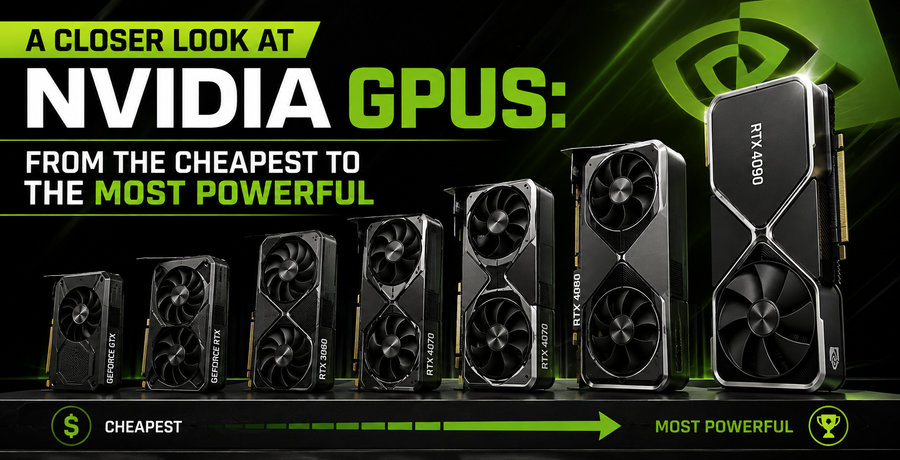

Choosing an NVIDIA graphics card can feel confusing because the company offers GPUs across dramatically different price and performance levels. A budget model may be designed mainly for 1080p gaming, while a flagship card can handle demanding 4K gaming, ray tracing, AI workloads, 3D rendering, and professional content creation. 🚀
For this guide, we’ll focus primarily on NVIDIA’s desktop GeForce RTX 50-series, moving from the least expensive models toward the fastest consumer gaming GPU in the family.
Pricing note: GPU street prices change constantly depending on region, availability, manufacturer, and promotions. Because live web search is unavailable here, the prices below should be treated as launch/reference pricing rather than verified August 2026 store prices. There may also be newer refreshes or regional variants not reflected here.
🟢 Understanding NVIDIA’s GPU Naming System
Before comparing the cards, NVIDIA’s naming system is worth understanding.
Consider a card such as the GeForce RTX 5070 Ti.
- 50 represents the GPU generation.
- 70 represents its approximate performance tier.
- Ti usually indicates a faster version of the standard model.
Generally, within the same generation:
RTX 5050 < RTX 5060 < RTX 5060 Ti < RTX 5070 < RTX 5070 Ti < RTX 5080 < RTX 5090
Higher numbers normally mean more processing power, greater memory bandwidth, stronger ray-tracing performance, and a higher price.
Let’s examine them one by one. 👇
1. NVIDIA GeForce RTX 5050 💰
Approximate launch positioning: $249
The RTX 5050 sits near the entry point of NVIDIA’s RTX 50-series desktop lineup.
It is designed primarily for gamers who want access to modern NVIDIA technologies without spending several hundred dollars on a graphics card.
The RTX 5050 is best suited to:
- 1080p gaming 🎮
- Competitive esports
- Older AAA games
- Light video editing
- Entry-level 3D work
- AI-assisted graphics features
It generally comes with 8GB of VRAM, which is enough for many games at 1080p, although demanding modern titles with extremely high-resolution textures can push beyond 8GB.
One interesting difference is that the RTX 5050 uses GDDR6 memory, whereas the more expensive cards in the RTX 50 family largely move to faster GDDR7.
🏆 Best for:
Budget gamers who want NVIDIA features such as ray tracing and DLSS without paying mid-range GPU prices.
⚠️ Main limitation:
8GB of VRAM and entry-level processing power make it less suitable for maximum-quality 1440p or 4K gaming.
2. NVIDIA GeForce RTX 5060 ⚡
Approximate launch positioning: $299
The RTX 5060 represents a significant step above the 5050 while remaining relatively affordable.
This is the type of GPU aimed at mainstream PC gamers who primarily use 1080p monitors but may occasionally play at 1440p.
Compared with the RTX 5050, it offers substantially greater graphics processing capability and uses faster GDDR7 memory.
The RTX 5060 is particularly attractive for games where technologies such as DLSS can improve performance.
Ideal gaming targets:
🎯 1080p — Excellent
🎯 1440p — Good with optimized settings
🎯 4K — Generally not its intended target
The biggest criticism of this performance tier is still its typical 8GB VRAM capacity.
While 8GB can work perfectly well in many games, increasingly detailed textures and ray-tracing workloads can make additional VRAM valuable.
🏆 Best for:
Mainstream 1080p gaming and esports players looking for good performance per dollar.
3. NVIDIA GeForce RTX 5060 Ti 🔥
Approximate launch positioning:
8GB version: around $379
16GB version: around $429
The RTX 5060 Ti is where NVIDIA’s lineup becomes especially interesting.
It delivers more GPU processing power than the RTX 5060 while being available in configurations with substantially more graphics memory.
The 16GB model is particularly useful for users interested in more than gaming.
For example, extra VRAM can benefit:
- 🎬 Video editing
- 🧊 Blender rendering
- 🤖 Local AI models
- 🎨 Generative AI applications
- 🕹️ Heavily modded games
- 🖼️ High-resolution textures
For gaming alone, the performance difference between the 8GB and 16GB versions isn’t necessarily proportional to the memory difference. However, games that exceed 8GB of memory can behave considerably better on the larger model.
Gaming target:
High-refresh-rate 1080p and capable 1440p gaming.
🏆 Best for:
Gamers who want stronger longevity than an entry-level card without moving into expensive enthusiast hardware.
4. NVIDIA GeForce RTX 5070 🎯
Approximate launch positioning: $549
The RTX 5070 enters the serious 1440p gaming category.
Instead of simply targeting playable frame rates, this tier is intended for people using high-refresh-rate monitors and demanding graphical settings.
It typically includes 12GB of GDDR7 memory, giving it more room for high-quality textures than the 8GB cards below it.
For many gamers, this class represents a practical balance between extreme performance and reasonable power requirements.
Games featuring heavy ray tracing also benefit from NVIDIA technologies such as:
- DLSS Super Resolution
- Ray Reconstruction
- Frame Generation
- Multi Frame Generation on supported RTX 50-series hardware
These technologies use AI to reconstruct images and generate additional frames, significantly increasing perceived frame rates in compatible games. 🤖🎮
Gaming target:
✅ 1080p ultra/high-refresh
✅ 1440p high or ultra
⚠️ 4K possible with DLSS and optimized settings
🏆 Best for:
Gamers looking for a powerful 1440p system without paying flagship prices.
5. NVIDIA GeForce RTX 5070 Ti 🚀
Approximate launch positioning: $749
The jump from the 5070 to the 5070 Ti is more substantial than the name might initially suggest.
This card typically features 16GB of GDDR7 VRAM, making it considerably better prepared for intensive gaming and creator workloads.
The additional memory is useful when working with:
- 4K textures
- High-resolution video
- Complex 3D scenes
- AI inference
- Large creative projects
The RTX 5070 Ti sits in an appealing position because it begins approaching high-end GPU performance without reaching the extreme cost and power requirements of the flagship 5090.
Gaming target:
🔥 Excellent 1440p
🔥 Strong 4K
🔥 High ray-tracing settings with DLSS
For many enthusiasts, this tier may provide a more sensible high-end gaming configuration than buying the most expensive GPU available.
🏆 Best for:
Enthusiast gamers who want powerful 1440p and 4K performance while keeping 16GB of VRAM available for future games.
6. NVIDIA GeForce RTX 5080 🏎️
Approximate launch positioning: $999
The RTX 5080 is firmly a high-end graphics card.
It targets gamers who want excellent 4K gaming without stepping all the way up to NVIDIA’s enormous flagship GPU.
The RTX 5080 comes with approximately 16GB of GDDR7 memory and significantly greater processing capability than lower-tier models.
It is particularly well suited for visually demanding games using:
✨ Path tracing
✨ Ray tracing
✨ Ultra-resolution textures
✨ High refresh rates
✨ DLSS 4 technologies
A card at this level also becomes highly capable for professional-style workloads such as Blender, DaVinci Resolve, Adobe applications, and GPU-accelerated rendering.
Gaming target:
✅ 1440p extremely high refresh rates
✅ 4K ultra settings
✅ Heavy ray tracing
✅ VR gaming
🏆 Best for:
High-end 4K gaming systems where performance is more important than budget.
7. NVIDIA GeForce RTX 5090 👑
Approximate launch positioning: $1,999
At the top of the GeForce RTX 50-series sits the monster: RTX 5090.
This card is not simply a slightly faster 5080.
It moves into an entirely different class of hardware.
The RTX 5090 provides approximately 32GB of GDDR7 VRAM, enormous memory bandwidth, thousands of CUDA processing cores, advanced Tensor Cores, and extremely powerful ray-tracing hardware.
It is built for users who want maximum GPU performance regardless of cost.
What can an RTX 5090 handle?
🎮 Extreme 4K gaming
🌈 Path-traced games
🖥️ Very high refresh-rate displays
🎬 8K video workflows
🧊 Professional 3D rendering
🤖 Local AI workloads
🏗️ CAD and visualization
🎨 Advanced content creation
The huge 32GB memory capacity is especially valuable for AI and professional rendering workloads.
However, all that performance creates another challenge:
⚡ Power consumption
The RTX 5090 can consume roughly 575 watts by itself under heavy workloads.
That means a system containing one requires a powerful PSU, strong airflow, sufficient case space, and appropriate power connectors.
High-end RTX 5090 cards can also be physically enormous. 🧱
🏆 Best for:
Users who simply want the fastest consumer NVIDIA gaming GPU available from this generation and are willing to pay heavily for it.
📊 NVIDIA RTX 50-Series Hierarchy
| GPU | Launch Price* | VRAM | Best Gaming Target |
|---|---|---|---|
| RTX 5050 | ~$249 | 8GB | 1080p |
| RTX 5060 | ~$299 | 8GB | 1080p |
| RTX 5060 Ti | ~$379–429 | 8GB / 16GB | 1080p / 1440p |
| RTX 5070 | ~$549 | 12GB | 1440p |
| RTX 5070 Ti | ~$749 | 16GB | 1440p / 4K |
| RTX 5080 | ~$999 | 16GB | 4K |
| RTX 5090 | ~$1,999 | 32GB | Extreme 4K / AI / Rendering |
*Launch/reference pricing rather than guaranteed current retail pricing.
🧠 What Are CUDA Cores?
One specification commonly listed on NVIDIA GPUs is the number of CUDA cores.
CUDA cores are parallel processing units used for graphics calculations and other GPU workloads.
More CUDA cores generally contribute to higher performance, although CUDA-core counts should not be used to compare GPUs from very different architectures by themselves.
GPU performance also depends on factors such as:
- Architecture
- Clock speed
- Memory bandwidth
- Cache
- Tensor Cores
- RT Cores
- Power limits
- Software optimization
Therefore, a GPU should always be evaluated using actual workload benchmarks rather than a single specification. 📊
🌈 What Are RT Cores?
NVIDIA’s RT Cores are specialized processors designed to accelerate ray-tracing calculations.
Ray tracing simulates how light interacts with objects inside a scene.
It can create much more realistic:
💡 Lighting
🪞 Reflections
🌑 Shadows
💎 Transparency
🌆 Global illumination
The downside is that ray tracing is computationally expensive.
That’s why NVIDIA combines RT hardware with technologies such as DLSS.
🤖 Why Tensor Cores Matter
Tensor Cores are NVIDIA processors designed primarily for artificial-intelligence calculations.
They help power features such as DLSS, but their usefulness extends beyond gaming.
Applications can use NVIDIA GPUs for:
- Machine learning
- Generative AI
- Image generation
- Language models
- Scientific computing
- Video enhancement
This is one reason powerful NVIDIA GPUs have become popular beyond the gaming community.
📈 Which NVIDIA GPU Tier Makes the Most Sense?
The fastest GPU isn’t automatically the best GPU.
Someone playing Counter-Strike, Valorant, Fortnite, or similar games at 1080p probably doesn’t need an RTX 5090.
Likewise, someone training AI models or rendering enormous Blender scenes may quickly encounter the limitations of an 8GB graphics card.
A simple way of thinking about the lineup is:
💰 Budget gaming: RTX 5050
🎮 Mainstream gaming: RTX 5060
⚡ Performance/value tier: RTX 5060 Ti
🎯 Serious 1440p gaming: RTX 5070
🚀 High-end enthusiast: RTX 5070 Ti
🏎️ Premium 4K: RTX 5080
👑 Maximum consumer performance: RTX 5090
🕰️ What About RTX 30- and RTX 40-Series Cards?
Older NVIDIA cards haven’t suddenly become useless.
GPUs such as the:
RTX 3060, RTX 3070, RTX 3080, RTX 3090, RTX 4060, RTX 4070, RTX 4080, and RTX 4090
can still deliver excellent performance.
A discounted or used older GPU may sometimes offer better value than a brand-new entry-level model.
However, buyers should consider differences in:
🔧 Warranty
⚡ Power efficiency
🤖 DLSS feature support
🧠 AI performance
📦 VRAM capacity
🛠️ Driver longevity
💰 Used-market pricing
For example, an older high-end GPU may outperform a new budget GPU in traditional rendering while consuming substantially more electricity.
🏁 Final Thoughts
NVIDIA’s GPU range stretches from relatively affordable 1080p cards to astonishingly powerful processors capable of gaming, rendering, and AI computation.
The RTX 5050 and 5060 focus on accessible gaming. The 5060 Ti and 5070 move into stronger 1440p performance. The 5070 Ti and 5080 target enthusiasts and 4K players.
Then there is the RTX 5090. 👑
With massive processing power and 32GB of graphics memory, it represents the extreme end of NVIDIA’s consumer GPU strategy. But its enormous price and power requirements mean it makes sense for only a relatively small group of users.
For most buyers, the smartest GPU isn’t the fastest one—it is the card that matches their monitor resolution, games, applications, power supply, and budget.
That makes understanding NVIDIA’s hierarchy far more useful than simply buying the GPU with the biggest number. 🎮🧠