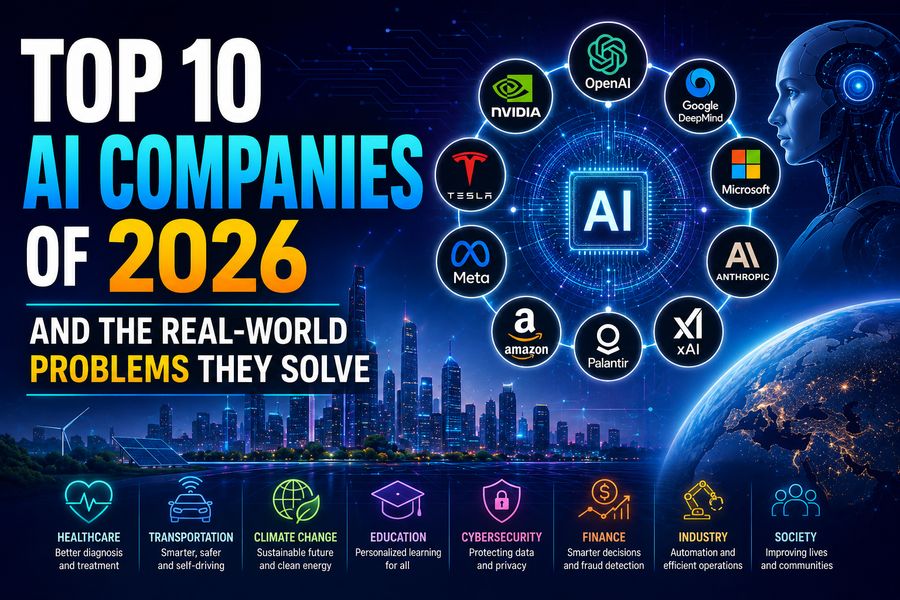

Artificial intelligence has moved far beyond experimental chatbots and research laboratories. In 2026, AI is increasingly being used to write software, analyze medical information, automate customer service, optimize supply chains, generate videos, assist scientific research, improve cybersecurity, and operate intelligent machines. 🌍⚙️
Some companies focus on building powerful foundation models, while others specialize in AI infrastructure, enterprise software, robotics, cloud computing, or autonomous systems.
Because company leadership, product releases, valuations, and market positions can change rapidly, the following should be understood as an editorial list of ten major AI companies shaping the industry in 2026, rather than a definitive live ranking.
More importantly, instead of focusing only on model benchmarks or company valuations, this article looks at a more practical question:
What real-world problems are these AI companies actually trying to solve? 🧠✨
🥇 1. OpenAI
OpenAI is one of the most influential companies in generative artificial intelligence.
Its AI systems are designed to understand and generate text, analyze information, write and debug code, reason across complex tasks, work with images, and assist users with a wide variety of professional and everyday activities.
🌍 Real-World Problems OpenAI Helps Solve
💻 Software Development
AI coding assistants can help programmers:
- Generate code
- Explain unfamiliar code
- Debug software
- Write tests
- Refactor applications
- Create prototypes faster
This can reduce the time required to develop software and help smaller teams build more sophisticated products.
📚 Knowledge Work
Professionals frequently spend large amounts of time:
- Summarizing documents
- Drafting reports
- Analyzing information
- Preparing presentations
- Organizing research
- Writing communications
AI assistants can automate or accelerate many of these repetitive cognitive tasks.
🎓 Education
AI can provide:
- Personalized explanations
- Interactive tutoring
- Practice questions
- Language assistance
- Study support
The major challenge is ensuring students use AI to improve understanding rather than simply bypass learning.
🏢 Business Productivity
Organizations can use AI assistants for internal knowledge retrieval, customer service, document analysis, workflow automation, and data interpretation.
Core problem being addressed: Making advanced AI reasoning and generation accessible for everyday work.
🥈 2. Google DeepMind
Google DeepMind combines advanced AI research with Google’s enormous computing, data, cloud, and consumer technology ecosystem.
Its work covers areas such as:
- Large language models
- Scientific AI
- Medical research
- Robotics
- Mathematics
- Weather prediction
- Video generation
One of its most important contributions has been demonstrating that AI can help solve problems beyond traditional software automation.
🧬 Real-World Problem: Understanding Biology
Protein structure is fundamental to biology and medicine.
Determining how proteins fold has traditionally been a difficult and time-consuming scientific problem.
AI systems developed by DeepMind have helped researchers predict protein structures, giving scientists new tools for studying:
- Diseases
- Drug targets
- Enzymes
- Molecular interactions
🌦️ Weather Prediction
AI-based forecasting methods are also being explored to improve weather prediction.
More accurate forecasts can support:
- Agriculture
- Disaster preparation
- Renewable energy management
- Aviation
- Shipping
🎥 Generative Media
Google’s AI ecosystem also includes technologies capable of generating images, video, text, and multimedia content.
Core problem being addressed: Applying AI to scientific discovery, information access, and large-scale digital productivity.
🥉 3. Microsoft
Microsoft is one of the world’s largest technology companies and has made AI a central part of its software and cloud strategy.
Rather than treating AI as a standalone application, Microsoft has been integrating AI capabilities into productivity software, developer tools, cybersecurity platforms, and enterprise systems.
🏢 Real-World Problem: Workplace Productivity
Millions of employees spend significant time working with:
- Emails
- Spreadsheets
- Documents
- Meetings
- Presentations
- Business databases
AI can help automate portions of this workload.
For example, enterprise AI systems may:
- Summarize meetings
- Generate reports
- Analyze spreadsheets
- Draft documents
- Retrieve internal company information
- Create presentations
🛡️ Cybersecurity
Security teams often face thousands of alerts every day.
AI can help prioritize suspicious activity and identify patterns associated with:
- Malware
- Account compromise
- Network attacks
- Fraud
☁️ Cloud AI Infrastructure
Microsoft also provides cloud infrastructure that companies can use to build and operate their own AI applications.
Core problem being addressed: Bringing AI directly into enterprise productivity and business workflows.
🧠 4. Anthropic
Anthropic is an AI company focused heavily on advanced language models and AI safety.
Its Claude family of AI systems is used for applications such as:
- Writing
- Coding
- Research
- Document analysis
- Enterprise knowledge work
Anthropic has placed significant emphasis on making AI systems more predictable, controllable, and suitable for professional use.
📄 Real-World Problem: Processing Large Amounts of Information
Organizations often have thousands or millions of documents.
These may include:
- Legal contracts
- Financial reports
- Technical manuals
- Research papers
- Internal policies
Finding important information manually can require enormous amounts of human effort.
AI systems capable of analyzing long documents can help professionals:
- Summarize information
- Compare documents
- Extract important clauses
- Identify inconsistencies
- Answer questions about internal data
💻 Programming Assistance
AI coding systems can also help developers understand large software repositories and produce code more efficiently.
Core problem being addressed: Helping organizations reason over complex information while emphasizing safer AI behavior.
🎮 5. NVIDIA
NVIDIA occupies a unique position in the AI industry.
While many companies develop AI software, NVIDIA provides much of the computing hardware and software infrastructure used to train and run advanced AI models.
Its graphics processing units, or GPUs, have become fundamental to modern artificial intelligence.
⚡ Real-World Problem: AI Requires Enormous Computing Power
Training advanced AI systems requires massive numbers of mathematical calculations.
Traditional computer processors are often inefficient for these workloads.
GPUs can perform many calculations simultaneously, making them particularly useful for:
- Neural-network training
- AI inference
- Scientific simulations
- Computer vision
- Generative AI
🏭 Industrial AI
NVIDIA technology is also used in:
- Robotics
- Manufacturing
- Autonomous machines
- Digital twins
- Engineering simulations
A factory, for example, can create a digital simulation of its production line before making expensive physical changes.
🚗 Autonomous Vehicles
AI computing platforms can process information from:
- Cameras
- Radar
- Other sensors
to help vehicles understand their surroundings.
Core problem being addressed: Providing the computing infrastructure that allows modern AI systems to exist and scale.
🌐 6. Meta
Meta has become an important AI company through its research, recommendation systems, generative AI, and open-model ecosystem.
AI already plays a major role across social platforms by helping determine what content users see.
📱 Real-World Problem: Understanding Massive Volumes of Content
Online platforms receive extraordinary amounts of:
- Text
- Images
- Videos
- Comments
- Advertising content
AI can help:
- Recommend relevant posts
- Detect spam
- Identify harmful content
- Translate languages
- Rank advertisements
- Assist creators
🌍 Language Translation
Automatic translation can reduce communication barriers between people who speak different languages.
AI translation systems are particularly valuable on global communication platforms.
🧠 Open AI Development
Meta’s release of open-weight AI models has also allowed researchers and developers to build customized AI systems without developing foundation models from the beginning.
Core problem being addressed: Making communication, content discovery, and AI development more scalable.
☁️ 7. Amazon Web Services
Amazon is deeply involved in AI through its cloud-computing division, Amazon Web Services, commonly called AWS.
Many businesses want to use AI but do not have the infrastructure required to train and operate large models.
AWS provides cloud services that help organizations deploy AI without building their own data centers.
🏢 Real-World Problem: Making AI Available to Businesses
A company may want AI for:
- Customer support
- Product recommendations
- Document processing
- Fraud detection
- Forecasting
- Software development
Instead of purchasing huge amounts of computing hardware, businesses can use cloud AI infrastructure.
📦 Supply-Chain Optimization
Amazon itself uses advanced algorithms across areas such as:
- Inventory forecasting
- Warehouse operations
- Delivery planning
- Product recommendations
AI can help predict what customers are likely to purchase and where inventory should be located.
🛒 Recommendation Systems
Machine-learning systems help match customers with relevant products.
Core problem being addressed: Giving businesses scalable access to AI infrastructure and machine-learning services.
🚀 8. xAI
xAI is an artificial intelligence company focused on developing large-scale AI models and systems capable of reasoning across substantial amounts of information.
Its work reflects growing competition among companies attempting to build increasingly capable AI assistants.
🔎 Real-World Problem: Navigating Information Overload
The modern internet produces more information than any individual can realistically process.
AI assistants can help users:
- Summarize complex subjects
- Compare arguments
- Analyze data
- Interpret documents
- Generate explanations
🧠 AI Reasoning
Advanced models are increasingly expected to perform multi-step reasoning rather than simply predicting short pieces of text.
This can support applications involving:
- Mathematics
- Software development
- Research
- Business analysis
⚡ Large-Scale AI Computing
xAI has also emphasized large computing systems for training advanced models.
Core problem being addressed: Building AI systems capable of rapidly analyzing and reasoning across enormous amounts of information.
💼 9. IBM
IBM has been involved in artificial intelligence for decades.
While newer AI companies often receive more attention for consumer chatbots, IBM has concentrated heavily on enterprise AI.
Its technologies are frequently aimed at businesses operating in highly regulated environments.
🏦 Real-World Problem: Using AI in Large Organizations
Banks, healthcare companies, manufacturers, and government organizations need AI systems that can operate within complicated rules.
Enterprise AI must address issues such as:
- Data privacy
- Governance
- Auditing
- Security
- Model monitoring
- Regulatory compliance
🔧 Predictive Maintenance
Industrial companies can use sensors and AI to predict when machinery may fail.
Instead of waiting for equipment to break, maintenance can be scheduled beforehand.
This can reduce:
- Downtime
- Repair costs
- Production interruptions
📊 Business Automation
IBM’s enterprise technologies can also support document processing, customer service, analytics, and workflow automation.
Core problem being addressed: Making AI practical and governable for large enterprises and regulated industries.
🇫🇷 10. Mistral AI
Mistral AI has emerged as a significant European participant in the generative AI industry.
The company focuses on efficient language models and enterprise AI solutions.
One reason companies such as Mistral are important is that businesses increasingly want more choices over where and how their AI systems are deployed.
🔐 Real-World Problem: Data Control and AI Flexibility
Some companies cannot send sensitive information to arbitrary third-party services.
Industries such as:
- Banking
- Government
- Healthcare
- Defense
- Legal services
may require greater control over data and model deployment.
Flexible AI systems can potentially be deployed in environments where organizations maintain tighter control over infrastructure.
⚡ Efficient AI Models
Not every business needs the largest AI model available.
Smaller, more efficient models may offer:
- Lower computing costs
- Faster responses
- Easier deployment
- Greater privacy
Core problem being addressed: Providing efficient and flexible AI systems for organizations requiring greater deployment control.
📊 Top 10 AI Companies and the Problems They Solve
| AI Company | Major AI Focus | Real-World Problem |
|---|---|---|
| OpenAI | General-purpose generative AI | Automating knowledge work and software development |
| Google DeepMind | AI research and scientific AI | Scientific discovery, weather, biology and information |
| Microsoft | Enterprise AI and cloud | Improving workplace productivity |
| Anthropic | Language models and AI safety | Processing complex documents and knowledge |
| NVIDIA | AI chips and infrastructure | Providing computing power for AI |
| Meta | AI models and recommendation systems | Content discovery, communication and translation |
| Amazon AWS | Cloud AI | Making AI infrastructure accessible to businesses |
| xAI | Advanced AI models | Understanding and reasoning across large information volumes |
| IBM | Enterprise AI | Governed AI for regulated organizations |
| Mistral AI | Efficient language models | Flexible and private enterprise AI deployment |
🏥 What Industries Are AI Companies Transforming?
The influence of these companies extends into nearly every major industry.
🧬 Healthcare
AI is helping researchers and healthcare organizations with:
- Medical imaging analysis
- Drug discovery
- Patient documentation
- Clinical research
- Administrative automation
AI should support healthcare professionals rather than replace qualified medical judgment.
💻 Software Engineering
AI coding assistants can reduce the time required to:
- Generate software
- Debug applications
- Write documentation
- Build prototypes
This may significantly change how programmers work.
🏭 Manufacturing
Industrial AI can monitor machinery and detect signs of failure.
Predictive systems can help factories avoid costly equipment breakdowns.
🚚 Logistics
AI can optimize:
- Delivery routes
- Inventory
- Warehouses
- Shipping schedules
- Demand forecasting
Even small efficiency improvements can create enormous savings at global scale.
💰 Finance
Financial institutions use machine learning for:
- Fraud detection
- Risk analysis
- Customer support
- Document processing
🎓 Education
AI tutoring systems can provide explanations adapted to individual learners.
They may help make high-quality educational support more accessible.
🔬 Scientific Research
AI is increasingly being used to analyze scientific datasets, simulate physical systems, predict molecular structures, and help researchers identify promising experiments.
🤔 What Makes an AI Company Important in 2026?
The most important AI companies are not necessarily those with the largest chatbot.
Several factors matter.
🧠 Model Capability
How effectively can the AI reason, write, analyze, and solve problems?
⚡ Computing Infrastructure
Can the company operate AI at global scale?
🏢 Enterprise Adoption
Are companies actually using the technology in everyday operations?
🔬 Research Impact
Is the company advancing science or AI engineering?
💰 Cost Efficiency
Can organizations afford to deploy the technology?
🛡️ Safety and Reliability
Can AI systems behave predictably enough for important applications?
🌍 Real-World Impact
Most importantly, does the technology solve meaningful problems?
⚠️ Major Challenges Facing AI Companies
Despite rapid progress, the AI industry faces serious challenges.
❌ AI Hallucinations
Generative AI can sometimes produce incorrect information confidently.
This is particularly problematic in medicine, law, engineering, and finance.
🔐 Privacy
AI systems may process sensitive personal or corporate information.
Strong privacy protections are therefore essential.
🛡️ Cybersecurity
AI can improve cybersecurity, but attackers can also use AI to create more sophisticated scams and automated attacks.
⚖️ Regulation
Governments are developing new rules for AI safety, transparency, copyright, and accountability.
Companies operating globally must navigate different regulatory environments.
⚡ Energy Consumption
Large AI data centers require considerable electricity.
Improving hardware and model efficiency will be increasingly important.
👷 Workforce Disruption
AI can automate parts of many jobs.
The challenge is ensuring that productivity improvements are accompanied by new skills, training, and employment opportunities.
🔮 Where Is the AI Industry Heading Next?
AI development is increasingly moving beyond simple text chat.
Several major trends are becoming important.
🎥 Multimodal AI
AI systems can increasingly understand combinations of:
- Text
- Images
- Audio
- Video
- Data
🤖 AI Agents
AI agents are designed to complete multi-step tasks rather than simply answer individual questions.
An agent might:
Read an email → Research information → Update a spreadsheet → Draft a response → Prepare a report
🦾 Robotics
Combining advanced AI with robots could transform:
- Warehouses
- Manufacturing
- Agriculture
- Healthcare
- Home assistance
🔬 AI for Science
One of the biggest long-term opportunities may be using AI to accelerate discoveries in:
- Medicine
- Chemistry
- Materials science
- Physics
- Climate research
❓ Frequently Asked Questions
Which company is the biggest AI company in 2026?
There is no single universally accepted definition of “biggest.” Companies can be ranked by revenue, valuation, model capability, infrastructure, research influence, or enterprise adoption. OpenAI, Google, Microsoft, NVIDIA, Anthropic, and other major technology companies are among the most influential participants in modern AI.
Why is NVIDIA considered an AI company?
NVIDIA produces GPUs and computing platforms used to train and operate many advanced AI systems. Without high-performance computing hardware, modern generative AI would be extremely difficult to scale.
Which AI companies focus on business applications?
Microsoft, IBM, Amazon AWS, Anthropic, OpenAI, and Mistral AI all provide technologies that can be applied to enterprise workflows.
Which AI company focuses most on scientific research?
Google DeepMind is particularly well known for applying AI to scientific problems, including biology and other research areas.
Will AI companies replace human jobs?
AI is likely to automate certain tasks rather than simply eliminate entire professions. Many jobs may change as workers increasingly use AI tools. Some roles may decline while new roles and specialties emerge.
What is the biggest real-world benefit of AI?
One of AI’s largest potential benefits is increasing human productivity by helping people analyze information, automate repetitive tasks, make discoveries, and solve problems more quickly.
🎯 Conclusion
The most important AI companies of 2026 are not simply competing to build the smartest chatbot. They are building technologies that could reshape how the world develops software, conducts scientific research, runs businesses, operates factories, manages supply chains, protects computer networks, and communicates information. 🤖🌍
OpenAI is expanding general-purpose AI assistance. Google DeepMind is pushing AI into scientific discovery. Microsoft is integrating AI deeply into workplace software. Anthropic is focusing on capable and controllable language models. NVIDIA provides much of the computing infrastructure behind the AI revolution.
Meanwhile, Meta is bringing AI to large-scale communication and open-model development, Amazon AWS provides cloud infrastructure for businesses, xAI is pursuing increasingly capable reasoning systems, IBM focuses on governed enterprise AI, and Mistral AI represents growing demand for efficient and flexible AI deployment.
The biggest question for the next phase of artificial intelligence will not simply be:
“Which company has the most powerful AI?”
A more meaningful question is:
“Which companies can use AI to solve valuable real-world problems safely, efficiently, and at scale?” 🌟
That will ultimately determine which AI companies have the greatest long-term impact.