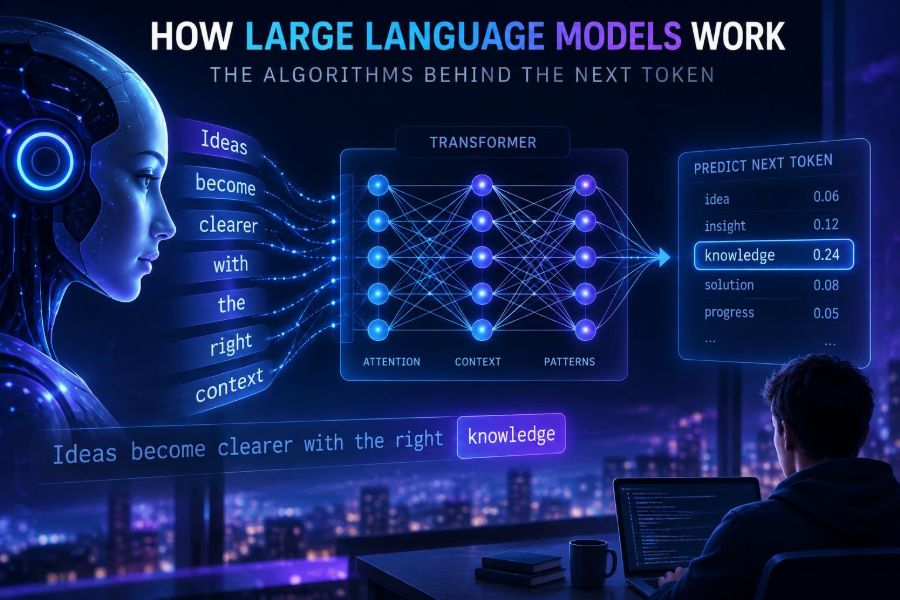

Large language models now sit inside chat assistants, coding tools, search experiences, creative software, and internal business workflows. Their answers can seem remarkably human, but the core operation is more specific: repeatedly estimate which small piece of text is most likely to come next.
That simple-sounding task connects several powerful ideas: tokenization, vector representations, neural networks, attention, probability distributions, and sampling. Understanding the pipeline makes AI outputs less mysterious and makes you much better at prompting, evaluating, and building with models.
This matters now because language models are increasingly used as components rather than just chatbots. Developers route documents into them, request structured data, connect tools, and build agents around them. Creators and professionals need to know where fluent output is reliable, where it can fail, and how to guide it.
By the end, you will be able to explain next-token prediction in plain language, inspect the choices that shape an answer, write prompts that reduce ambiguity, and prototype a small predictive text system with code.
🧩 1. Start With the Central Idea: Predict One Token
A large language model, or LLM, receives a sequence of tokens and calculates a probability for each possible next token. It then selects or samples one candidate, appends it to the sequence, and repeats.
For the partial sentence “The capital of France is”, a model may place high probability on the token representing “ Paris”. Once that token is generated, it predicts again, perhaps selecting punctuation or the first word of a following explanation.
input:  "The capital of France is"
predict: " Paris"
new input: "The capital of France is Paris"
predict: "."
The model does not generate a complete answer in a single indivisible act. A paragraph is a chain of many local decisions, each conditioned on the tokens already present.
🔤 2. Tokens Are Not Quite Words
A token is the unit an LLM reads and emits. Depending on the tokenizer, a token can be a whole common word, part of a long word, a space-plus-word fragment, punctuation, a digit sequence, or code syntax.
This choice lets a model handle an open-ended vocabulary without storing every possible spelling as one separate unit. It can combine pieces to represent unfamiliar names, technical terminology, typos, and many languages.
- Common text may be represented by relatively few tokens.
- Unusual words, compact code, and certain languages may split into more tokens.
- Whitespace and punctuation can matter because they affect token boundaries.
- A model has a fixed context window: the maximum token sequence it can consider at once.
Do not assume “one word equals one token.” When building applications, use the tokenizer associated with your chosen model to estimate context usage and cost. Tokenization behavior varies across model families, so check the provider’s official documentation.
🔢 3. Turn Text Into Integer IDs
Neural networks operate on numbers, not characters. The tokenizer first maps each token to an integer from a vocabulary, a curated collection of token pieces.
text:       "AI writes code"
tokens:     ["AI", " writes", " code"]
token IDs:  [421, 9876, 2011]
The IDs have no numerical meaning by themselves. Token 9876 is not semantically “larger” than token 2011; it is simply an index that lets software retrieve learned parameters efficiently.
A common mistake is to think the model receives letters one by one or reads a dictionary definition at generation time. It receives token IDs and uses patterns learned during training.
🧭 4. Convert IDs Into Meaningful Vectors
Each token ID retrieves an embedding: a dense vector of learned numbers. During training, the model adjusts these values so its internal geometry captures useful relationships among contexts, concepts, styles, and syntax.
An embedding is not a hand-written label such as “this is a noun.” Instead, it is a distributed representation. Meaning is encoded across many dimensions and through how vectors interact inside the network.
# Illustrative pseudocode
embedding_table = learned_matrix[vocabulary_size][hidden_size]
vector = embedding_table[token_id]
At this point, a token vector represents the token itself, but not its location. The word “bank” needs surrounding context to distinguish a riverbank from a financial institution, and order changes meaning too.
📍 5. Add Position So Order Has Meaning
Language is ordered. “Dog bites person” and “person bites dog” use the same words but say different things. LLMs therefore add position information to token representations.
Modern architectures use several approaches, including learned positional vectors and position-aware rotations inside attention. The implementation differs, but the goal is consistent: give the model a way to reason about relative and absolute placement.
- Position helps models follow grammar and narrative sequence.
- Relative distance can influence which earlier facts are useful.
- Very long contexts remain challenging even when technically supported.
For users, the practical lesson is simple: put critical instructions clearly in the prompt, repeat essential constraints near the requested output when appropriate, and avoid burying key information in a huge unstructured paste.
🏗️ 6. Meet the Transformer Architecture
Most modern LLMs are based on the Transformer, an architecture built from repeated processing layers. Each layer refines the representation of every token by combining information from other relevant tokens and transforming the result.
For next-token generation, a decoder-style Transformer uses causal masking. A position can attend to tokens before it, but not future tokens. Without that restriction, training would accidentally reveal the answer.
Visible while predicting token 4:
[token 1] [token 2] [token 3] [token 4]
   yes       yes       yes       no future tokens
This masking is why an LLM can be trained on complete documents while still learning the same left-to-right prediction behavior used at inference time.
🔍 7. Attention Decides What to Consult
Attention lets each token representation weigh information from earlier tokens. When processing the end of “Maya put the telescope in the case because it was fragile,” a model can learn to examine words that help resolve what “it” refers to.
Within an attention mechanism, each token produces three learned projections: a query, a key, and a value. A query from the current position is compared with keys from eligible earlier positions. The resulting scores become weights applied to values.
attention_weights = softmax((Q × Kᵀ) / scale + causal_mask)
context_vectors   = attention_weights × V
The formula is compact, but its effect is powerful: it gives the network a content-dependent way to retrieve information from its working context. Attention weights are useful clues, but they are not a complete or guaranteed explanation of a model’s reasoning.
🧠 8. Multi-Head Attention Looks in Several Ways
One attention calculation may capture one type of relationship. Multi-head attention runs several attention projections in parallel, then combines them.
Different heads can specialize in patterns such as nearby syntax, matching brackets in code, references to earlier entities, formatting conventions, or broad topical links. These patterns are learned, not manually assigned.
| Component | Practical job | What it helps capture |
|---|---|---|
| Token embedding | Represents the input piece | Basic lexical and semantic signals |
| Position information | Represents order and distance | Sequence structure |
| Attention heads | Retrieve relevant context | References, dependencies, patterns |
| Feed-forward network | Transforms each position | Features and nonlinear combinations |
More heads do not automatically mean a better model. Architecture, data quality, training objectives, optimization, and post-training all work together.
⚙️ 9. Feed-Forward Layers Transform What Attention Finds
After attention mixes contextual information, each position passes through a feed-forward network, often called an MLP. It applies learned linear transformations and nonlinear activations to build more useful features.
Attention is often described as the mechanism that moves information between positions. Feed-forward layers do much of the per-token computation that recognizes and recombines features after that information arrives.
Residual connections and normalization are also essential. They stabilize deep training and preserve useful signals as representations pass through many layers.
# Simplified layer sketch
x = x + attention(normalize(x))
x = x + feed_forward(normalize(x))
A real implementation includes details for numerical stability and efficiency, but this sketch shows the repeated pattern: normalize, transform, add the result back, and continue.
🎯 10. Logits Become a Probability Distribution
After the final Transformer layer, the model converts the last position’s hidden representation into one score for every vocabulary token. These unnormalized scores are called logits.
The softmax function converts logits into probabilities that add up to one. A high probability means the model considers a token more plausible given the current context, not that the statement containing it is factually verified.
logits:       [2.1, 0.3, 4.7]
softmax:      [0.07, 0.01, 0.92]
candidates:   [" Berlin", " Lyon", " Paris"]
This distinction explains a central limitation: a model optimizes for likely continuations based on patterns in its learned parameters and supplied context. Truthfulness needs additional support, such as good source material, retrieval, tools, validation, and careful task design.
📚 11. Training Teaches the Model by Correcting Errors
During pretraining, an LLM processes vast collections of token sequences. At each position, it predicts the next token and compares its probability distribution with the actual token that followed in the training text.
The error signal is typically measured with cross-entropy loss. If the correct token received low probability, the loss is high. Optimization algorithms adjust billions of parameters through backpropagation to make better predictions over many examples.
- Tokenize a sequence from the training data.
- Hide each future token with causal masking.
- Predict a distribution at each position.
- Measure how much probability the model assigned to the observed next token.
- Backpropagate the error and update parameters.
- Repeat across enormous numbers of sequences and batches.
Training is not a database lookup process. The model compresses statistical regularities into parameters, which can support generalization but can also produce gaps, distortions, and confident errors.
🗣️ 12. Post-Training Makes Prediction More Useful in Conversation
A base model is trained to continue text. To behave more helpfully in an assistant setting, model builders commonly use additional post-training steps based on demonstrations, preference feedback, safety policies, and task-specific evaluations.
The exact methods vary by organization and change quickly. Broadly, post-training encourages outputs that follow instructions, maintain useful formats, decline certain unsafe requests, and communicate uncertainty better.
This does not replace next-token prediction. It shapes the kinds of continuations the model prefers after it has learned general language and code patterns.
- Pretraining develops broad predictive capability.
- Instruction tuning teaches examples of desired request-response behavior.
- Preference optimization nudges outputs toward preferred responses.
- Evaluation and red-teaming expose weaknesses that require mitigation.
🎲 13. Decoding Controls Whether Output Is Steady or Surprising
After the model computes probabilities, a decoding strategy chooses the next token. This choice changes the personality of the output without changing the model’s underlying knowledge.
| Strategy | What it does | Useful for |
|---|---|---|
| Greedy decoding | Always selects the most probable token | Stable, repeatable baseline tasks |
| Temperature | Sharpens or flattens probabilities before selection | Controlling variation |
| Top-k sampling | Samples only from the k most likely candidates | Limiting unlikely detours |
| Top-p sampling | Samples from the smallest set reaching probability p | Adaptive creative generation |
Lower temperature usually makes choices more concentrated and predictable. Higher temperature increases variation, but it can also increase contradictions, invented details, and poor formatting.
# Conceptual sampling pipeline
adjusted_logits = logits / temperature
allowed = filter_top_p(adjusted_logits, p=0.9)
next_token = sample(softmax(allowed))
For extraction, classification, and code transformations, begin with conservative settings. For brainstorming, fiction, or alternate headlines, increase variation gradually and compare results.
🔁 14. Autoregression Repeats Until the Answer Is Complete
Autoregressive generation means the newly selected token becomes part of the input for the next prediction. The model is always extending its own prior output.
That loop creates an important risk: an early weak choice can influence later tokens. A mistaken premise, malformed field, or vague interpretation can compound into a polished but unhelpful response.
- Ask for an outline before a long high-stakes draft.
- Use explicit schemas for machine-consumed output.
- Validate generated data before an action is taken.
- Set sensible maximum output lengths to prevent rambling.
Generation stops when the model emits a designated stop token, reaches a length limit, or meets an application-defined stop sequence. Never assume a stopping rule proves that an answer is complete.
🧪 15. Build a Tiny Next-Token Baseline
You do not need a giant GPU cluster to understand the basic prediction loop. A frequency baseline can count which token historically follows a given token and sample from that small distribution.
from collections import defaultdict, Counter
import random

text = "models predict tokens models predict patterns"
tokens = text.split()
counts = defaultdict(Counter)

for left, right in zip(tokens, tokens[1:]):
    counts[left][right] += 1

current = "models"
choices, weights = zip(*counts[current].items())
next_word = random.choices(choices, weights=weights)[0]
print(next_word)  # likely: predict
This is not an LLM. It has almost no context, no learned semantic representation, and no ability to generalize beyond observed pairs. But it reveals the skeleton of the task: estimate a distribution over the next item.
💻 16. Inspect a Real Model’s Next-Token Candidates
Many model libraries expose tokenization and logits for local or hosted models. API names differ, so consult the official documentation for the library and model you use. The following pseudocode shows the inspection workflow.
# Pseudocode: interfaces vary by library
ids = tokenizer.encode("A neural network learns")
logits = model(ids).logits[-1]
top_ids = top_k(logits, k=5)

for token_id in top_ids:
    print(tokenizer.decode([token_id]), logits[token_id])
Run this experiment with several prompts. Compare an incomplete factual sentence, a code fragment, a poem opening, and a JSON key. You will see that the distribution reflects both grammar and the local conventions implied by the prompt.
Do not present raw logits to end users as confidence scores. They measure relative next-token preference, not the probability that a whole generated claim is correct.
📝 17. Prompt With the Prediction Process in Mind
Prompts work because they alter the context from which the next token is predicted. A clear prompt creates a strong pattern for the model to continue; a muddled prompt forces it to guess the task, audience, scope, and format.
Use this step-by-step prompt recipe:
- State the task in a direct verb-led sentence.
- Provide the necessary source material or constraints.
- Name the audience and desired level of detail.
- Specify a format that is easy to check.
- Add acceptance criteria and exclusions.
Task: Extract action items from the meeting notes below.
Audience: A project manager.
Return: A table with owner, action, due date, and confidence.
Rules: Do not invent owners or dates. Use "unknown" when absent.
Notes:
[paste notes here]
This beats “Summarize this” because it narrows the space of plausible continuations. If the answer matters, ask the model to quote the source phrase supporting each extracted field.
🧱 18. Use Structure to Make Outputs Easier to Trust
Free-form prose is flexible, but structured outputs are easier for people and software to inspect. Tell the model exactly which fields are required, what types they use, and how to represent missing information.
Return only this structure:
{
  "decision": "approve | revise | reject",
  "reasons": ["short reason"],
  "missing_information": ["item"],
  "source_evidence": ["quoted phrase"]
}

Do not add facts not present in the supplied text.
Then validate the result in your application. Parsing success is not semantic correctness: a perfectly valid JSON object can still contain an unsupported conclusion.
- Validate syntax and required fields programmatically.
- Check enumerated values against an allowlist.
- Verify citations or evidence against source text.
- Require human review for consequential decisions.
🛡️ 19. Know the Limits, Privacy Risks, and Responsibility Boundaries
Fluent writing can conceal uncertainty. LLMs can hallucinate citations, misunderstand ambiguous instructions, reproduce biases present in data, and fail on edge cases. They may also be susceptible to prompt injection when processing untrusted text.
Use extra safeguards in domains involving health, law, finance, hiring, education, security, or access to real-world systems. A model should not become the unreviewed final authority in high-impact decisions.
- Minimize personal, confidential, and proprietary data in prompts.
- Read your tool provider’s current data handling, retention, and training policies.
- Separate untrusted content from system instructions and tool permissions.
- Ground factual tasks in approved sources and verify critical claims.
- Log, test, and monitor workflows while protecting sensitive user information.
Responsible use is not only a policy layer added afterward. It is a product design practice: constrain the task, limit permissions, evaluate failure modes, and make escalation to a person easy.
🚀 20. Quick-Start Checklist
- Identify the next-token loop: tokenize, represent, attend, score, select, repeat.
- Remember that tokens are pieces of text, not necessarily words.
- Use clear context, explicit constraints, and a concrete output format.
- Choose low-variation decoding for consistency and higher variation for ideation.
- Prototype with a tiny frequency model, then inspect real-model candidates.
- Validate structured outputs before downstream automation.
- Ground high-stakes answers in trusted sources and keep human oversight.
- Review privacy and data handling before sending sensitive material.
Large language models become far more useful when you treat them not as oracles, but as probability-driven systems whose context, decoding, and safeguards you can deliberately design. 🤖✨🧠