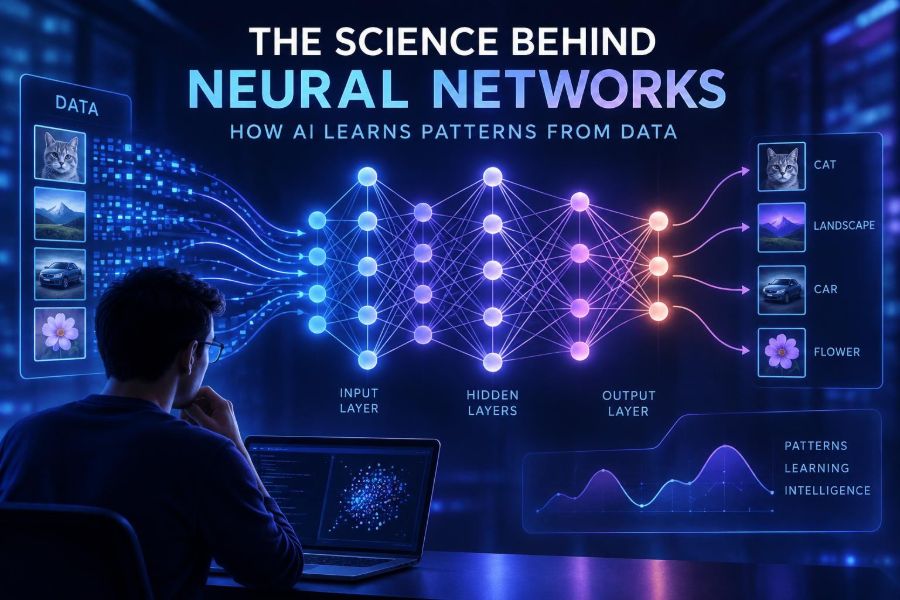

Neural networks now sit behind tools that write, translate, recommend, recognize images, detect fraud, generate media, and help developers work faster. They can feel mysterious because their results are often fluent or surprisingly accurate, yet their core learning process is built from repeatable mathematical steps.
This matters now because using AI well requires more than knowing which button to press. Whether you are evaluating an AI product, preparing data, writing an application, or training a small model, you need a practical mental model for what a network can learn, where it can fail, and how to improve it.
Neural networks do not “understand” examples in the human sense. They adjust many numerical settings so that useful patterns become easier to detect. Their strengths emerge from data, architecture, training objectives, and careful evaluation—not magic.
By the end of this guide, you will be able to explain the learning loop, recognize the role of layers, weights, activations, loss functions, and gradients, train a small classifier, diagnose common failures, and make more responsible choices about AI systems.
🧠 1. Start With the Core Idea: Pattern Mapping
A neural network is a function that transforms inputs into outputs. Give it pixels and it might return probabilities for image labels. Give it a customer’s recent activity and it might estimate whether they will cancel a subscription.
The network learns this mapping from examples. During training, it sees an input, makes a prediction, compares that prediction with a target answer, measures the error, and slightly changes internal numbers to reduce similar errors next time.
A useful abstraction is:
prediction = neural_network(input, parameters)
error = compare(prediction, target)
parameters = adjust(parameters, error)
The word parameters usually means weights and biases. Modern models may have millions or billions of them, but the central loop remains the same.
📊 2. Define the Learning Problem Before Choosing a Model
Before architecture or code, define what the system should predict and what counts as success. A vague objective creates confusing data and misleading metrics.
- Classification: choose a category, such as spam versus legitimate email.
- Regression: predict a number, such as energy demand.
- Generation: predict likely next tokens, pixels, audio frames, or actions.
- Ranking: order items, such as search results or recommendations.
Write a one-sentence task statement: “Given X available at time T, predict Y needed at time T plus one.” This simple constraint helps prevent data leakage, where the model accidentally receives information from the future.
Task: Given product details and customer behavior before purchase,
predict whether the customer will request a refund within 30 days.
🔢 3. Turn Real-World Information Into Numbers
Networks operate on tensors: structured arrays of numbers. Data preparation converts text, images, sound, tables, and events into numerical representations while preserving relevant signals.
For a simple tabular model, age may remain numeric, a country may become a categorical encoding, and a purchase history may become counts or recent averages. Image models commonly receive pixel values, while language models use token IDs that refer to pieces of text.
| Data type | Typical representation | Useful preparation |
|---|---|---|
| Tabular records | Numbers and encoded categories | Handle missing values, scale ranges |
| Images | Pixel arrays | Resize, normalize, augment carefully |
| Text | Token IDs or embeddings | Clean source data, tokenize consistently |
| Audio | Waveforms or spectral features | Trim silence, standardize sample format |
Scaling matters because very different numerical ranges can make optimization unstable. For many tabular inputs, subtracting the training-set mean and dividing by the training-set standard deviation is a sensible baseline.
⚖️ 4. Understand Neurons, Weights, and Biases
A simplified artificial neuron takes numbers, multiplies each by a weight, adds them together, adds a bias, then applies an activation function. Weights represent how strongly an input contributes to this intermediate feature.
z = w1*x1 + w2*x2 + w3*x3 + b
output = activation(z)
Imagine a network learning to recognize a house price pattern. One hidden unit may respond strongly to larger floor area and another to a favorable location encoding. These units are not guaranteed to correspond to human-friendly concepts, but their combined behavior can support a useful prediction.
A bias lets a unit shift its threshold. Without it, a neuron is more restricted in the patterns it can represent.
🏗️ 5. See Why Layers Create Useful Representations
A layer is a group of units that transforms one representation into another. Early layers can detect simpler regularities; later layers combine them into increasingly task-relevant features.
In image recognition, a model may move from local contrasts to edges, textures, parts, and finally object-level evidence. In text, representations can gradually incorporate neighboring words, sentence structure, and longer context.
This is why neural networks are called deep learning models when they contain many layers. Depth helps compose simple transformations into complex functions, although deeper is not automatically better. The right size depends on data volume, task complexity, compute limits, latency needs, and risk tolerance.
✨ 6. Add Nonlinearity With Activation Functions
If every layer only performed multiplication and addition, many stacked layers would collapse into one linear transformation. Activation functions add nonlinearity, allowing networks to model curves, interactions, boundaries, and more complex relationships.
- ReLU: returns zero for negative values and passes positive values through; common in hidden layers.
- Sigmoid: maps values between zero and one; often used for binary probabilities at an output.
- Softmax: converts several output scores into class probabilities that sum to one.
- GELU and related functions: smooth activations commonly used in transformer-style networks.
Choose output activation based on the task. A multi-class classifier where exactly one class is correct often uses softmax. A multi-label classifier, where several labels may all be correct, commonly uses independent sigmoid outputs instead.
➡️ 7. Follow a Forward Pass Step by Step
The forward pass is the journey from input to prediction. At this stage, the model does not learn; it simply applies its current parameters.
- Load one batch of encoded examples.
- Pass inputs through each layer.
- Produce raw output scores, often called logits.
- Apply the relevant output transformation.
- Return predictions and confidence values.
Suppose a classifier assigns these probabilities to an image: cat 0.72, dog 0.22, rabbit 0.06. Its top prediction is cat, but the probability distribution also tells you it has meaningful uncertainty between cat and dog.
Do not equate a model’s confidence with truth. Neural networks can be confidently wrong, especially when inputs differ from their training data.
🎯 8. Use a Loss Function to Quantify Wrongness
A loss function turns the gap between predictions and targets into a number that training can minimize. Lower loss generally means predictions better match the training objective.
For a continuous target, mean squared error penalizes large numerical mistakes. For classification, cross-entropy strongly penalizes assigning low probability to the correct class. The loss must match the meaning of the output.
# Conceptual binary classification loss
loss = -(target * log(probability) +
         (1 - target) * log(1 - probability))
Loss and business success are related but not identical. A fraud system could have strong average loss while still missing too many costly cases. Pair training loss with real decision metrics such as precision, recall, false-positive rate, revenue impact, or review workload.
⛰️ 9. Learn With Backpropagation and Gradient Descent
Training improves parameters using gradient descent. A gradient indicates how a tiny change in each parameter would change the loss. The model then moves parameters in a direction expected to reduce error.
Backpropagation efficiently computes those gradients by applying the chain rule from the output layer back through earlier layers. It is not a separate intelligence mechanism; it is an efficient accounting method for assigning responsibility for error across parameters.
# Conceptual update for one parameter
weight = weight - learning_rate * gradient
The learning rate controls step size. Too large, and training may bounce past good solutions or diverge. Too small, and learning can become painfully slow. Optimizers such as Adam adapt update behavior, but they still need thoughtful configuration and validation.
🔁 10. Learn the Vocabulary of Batches, Epochs, and Optimizers
Training data is usually split into small groups called batches. The model performs a forward pass and parameter update for each batch. One complete pass through the training set is an epoch.
| Term | What it means | Why it matters |
|---|---|---|
| Batch | A subset of training examples | Controls memory use and gradient noise |
| Epoch | One pass through training data | Useful unit for tracking learning |
| Learning rate | Parameter update size | Major factor in stability and speed |
| Optimizer | Rule for applying gradients | Influences convergence behavior |
| Checkpoint | Saved model state | Supports recovery and model selection |
Plot training and validation curves after each epoch. The plot often reveals more than a final score: stalled learning, overfitting, instability, and data pipeline errors become easier to spot.
🧪 11. Split Data Correctly to Test Generalization
A model is valuable when it works on new examples, not when it memorizes its training set. Reserve data for validation during development and a final test set for an unbiased final assessment.
- Use the training set to fit parameters.
- Use the validation set to choose settings, thresholds, and model designs.
- Use the test set once, near the end, for a final estimate.
For time-based data, split chronologically rather than randomly. For data involving the same people, documents, devices, or organizations, keep related records in the same split. Otherwise the model may effectively see near-duplicates of its test cases during training.
Common mistake: normalizing the entire dataset before splitting. Compute preprocessing statistics on training data only, then apply them to validation and test data.
🧩 12. Recognize Underfitting and Overfitting
Underfitting means the model cannot capture enough signal. Training and validation performance are both poor. The model may be too simple, poorly trained, fed weak features, or aimed at a task with noisy labels.
Overfitting means it learns training-specific quirks that do not generalize. Training performance improves while validation performance stalls or worsens.
- For underfitting, improve data quality, train longer, tune optimization, add relevant features, or use a suitable architecture.
- For overfitting, add diverse data, simplify the model, use augmentation, apply regularization, or stop training earlier.
- For both, inspect individual mistakes rather than trusting only aggregate metrics.
Regularization techniques such as weight decay and dropout can help, but they cannot repair mislabeled data, leakage, or an objective that does not reflect the real problem.
🧱 13. Match the Architecture to the Data
Different network structures bake in different assumptions. Selecting an architecture is partly about choosing an efficient way to express the patterns your data contains.
- Dense networks: a practical baseline for many structured, tabular problems.
- Convolutional networks: exploit local spatial patterns and are useful for image-like data.
- Recurrent models: process sequences step by step; still relevant in some specialized settings.
- Transformers: use attention to relate pieces of a sequence or other structured input; widely used in language and increasingly in vision, audio, and multimodal work.
Attention lets a model weigh which parts of an input are most relevant to another part. It does not make a system automatically truthful, unbiased, or interpretable. Architecture creates capability; data and training determine much of how that capability behaves.
💻 14. Train a Tiny Neural Network in Code
A small example is the fastest way to make the loop concrete. The following illustrative Python-style code shows the essential workflow with a common deep-learning library. Exact APIs evolve, so verify current syntax in the official documentation for your chosen framework.
import torch
from torch import nn

# X_train: shape [examples, features]
# y_train: binary labels, shape [examples, 1]
model = nn.Sequential(
    nn.Linear(4, 16),
    nn.ReLU(),
    nn.Linear(16, 1)
)

loss_fn = nn.BCEWithLogitsLoss()
optimizer = torch.optim.Adam(model.parameters(), lr=0.001)

for epoch in range(50):
    logits = model(X_train)
    loss = loss_fn(logits, y_train.float())

    optimizer.zero_grad()
    loss.backward()
    optimizer.step()
BCEWithLogitsLoss combines a numerically stable binary loss with the sigmoid-like output behavior, so the final layer returns raw logits. For prediction, convert logits to probabilities only when needed.
with torch.no_grad():
    probabilities = torch.sigmoid(model(X_valid))
    predictions = (probabilities >= 0.5).int()
Start with a small model and a small, known dataset. Confirm that it can intentionally overfit a tiny subset before investing in a larger training run. If it cannot, investigate the labels, shapes, loss, and update loop.
🔍 15. Evaluate More Than a Single Accuracy Score
Accuracy is intuitive, but it can hide serious failures when classes are imbalanced. A model that predicts “not fraud” for every transaction may look accurate if fraud is rare, while being operationally useless.
| Metric | Best question it answers | Watch out for |
|---|---|---|
| Accuracy | How often is the prediction correct? | Misleading with imbalanced classes |
| Precision | When it predicts positive, how often is it right? | Can miss many true positives |
| Recall | How many true positives did it find? | May create many false alarms |
| F1 score | How balanced are precision and recall? | Does not reflect all business costs |
| Calibration | Do stated probabilities match reality? | Needs enough evaluation data |
Inspect a confusion matrix and sample failures. Break results down by input source, language, device, demographic group where appropriate and lawful, time period, and edge case. Averages can conceal harms concentrated in a smaller group.
🛠️ 16. Debug Neural Networks Systematically
When a model disappoints, resist changing ten settings at once. Use a disciplined sequence that turns unknowns into testable hypotheses.
- Confirm input and label alignment by printing a few examples.
- Check shapes, data types, ranges, and missing-value handling.
- Build a simple baseline, such as logistic regression or a rules-based heuristic.
- Try to overfit a tiny sample deliberately.
- Track training and validation loss separately.
- Review false positives and false negatives with domain experts.
- Change one important variable, record the result, and repeat.
Common mistakes include applying the wrong output activation, using integer labels with an incompatible loss, mixing train and validation preprocessing, shuffling time-series data carelessly, and treating a class threshold of 0.5 as universally correct.
🗣️ 17. Use Neural-Network Knowledge When Prompting AI
You may not train a foundation model, but its learned-pattern behavior still affects how you use it. A generative model predicts plausible continuations from patterns in its training and context—not guaranteed facts or verified reasoning.
Make your requests concrete, provide constraints, and ask for a format that makes checking easy. For high-stakes work, supply trusted source material and require the model to distinguish evidence from inference.
Act as a technical editor. Using only the notes below,
create a five-bullet project summary.

Rules:
- Mark missing information as “not provided.”
- Do not invent dates, metrics, or decisions.
- Put risks in a separate final bullet.

Notes:
[paste verified notes here]
Practical trick: ask for uncertainty and verification needs explicitly. This does not guarantee correctness, but it encourages a reviewable output and makes unsupported claims easier to notice.
🛡️ 18. Treat Privacy, Bias, and Safety as Design Requirements
Neural networks reflect patterns in their data, including errors, historic inequities, and sensitive information. A technically strong model can still be harmful if its purpose, training data, deployment context, or decision process is poorly designed.
- Collect only data needed for the defined purpose.
- Remove or protect personal information where possible and follow applicable privacy obligations.
- Document data sources, known gaps, labeling rules, and intended use.
- Test for uneven errors across relevant groups and realistic conditions.
- Keep human review and an escalation path for consequential decisions.
- Monitor deployed models for drift, misuse, and changing data distributions.
Do not upload confidential code, customer records, medical information, or private identifiers into external AI tools unless your organization has approved the provider, settings, retention terms, and workflow. Product controls and policies change, so check official documentation before handling sensitive material.
🚀 19. Build Your First Learning Experiment
The best way to internalize the science is to run a narrow experiment with a clear question. Choose a public, non-sensitive dataset and aim for understanding rather than an impressive score.
- Pick a binary or multi-class classification problem.
- Describe the target and what information is available at prediction time.
- Create train, validation, and test splits before preprocessing.
- Build a simple non-neural baseline.
- Train a small network with logged loss and metrics.
- Inspect at least 20 errors manually.
- Change one factor, such as hidden-layer size or learning rate.
- Write down what changed and why you think it happened.
Keep an experiment log with dataset version, split method, code revision, parameter choices, metrics, and qualitative observations. Reproducibility is not paperwork; it is how you learn whether an improvement is real.
✅ 20. Use This Quick-Start Checklist
- Define: state the input, target, decision, and cost of errors.
- Inspect: review examples, labels, missing values, duplicates, and potential leakage.
- Split: isolate validation and test data in a way that matches real use.
- Baseline: compare the network with a simpler method.
- Train: select a task-appropriate output and loss, then log curves.
- Evaluate: use metrics that reflect your actual risk and workflow.
- Debug: overfit a tiny subset and inspect concrete failures.
- Protect: handle sensitive data carefully and test for uneven impacts.
- Monitor: re-evaluate after deployment as data and behavior change.
Neural networks learn useful patterns by repeatedly turning errors into small parameter updates, but reliable AI comes from the full discipline around that loop: clear goals, sound data, rigorous evaluation, and responsible deployment. 🧠⚡🚀