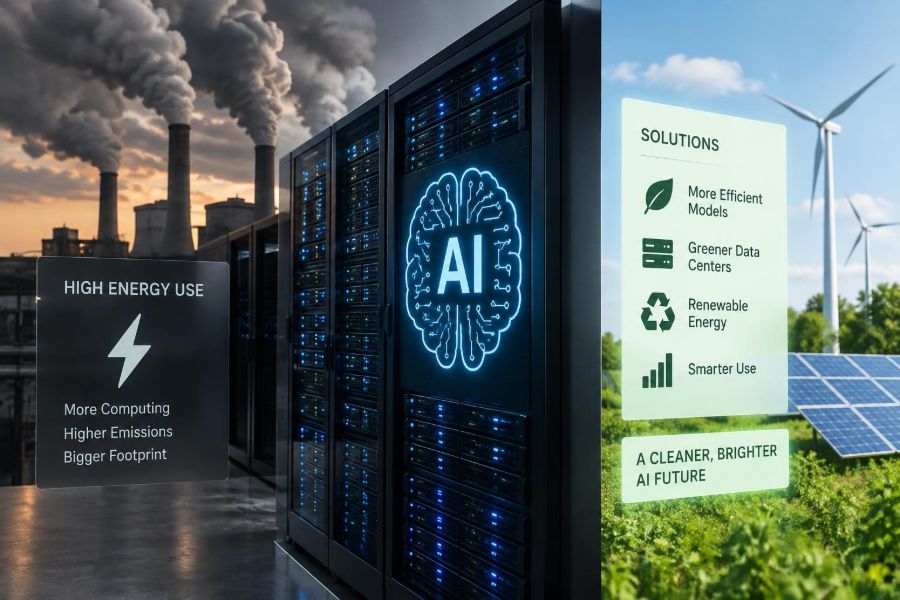

Generative AI can write, summarize, translate, create images, produce code, and answer questions in seconds. That apparent ease can obscure a physical reality: every response depends on chips performing vast numbers of calculations, memory systems moving data, networking equipment carrying requests, and cooling infrastructure keeping servers within safe operating limits.
The energy cost is not a reason to abandon generative AI. It is a reason to use it with the same discipline applied to any other resource-intensive technology. The most useful question is not whether AI consumes energy—it does—but whether a specific use produces enough value to justify its energy, hardware, and operational footprint, and what choices can reduce that footprint.
Why generative AI has an energy cost
At its core, a generative model predicts the next token, pixel, audio segment, or action from patterns learned during training. Doing that reliably requires mathematical operations across many layers of a neural network. Modern models run on specialized accelerators, which are efficient at these operations but still draw substantial electricity at scale.
The total energy picture has two distinct phases:
- Training: building or substantially updating a model by processing enormous collections of examples repeatedly.
- Inference: generating an answer, image, code completion, or other output after the model has been deployed.
Training can be a large, concentrated expense. Inference is often smaller per request, but it can become the dominant cost when a service handles millions or billions of requests. A model that is expensive to train but rarely used has a different profile from a moderately sized model that answers queries around the clock.
The hidden parts of the energy bill
It is tempting to focus only on the electricity consumed by the AI chip. That misses several important components of the system.
| Component | What consumes energy | Why it matters |
|---|---|---|
| Compute | GPUs, TPUs, and other accelerators performing model calculations | Usually the most visible demand, especially for large models and image or video generation. |
| Memory and data movement | Reading model weights, moving inputs, caching context, and communicating among chips | Moving data can be a major bottleneck; a larger context window means more information to manage. |
| Storage and networking | Storing datasets, model checkpoints, logs, and sending data between systems | Training and serving are distributed operations, not isolated chip tasks. |
| Cooling and power delivery | Fans, pumps, chillers, transformers, and backup systems | Data centers need supporting infrastructure to convert grid power into reliable computing. |
| Hardware lifecycle | Manufacturing, transporting, maintaining, and retiring servers and chips | Electricity is only one part of the broader environmental footprint. |
These factors explain why no single “energy per prompt” number is universally reliable. Energy use changes with model architecture, hardware generation, data-center efficiency, request length, response length, batching, location, traffic patterns, and the carbon intensity of the local electricity grid.
What makes one request more energy-intensive than another
A short factual answer from a compact model is fundamentally different from asking a frontier model to reason through a long document, generate many alternatives, call tools, or create a high-resolution video. The label “one prompt” hides that variation.
Model size and architecture
Larger models generally require more memory and more computation per generated token. They may be necessary for difficult reasoning, nuanced writing, or broad capability, but they are often unnecessary for classification, extraction, routing, formatting, or routine customer support.
Input and output length
Long conversations, attached documents, and extensive system instructions raise the amount of information the model must process. Long answers multiply generation work. Asking for five drafts, twenty image variations, or a detailed chain of revisions can add up quickly.
Modality
Text generation can be relatively lightweight compared with producing images, audio, or video, though results vary widely by model and implementation. Rich media generation commonly involves repeated processing over large spatial or temporal representations, making output settings especially important.
Retries and low-value use
Unclear prompts, automatic retries, duplicate requests, and “generate just in case” workflows spend compute without necessarily improving outcomes. Poor interface design can turn a useful feature into a stream of avoidable requests.
When and where the work runs
The same workload can carry different emissions depending on the power source serving a data center at a given time. Energy use and carbon emissions are related but not identical: a kilowatt-hour consumed on a cleaner grid has a different climate impact than one consumed on a fossil-heavy grid.
Energy is not the same as carbon, water, or total impact
Energy is an essential metric, but it is not sufficient on its own. Electricity demand becomes climate impact through the generation mix of the grid or contracted clean-energy supply. Some data centers also use water directly or indirectly for cooling and power generation. Manufacturing advanced chips and servers requires materials, industrial energy, and complex supply chains.
That distinction matters for decision-making. A team might reduce electricity use by making a system more efficient, reduce emissions by shifting flexible tasks to cleaner hours or locations, and reduce water stress by choosing appropriate cooling practices. These are related goals, but not interchangeable ones.
What can reduce the energy cost
The biggest improvements usually come from a stack of choices rather than one dramatic breakthrough. A smaller model alone is not enough if the product sends it oversized prompts, repeats calls, and generates unused output. Conversely, a well-designed workflow can dramatically reduce demand without making the experience worse.
1. Match the model to the task
Use the least computationally intensive model that meets the required quality, reliability, privacy, and latency target. Route simple requests to smaller models and reserve larger models for cases where they demonstrably improve results. This approach is often called model routing or cascade design.
For example, an application can use a compact model to identify whether an email is about billing, technical support, or sales. Only ambiguous or high-stakes cases need escalation to a more capable model or a human reviewer.
2. Reduce unnecessary tokens and media generation
Keep prompts focused. Retrieve only the documents that are relevant instead of inserting an entire knowledge base into every request. Set sensible output limits. Ask for one strong answer before requesting multiple alternatives, and select modest image or video settings unless high resolution is truly needed.
- Summarize long histories and retain only the facts needed for the next turn.
- Use structured inputs rather than verbose repeated instructions.
- Limit output length for extraction, classification, and routine summaries.
- Generate previews before committing to expensive high-quality media renders.
- Cache stable answers and repeated transformations where appropriate.
3. Improve serving efficiency
Providers can lower energy per result through better hardware utilization. Batching compatible requests, using optimized inference engines, managing memory efficiently, and avoiding idle capacity all matter. Techniques such as quantization, distillation, pruning, and smaller specialized models can reduce computation or memory requirements, provided quality is carefully evaluated.
Efficiency gains should be measured at the system level. A compressed model that causes many more retries, or a fast model that produces unusable results, may not reduce real-world resource use.
4. Design products that discourage waste
Product design determines demand. Default settings can favor concise answers, limited variations, and progressive quality levels. Interfaces can show users what will be generated before launching a costly video job. Teams can avoid autoplay generation, unnecessary background refreshes, and AI features added merely because they are technically possible.
The best energy-saving request is often the one the product never needed to make.
5. Schedule flexible work more intelligently
Not every task needs an immediate answer. Model training, batch summarization, indexing, evaluation, and nonurgent media rendering can sometimes be scheduled for times or regions with lower-carbon electricity, subject to reliability, privacy, and legal requirements. Location-aware and time-aware scheduling can reduce emissions even when total energy remains similar.
6. Build and operate cleaner data centers
Data-center operators can improve power usage effectiveness, deploy more efficient cooling, procure lower-carbon electricity, reuse waste heat where feasible, and report operational metrics transparently. Hardware choices, server lifetimes, and responsible equipment retirement also affect the broader footprint.
A practical checklist for AI teams
- Define the value: What user problem does the AI feature solve, and what quality level is actually required?
- Measure the workload: Track model choice, input tokens, output tokens, media settings, retries, cache hits, latency, and utilization.
- Establish a baseline: Compare the current system with a smaller model, shorter context, lower output cap, or non-generative alternative.
- Route intelligently: Escalate only difficult, uncertain, or high-impact cases to more expensive models.
- Evaluate outcomes: Measure task success, not just benchmark scores. Include retry rates and human correction effort.
- Report uncertainty honestly: State assumptions, system boundaries, and whether figures represent energy, carbon, water, or lifecycle effects.
- Revisit regularly: Hardware, models, grid conditions, and product behavior change quickly.
How to discuss AI energy claims responsibly
Headline comparisons can be memorable, but they are often misleading when they treat a highly variable workload as a fixed unit. A responsible estimate identifies what was counted: training, inference, cooling, networking, embodied hardware, or some combination. It also specifies the model, hardware, throughput, request size, and electricity assumptions where possible.
For organizations, the goal should be decision-useful accounting rather than a single perfect number. Track the metrics that can guide action: compute demand per successful task, average input and output size, percentage of requests handled by smaller models, cache effectiveness, and carbon intensity associated with flexible workloads.
The bottom line
Generative AI is physical infrastructure expressed through software. Its energy cost is real, variable, and shaped as much by product and operational decisions as by model size. Training matters, but the everyday pattern of inference—what users ask, how much the system generates, and how efficiently it serves requests—will increasingly determine the footprint of widely deployed AI.
Reducing that cost does not require choosing between usefulness and responsibility. It requires precision: use capable models where they create meaningful value, use lighter methods where they do not, eliminate avoidable generation, improve the systems underneath, and measure results with enough context to make better choices. That is how generative AI can become not only more powerful, but more resource-aware.