
Artificial intelligence often appears to “understand” that two things are related even when they do not contain the same words or pixels.
A search engine may recognize that “automobile repair” is similar to “car maintenance.” 🚗
An image system may understand that a photograph of a golden retriever is related to the phrase “a dog playing outside.” 🐕
A document search tool may retrieve a report about rising housing costs even when the user’s query says “why rent is becoming expensive.”
One of the key technologies behind this capability is the embedding.
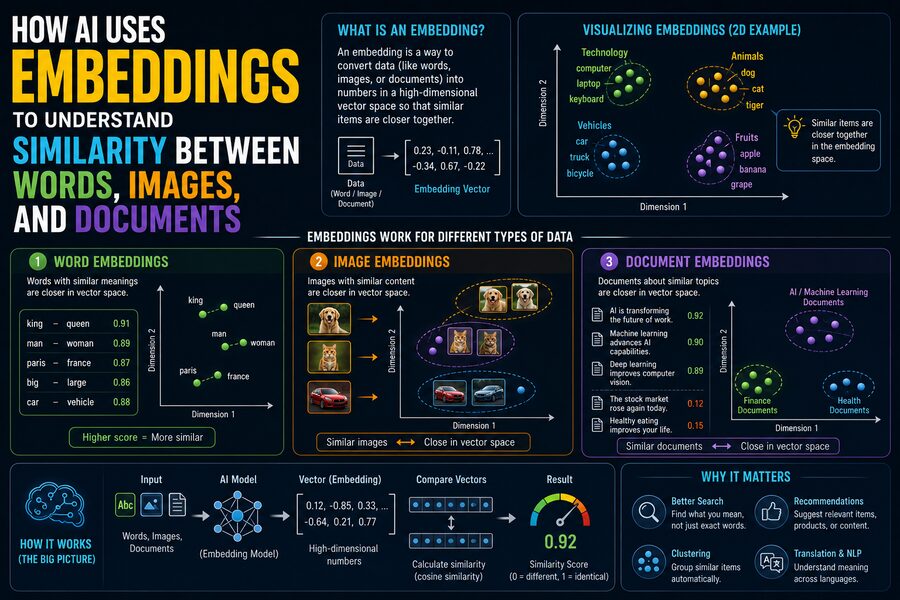
An embedding converts something complex—such as a word, sentence, image, product, user, or entire document—into a list of numbers called a vector.
These numbers are arranged so that items with similar meaning or characteristics tend to end up close together in a mathematical space.
This allows computers to compare meaning using geometry. 📐🤖
Instead of asking only:
“Do these two things contain exactly the same words?”
an embedding system can ask:
“How close are these two things in meaning?”
That shift is one of the foundations of modern AI search, recommendation systems, semantic retrieval, clustering, and multimodal intelligence.
🔢 What Exactly Is an Embedding?
An embedding is usually represented as a vector such as:
[0.21, -0.84, 0.13, 0.66, ...]
A real AI embedding may contain hundreds or thousands of numbers.
Each number is a coordinate in a high-dimensional mathematical space.
You can imagine a simple map with two coordinates:
[x, y]
A location might be represented as:
[4, 7]
Embeddings follow the same general idea, except instead of only two dimensions, the AI may use hundreds or more.
A word, image, or document becomes a point in that space.
The important part is not usually what one individual number means.
What matters is where the vector is located relative to other vectors. 🗺️
📍 Similar Things End Up Close Together
Suppose an AI model creates embeddings for these words:
- Dog
- Puppy
- Cat
- Refrigerator
- Microwave
The vectors for dog and puppy would ideally be very close.
Cat might also be nearby because it is another animal.
Refrigerator and microwave may form a different cluster because both are kitchen appliances.
Conceptually, the space might behave like:
Dog ↔ Puppy ↔ Cat
far away from:
Refrigerator ↔ Microwave
The model has transformed semantic relationships into geometric relationships.
That is the central idea behind embeddings. 🎯
🧠 How Does an AI Learn These Relationships?
Embeddings are not normally written manually by programmers.
They are learned from data.
For language, a model may observe enormous numbers of sentences and discover statistical relationships between words and phrases.
For example:
“Dogs often bark.”
“Puppies need training.”
“Cats are common pets.”
“Refrigerators keep food cold.”
Through training, the model learns patterns of usage.
Words that appear in similar contexts often develop similar representations.
Modern neural networks go much further than simple word co-occurrence, but the fundamental principle remains:
Meaning can be inferred from patterns in data.
📚 From Word Embeddings to Sentence Embeddings
Early embedding systems often focused on individual words.
A model might generate one vector for:
king
another for:
queen
and another for:
castle.
Modern systems can create embeddings for much larger units of text.
A sentence such as:
“The company’s profits increased sharply this quarter.”
can be represented by one vector.
Another sentence:
“The business reported strong earnings growth.”
may produce a nearby vector even though the wording is different.
This is called semantic similarity.
The AI recognizes that the sentences express related ideas rather than merely matching individual words. 📖
📄 Embedding Entire Documents
Embeddings can also represent paragraphs, articles, reports, contracts, support tickets, or other documents.
Imagine a company stores 500,000 internal documents.
A user searches:
“How do employees request parental leave?”
A traditional keyword search might look for exact terms such as:
parental
and:
leave
But the most relevant document might be titled:
“Family Absence and New Parent Benefits Policy.”
A semantic search system can embed both the query and the documents.
It then compares their vectors.
Because the concepts are similar, the policy document may rank highly even though the wording differs.
This is one of the main reasons embeddings are useful in modern enterprise search. 🔍
📏 How Does the Computer Measure Similarity?
Once two items have been converted into vectors, the computer needs a mathematical way to compare them.
One widely used technique is cosine similarity.
Cosine similarity compares the direction of two vectors.
If two vectors point in nearly the same direction, they are considered highly similar.
If they point in very different directions, their similarity is lower.
Conceptually:
Similar direction → similar meaning
The cosine similarity value is often interpreted on a scale where larger values indicate greater similarity, although exact ranges and conventions depend on implementation.
Another common metric is Euclidean distance, which measures the straight-line distance between two points in vector space.
Different systems may use different similarity metrics depending on how the embeddings were trained.
📐 Why Use Hundreds of Dimensions?
If embeddings only had two dimensions, they could capture only a small number of relationships.
Language and images are enormously complex.
Consider the word:
Apple
It could be related to:
- Fruit 🍎
- Food
- Trees
- Nutrition
- Technology
- Smartphones
- Computers
- Companies
A high-dimensional vector space allows many different relationships to be represented simultaneously.
One direction in the space may capture some concept related to animals.
Another may relate to technology.
Another may reflect emotional tone.
Another may correspond to geography or style.
Importantly, these dimensions are usually not cleanly labeled by humans.
Meaning is distributed across many coordinates.
🖼️ How Can an Image Become a Vector?
Text is not the only thing that can be embedded.
Neural networks can also convert images into vectors.
Suppose an image contains:
🐕 a brown dog running through grass.
An image encoder processes the pixels and creates a vector representation.
A photograph of another dog may produce a nearby vector.
An image of a wolf may be somewhat nearby.
A photograph of an airplane may be much farther away.
The network has learned visual relationships such as:
- Object type
- Shape
- Texture
- Color
- Scene
- Pose
- Context
The result is an image embedding.
🌉 Multimodal Embeddings Connect Text and Images
One of the most powerful developments in AI is the ability to embed different types of data into a shared or aligned representation space.
For example, a multimodal model may be trained so that:
Image of a red sports car
appears close to the text:
“red sports car”
Likewise:
Image of a sunset over the ocean
may be close to:
“sun setting above the sea.” 🌅
This allows the system to compare text and images directly.
That makes several useful applications possible.
A user can type:
“woman riding a bicycle in the rain”
and retrieve matching images without those images needing exact manual labels.
🎯 How Multimodal Training Creates Alignment
A common training strategy uses large numbers of paired examples.
For example:
Image ↔ Caption
The model learns two encoders:
One converts the image into a vector.
The other converts the text into a vector.
During training, the system is encouraged to place matching pairs close together.
Incorrect pairs are pushed farther apart.
For example:
Photo of a tiger ↔ “a tiger walking through grass”
should become similar.
But:
Photo of a tiger ↔ “a commercial airplane at an airport”
should not.
After enough training, the model learns a shared space connecting visual and linguistic concepts. 🐅✈️
🔄 Contrastive Learning
This type of training is often associated with contrastive learning.
The basic idea is to teach the model by comparison.
For each training example, the model learns:
These two things belong together.
and:
These other things do not.
For example:
Positive pair:
Image of a cat + "a cat sitting on a sofa"
Negative pair:
Image of a cat + "a truck driving on a highway"
Over many training examples, the system learns which features are important for matching concepts across different forms of data.
🔍 Semantic Search
One of the most important applications of embeddings is semantic search.
Traditional search often depends heavily on keyword overlap.
Suppose a user searches:
“How can I reduce my electricity bill?”
A relevant article might be titled:
“Home Energy Efficiency Tips.”
Keyword matching may miss some connections.
Embedding search can compare the meaning of the query against the meaning of documents.
This allows related concepts to match even when vocabulary differs.
Semantic search is increasingly common in:
- Enterprise knowledge systems
- Support centers
- E-commerce
- Research tools
- AI assistants
- Document management
🗃️ Vector Databases
Large embedding systems often use specialized storage technologies known as vector databases or vector search indexes.
Imagine you have embeddings for 10 million documents.
A user enters a query.
The system converts that query into a vector.
Now it needs to find the most similar document vectors.
Checking all 10 million one by one could be slow.
Vector search systems use specialized algorithms to find approximate nearest neighbors efficiently.
Popular techniques are designed to answer:
“Which stored vectors are closest to this new vector?”
very quickly. ⚡
This is the retrieval layer behind many modern semantic-search applications.
🧲 Nearest-Neighbor Search
Suppose the query embedding is:
Q
The system might search for the five document embeddings closest to Q.
Those are called the nearest neighbors.
If the embedding model works well, nearby vectors correspond to semantically related documents.
The system can then return those documents to the user.
This transforms search from string matching into geometry.
The query does not need to contain the same phrases.
It only needs to occupy a similar region of embedding space.
🤖 Embeddings and Retrieval-Augmented Generation
Embeddings are also widely used in Retrieval-Augmented Generation, often abbreviated as RAG.
A RAG system combines search with a generative AI model.
The process often works like this:
1. User asks a question.
2. The question is embedded.
3. Relevant documents are retrieved using vector similarity.
4. Those documents are provided to the language model.
5. The model generates an answer based on the retrieved information.
For example, an employee might ask:
“What is our policy for international travel reimbursement?”
The system retrieves the relevant company policy before answering.
Embeddings help locate the right context. 📚🤖
✂️ Why Long Documents Are Often Split Into Chunks
Embedding an entire 200-page document into a single vector may lose too much detail.
For that reason, RAG systems often divide documents into smaller sections called chunks.
For example:
- Paragraphs
- Sections
- Several hundred words
- Semantically grouped passages
Each chunk receives its own embedding.
When a query arrives, the system searches for the most relevant chunks rather than retrieving an entire book.
This usually improves precision.
However, chunk size involves tradeoffs.
Chunks that are too small may lose context.
Chunks that are too large may mix unrelated topics.
🛍️ Product Recommendations
Embeddings are also useful in e-commerce.
Imagine a customer views:
black waterproof hiking boots
The system can generate an embedding representing that product.
It can then find nearby products such as:
- Brown hiking boots
- Waterproof trail shoes
- Outdoor trekking footwear
These may be more useful recommendations than items that merely share one keyword.
Recommendation systems can also create embeddings for users based on their behavior.
A user vector might represent patterns in:
- Products viewed
- Videos watched
- Songs played
- Articles read
- Purchases made
The system can then match user vectors with item vectors. 🛒
🎵 Embeddings in Music and Entertainment
Streaming platforms can represent songs, movies, or videos using embeddings.
Two songs might be close because they share:
- Genre
- Tempo
- Instrumentation
- Mood
- Audience behavior
Movies could be related through:
- Themes
- Actors
- Tone
- Story structure
- Viewing patterns
The platform can recommend content based on similarity even if the user has never searched for it directly.
This is another example of embeddings turning complicated relationships into spatial proximity.
👥 User Embeddings
AI systems can create embeddings not only for content but also for people or accounts.
Suppose a platform observes that a user frequently watches:
- Space documentaries
- Rocket launches
- Astronomy tutorials
The platform may generate a user representation that lies near embeddings associated with space-related content.
This can help personalize recommendations.
However, user embeddings can involve important privacy considerations because they may summarize behavioral patterns.
Responsible systems need appropriate privacy, security, and governance controls. 🔐
🧩 Clustering Similar Items
Embeddings can also be used for clustering.
Suppose a company receives 100,000 customer-support messages.
Instead of manually sorting every message, it embeds them and groups nearby vectors.
Clusters may naturally form around issues such as:
- Password resets
- Shipping delays
- Billing questions
- Product defects
- Account cancellation
This allows companies to discover patterns even without predefined labels.
Clustering embeddings can therefore help with research, analytics, and categorization. 📊
🏷️ Classification Using Embeddings
Embeddings can support classification as well.
Suppose a company needs to determine whether incoming messages are about:
Billing
Technical support
Sales
or:
Returns
One method is to compare message embeddings with examples or category representations.
Another is to train a lightweight classifier on top of embeddings.
Because the embedding already contains useful semantic information, the classifier may require less training data than a model learning directly from raw text.
🌐 Multilingual Similarity
Embeddings can also connect meaning across languages.
A multilingual embedding model may place:
“dog”
near:
“perro”
and:
“chien”
because all three refer to the same concept in English, Spanish, and French.
This allows cross-language search.
A user could ask a question in one language and retrieve relevant documents written in another.
The system does not necessarily translate every word first.
Instead, the languages may be mapped into a shared semantic space. 🌍
🧠 Context Changes Embeddings
The meaning of a word often depends on context.
Consider:
“bank”
in:
“I deposited money at the bank.”
versus:
“We sat on the river bank.”
Older word-embedding systems often gave a word one fixed vector regardless of context.
Modern language models can create contextual representations.
The representation of “bank” changes depending on the surrounding sentence.
This greatly improves the model’s ability to distinguish meanings.
🧬 Embeddings Are Learned Representations, Not Dictionaries
It is tempting to imagine that each vector dimension corresponds neatly to a concept such as:
Dimension 1 = animal
Dimension 2 = color
Dimension 3 = emotion
That is usually not how modern embeddings work.
The information is distributed across many dimensions.
A concept such as “medical” may be represented through a pattern involving dozens or hundreds of coordinates.
Embeddings therefore act more like compressed learned representations than traditional dictionaries.
🗜️ Embeddings Compress Information
An image might contain millions of pixel values.
A long document might contain thousands of words.
An embedding compresses some of the useful information into a relatively small vector.
This compression is powerful because it makes similarity comparison efficient.
However, it also means information is lost.
An embedding is not a perfect reconstruction of the original item.
It is designed to preserve features that the model considers useful for its training objective.
That distinction matters.
⚠️ Similarity Does Not Mean Identity
If two embeddings are close, they are not necessarily identical in meaning.
For example:
“The medication is safe.”
and:
“Is the medication safe?”
may be semantically related but serve very different purposes.
Likewise:
“The company increased profits.”
and:
“The company failed to increase profits.”
share many concepts while differing critically in meaning.
Embedding similarity must therefore be used carefully in applications where small wording differences matter.
🚨 Negation Can Be Difficult
Negation is a classic challenge.
Consider:
“This device is compatible.”
versus:
“This device is not compatible.”
These sentences share most of the same words.
A weak embedding system might place them too close together.
Modern models are generally better at handling such distinctions, but no representation is perfect.
For high-stakes applications, semantic similarity should be supplemented with other validation techniques.
📊 Similarity Scores Are Model-Dependent
A cosine similarity score of:
0.82
does not have a universal meaning.
Different embedding models produce vectors with different geometry.
A score considered “high” in one model may not mean the same thing in another.
Thresholds should therefore be tested empirically using real application data.
Developers often build evaluation sets containing known relevant and irrelevant examples.
Then they choose thresholds based on desired precision and recall.
🎯 Precision vs. Recall
Embedding search often involves balancing two goals.
Precision asks:
How many retrieved results are actually relevant?
Recall asks:
How many relevant results did the system successfully retrieve?
If the similarity threshold is extremely strict, precision may improve but some useful results may be missed.
If it is too loose, more relevant results may appear, but so will more irrelevant ones.
Good retrieval systems tune this tradeoff based on the application.
🔐 Embeddings and Privacy
Embeddings may appear abstract because they are just arrays of numbers.
But they should not automatically be treated as harmless.
An embedding can contain information derived from sensitive source material.
Depending on the model and application, it may reveal aspects of:
- Personal documents
- User behavior
- Medical information
- Business records
- Private communications
Organizations should therefore apply appropriate access controls, retention policies, and privacy protections to embedding stores.
A vector database can be sensitive infrastructure. 🔒
🎭 Bias Can Also Appear in Embedding Spaces
Embeddings learn patterns from training data.
If the data contains social, cultural, or historical biases, those patterns may appear in the learned representations.
For example, certain professions or demographic groups might become associated inappropriately with particular concepts.
These biases can affect search rankings, recommendations, or classification.
Developers need to evaluate embedding systems for unfair behavior, particularly in high-impact domains.
🧪 How Embeddings Are Evaluated
Researchers evaluate embeddings using many methods.
They may test whether similar items are placed near each other.
They may evaluate retrieval accuracy on search queries.
They may measure performance on classification tasks.
For multimodal systems, they may test whether the correct caption matches the correct image.
Evaluation can include:
- Recall at K
- Precision at K
- Ranking quality
- Clustering quality
- Classification accuracy
- Human judgment
The correct evaluation depends on what the embedding will actually be used for.
⚡ Why Embeddings Make Search Fast
Once content has been embedded in advance, the system does not need to run a full language model over every document for every query.
Instead:
Documents → embeddings created once
Then:
New query → one embedding → vector search
This can be much more computationally efficient.
Large systems may store millions or billions of vectors and search them using approximate nearest-neighbor techniques.
That makes semantic retrieval practical at enormous scale.
🔁 Embeddings Can Change When the Model Changes
A subtle engineering issue is that embeddings from different models are generally not directly interchangeable.
Suppose a company has embedded 10 million documents using Model A.
Later, it switches to Model B.
The new model’s vectors may occupy a completely different mathematical space.
A query vector from Model B should not normally be compared directly with document vectors from Model A.
The documents may need to be re-embedded.
This is an important operational consideration for large production systems.
🖼️ Image-to-Image Search
Because images can be embedded, a system can search for visually or conceptually similar images.
Suppose you upload a photograph of a chair.
The system can return:
- Similar chair designs
- Similar furniture styles
- Products with comparable shapes
- Images from related categories
This technique is useful in:
- E-commerce
- Fashion
- Design
- Stock photography
- Manufacturing
- Visual search
The search can work even if no text description is available.
📝 Text-to-Image Search
A shared multimodal embedding space enables the reverse process.
A user types:
“minimalist wooden desk beside a large window”
The text is embedded.
The system compares it with stored image vectors.
Images whose vectors are closest to the text vector are returned.
This is how AI can retrieve visual content based on natural-language descriptions rather than only filenames or tags. 🪟🪵
📄 Document Deduplication
Embeddings can also help detect documents that are conceptually similar.
Suppose a knowledge base contains multiple articles that describe nearly the same troubleshooting process with slightly different wording.
Embedding similarity can identify potential duplicates.
This helps organizations clean up content and reduce redundancy.
It can also help detect near-duplicate support tickets, policies, reports, or product descriptions.
🧠 Embeddings Are Not the Same as Generative AI
An embedding model does not necessarily generate text or images.
Its main job is to create a useful representation.
A generative model may write:
“Here is a summary of your report.”
An embedding model might instead produce:
[0.14, -0.55, 0.88, ...]
That vector can then be used for:
- Search
- Matching
- Clustering
- Recommendation
- Classification
Many AI systems combine both technologies.
Embeddings retrieve relevant information.
A generative model interprets or presents it.
🧰 A Typical Semantic Search Pipeline
Imagine building a document search system.
The architecture might look like this:
Step 1: Collect documents 📄
Gather PDFs, articles, policies, manuals, or records.
Step 2: Split them into chunks ✂️
Break large documents into useful sections.
Step 3: Generate embeddings 🔢
Create a vector for every chunk.
Step 4: Store the vectors 🗃️
Save them in a vector database or search index.
Step 5: Embed the user’s query 🔍
Convert the question into the same vector space.
Step 6: Find nearest neighbors 📐
Retrieve the closest chunks.
Step 7: Rank or filter results 🎯
Apply metadata, permissions, or additional scoring.
Step 8: Return results or send them to an AI model 🤖
The system can display the documents directly or use them as context for an answer.
🏷️ Metadata Still Matters
Embeddings are powerful, but they should not replace every traditional search technique.
Metadata remains extremely useful.
For example:
- Publication date
- Department
- Author
- Access permissions
- Product category
- Language
- Geography
A search system might first filter documents to:
Department = Legal
and:
Year ≥ 2025
Then use vector similarity within that subset.
Combining semantic similarity with structured filters often produces better results than either technique alone.
🔎 Hybrid Search
Many production systems combine keyword search with vector search.
This is called hybrid search.
Keyword search is excellent when exact terminology matters.
Embedding search is excellent when meaning matters despite different wording.
For example, if a user searches for a specific model number such as:
XR-4721
keyword matching may be essential.
If they search:
“device that overheats after charging”
semantic search may be better.
Hybrid systems attempt to get the strengths of both. ⚙️
🌟 Why Embeddings Feel Like “Understanding”
Embeddings do not understand in exactly the same way humans do.
They do not need to possess human consciousness or experience to be useful.
What they do is encode patterns learned from data so that meaningful relationships become mathematically accessible.
When two phrases refer to similar concepts, their vectors may be close.
When an image and sentence describe the same scene, their embeddings may align.
When documents discuss related topics, they can cluster together.
This gives software the ability to operate on meaning-like relationships rather than only exact symbols.
That is why embedding-based systems can appear remarkably intelligent.
✅ The Bottom Line
AI uses embeddings to convert complex information into vectors whose positions capture useful relationships.
Words can become vectors.
Sentences can become vectors.
Documents can become vectors.
Images can become vectors.
Users, products, songs, videos, and many other entities can also be represented in the same general way.
Once those representations exist, the computer can use mathematical distance or similarity measures to find related items. 📐
That powers technologies such as:
- Semantic search 🔍
- Recommendation systems 🎯
- Multimodal image search 🖼️
- Document retrieval 📚
- RAG systems 🤖
- Clustering 📊
- Classification 🏷️
- Cross-language matching 🌍
The essential idea is beautifully simple:
AI turns meaning into geometry.
Instead of comparing only words, filenames, or pixels, it learns a mathematical space where similar ideas tend to live near one another.
That is how a system can recognize that “automobile” and “car” are related, that a picture of a puppy matches the phrase “young dog,” and that two documents can discuss the same topic even when they use completely different wording. 🧠✨
Embeddings are therefore one of the hidden mathematical tools that make modern AI feel less like exact-match software—and much more capable of recognizing relationships across language, images, and information.