
Large language models can generate remarkably fluent answers, but they have an important limitation: the information stored in their trained parameters is not the same as having direct access to every document, database, company file, or newly published fact. 📚
This is where Retrieval-Augmented Generation, commonly called RAG, becomes useful.
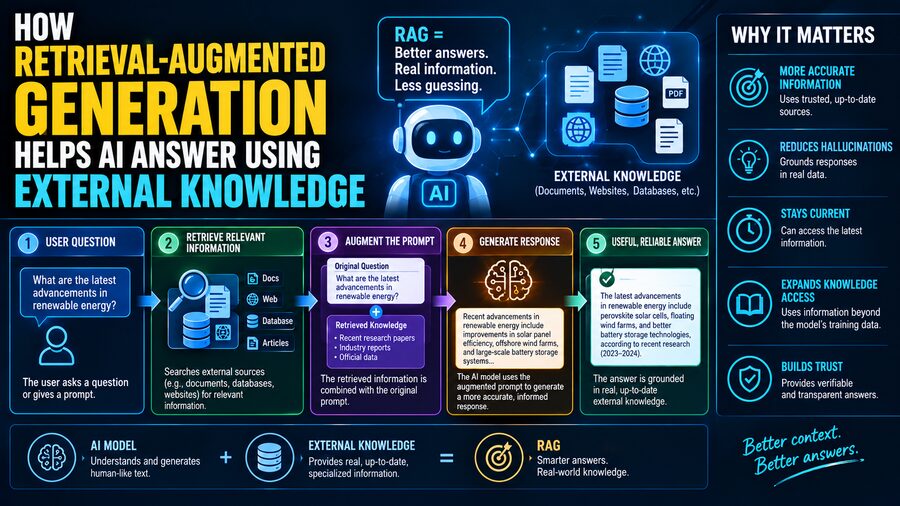
RAG is an AI architecture that combines two capabilities:
Retrieval — finding relevant information from an external knowledge source.
Generation — using a language model to produce a natural-language response based on that retrieved information.
Instead of asking an AI model to answer entirely from what it learned during training, a RAG system first searches for relevant material and then supplies that material to the model as context.
A simplified flow looks like this:
User question → Search external knowledge → Retrieve relevant passages → Give passages to language model → Generate answer
This approach can make AI systems more useful for company knowledge bases, technical documentation, research archives, customer support, legal documents, product catalogs, and other information that may not be contained reliably in the model itself. 🔎🧠
📚 Why Language Models Need External Knowledge
A language model learns patterns from large amounts of training data.
During training, it develops statistical representations that allow it to predict and generate language.
But it does not function like a traditional database containing a perfectly searchable copy of every document it has ever encountered.
This creates several practical limitations.
A model may not know:
- Information created after its training
- Private company documents
- Internal policies
- Proprietary technical manuals
- Customer-specific records
- Specialized research collections
- Frequently changing product information
Even when the model has encountered related information, it may not reliably recall the exact fact needed.
RAG addresses this by giving the model relevant information at the time the user asks the question.
🔎 What Does “Retrieval” Mean?
The retrieval part of RAG searches an external collection of information.
That collection might contain:
- PDFs
- Web pages
- Internal documentation
- Product manuals
- Support articles
- Research papers
- Database records
- Company policies
- Meeting notes
- Technical specifications
The system attempts to find the pieces most relevant to the user’s question.
For example, suppose an employee asks:
“What is our company’s policy for international travel expenses?”
A normal language model might answer using general knowledge about travel reimbursement.
A RAG system can instead search the company’s actual travel-policy documents and retrieve the paragraphs describing international expenses.
The model then answers based on those passages.
This makes the response much more specific to the organization. 🏢
🧩 Documents Are Usually Split Into Chunks
RAG systems rarely send an entire large document collection into the language model.
That would be inefficient and often impossible because language models have limits on how much text they can process at once.
Instead, documents are usually divided into smaller pieces called chunks.
A long manual might be split into:
- Individual sections
- Several paragraphs
- Short overlapping passages
Each chunk becomes a small retrievable unit.
Suppose a 200-page product manual contains one paragraph explaining battery replacement.
If a user asks:
“How do I replace the battery?”
the retrieval system does not need to send the entire 200-page manual.
It can retrieve only the most relevant passages.
That reduces unnecessary information and gives the language model a more focused context.
🔢 Embeddings Help Represent Meaning
Many RAG systems use embeddings to search for relevant information.
An embedding is a numerical representation of text.
A model converts a sentence, paragraph, or document chunk into a vector—a list of numbers representing aspects of its meaning.
For example, these sentences are phrased differently:
“How do I reset my account password?”
“I forgot my login credentials. How can I create a new password?”
Traditional keyword search might treat them as significantly different.
An embedding system can recognize that they are semantically related.
The chunks are represented as vectors, and the user’s question is converted into another vector.
The retrieval system then looks for vectors that are close together in the embedding space.
Conceptually:
Similar meaning → Nearby vectors
This technique is known as semantic search. 🧠🔎
🗄️ What Is a Vector Database?
Because RAG systems may contain millions of embeddings, they need an efficient way to store and search them.
A specialized system known as a vector database or vector index can perform this task.
It stores:
Document chunk + Embedding + Metadata
Metadata might include:
- Document title
- Author
- Date
- Department
- Product name
- Security classification
- Page number
When the user submits a question, the system computes the question embedding and searches for the nearest or most relevant stored vectors.
The top matching chunks are then returned.
Vector databases are therefore an important component in many RAG architectures.
🔤 RAG Can Also Use Traditional Keyword Search
Semantic embeddings are powerful, but they are not the only retrieval technique.
Traditional lexical search can still be extremely valuable.
For example, exact terms matter when searching for:
- Product model numbers
- Error codes
- Legal clauses
- Employee IDs
- Technical acronyms
A query for:
“Error E1047”
may work extremely well with keyword matching.
Many advanced RAG systems therefore use hybrid search, combining:
Keyword search + Semantic vector search
This can produce better results than relying on only one technique.
🏆 Ranking Determines Which Results Matter Most
Retrieving possible matches is only the beginning.
The system often needs to decide which retrieved chunks are actually the best.
Suppose the initial search produces 30 candidate passages.
A reranking model can examine the question and each candidate more carefully.
It might assign scores such as:
Passage A → 0.96 relevance
Passage B → 0.87 relevance
Passage C → 0.41 relevance
The system then sends only the top passages to the language model.
This helps prevent irrelevant information from distracting the generator.
🧠 The Language Model Receives the Retrieved Context
After retrieval, the system constructs a prompt containing both:
- The user’s question
- Relevant retrieved information
Conceptually, the prompt might say:
User question:
“What is the warranty period for Product X?”
Retrieved document:
“Product X includes a three-year limited warranty beginning on the original purchase date.”
The language model can then answer:
“Product X has a three-year limited warranty starting from the original purchase date.”
The crucial point is that the model is not expected to remember the warranty from training.
The information is provided directly in the prompt. 📄➡️🤖
🎯 RAG Can Reduce Hallucinations
Language models sometimes generate statements that sound plausible but are incorrect.
These are commonly called hallucinations.
RAG can reduce this problem by giving the model relevant source material.
Instead of asking:
“What do you think the policy says?”
the system effectively asks:
“Using these retrieved policy passages, answer the question.”
This encourages the model to ground its answer in evidence.
However, RAG does not completely eliminate hallucinations.
The system can still fail if:
- Retrieval finds the wrong documents
- The documents themselves are incorrect
- The prompt is poorly designed
- The model misinterprets the retrieved information
RAG improves grounding, but reliability still depends on the entire system.
📎 RAG Can Provide Citations
One major benefit of retrieval is that the system knows where the information came from.
This allows answers to include references such as:
- Document title
- Page number
- URL
- Section name
- Database record
For example:
“According to the Employee Travel Policy, Section 4.2…”
Citations make the answer easier to verify.
This is particularly valuable in:
- Research
- Enterprise knowledge systems
- Legal work
- Financial analysis
- Technical support
A user can inspect the original source rather than blindly trusting the generated text. 🔍
🏢 RAG Is Powerful for Internal Company Knowledge
Organizations often possess enormous amounts of internal information spread across:
- Wikis
- Shared drives
- PDFs
- Support systems
- Databases
- Project-management tools
- Email archives
- Documentation portals
Employees may know the information exists but have difficulty finding it.
A RAG-powered assistant can create a conversational interface over this knowledge.
Instead of manually searching several systems, an employee might ask:
“Which security review is required before launching a customer-facing API?”
The system can retrieve the relevant internal policies and summarize them.
This can make institutional knowledge far easier to access.
🛠️ RAG for Customer Support
Customer-support organizations are another common use case.
A company might have thousands of help-center articles and product manuals.
A RAG assistant can:
- Understand the customer’s question.
- Search support documentation.
- Retrieve relevant troubleshooting steps.
- Generate a clear response.
For example:
Customer: “My printer connects to Wi-Fi but won’t print.”
The system may retrieve articles about:
- Printer queue errors
- Driver configuration
- Network connectivity
- Firmware issues
The model can then synthesize those sources into a helpful troubleshooting answer.
🧪 RAG for Scientific and Technical Research
Research organizations can also use RAG to search large document collections.
Suppose a scientist has access to thousands of research papers.
Instead of manually reading each one, a RAG system can retrieve passages relevant to a specific question.
For example:
“Which studies reported improved battery performance using silicon-rich anodes?”
The system searches the literature collection, retrieves relevant sections, and helps summarize the findings.
Human review remains important, especially in high-stakes research, but RAG can dramatically reduce the time required to locate relevant information.
🏥 RAG in Healthcare Environments
Healthcare organizations may use retrieval systems to help professionals locate information from:
- Clinical guidelines
- Hospital procedures
- Drug references
- Internal policies
In high-stakes areas, however, the requirements for accuracy, validation, permissions, and human oversight are much stricter.
RAG does not automatically make an AI system medically reliable.
The retrieved information must be authoritative, current, and appropriate for the task.
This illustrates a broader principle:
A RAG system is only as good as the knowledge it retrieves and how safely that knowledge is used.
🔄 External Knowledge Can Be Updated Without Retraining the Model
One of RAG’s biggest advantages is update flexibility.
Suppose a company changes its return policy.
Without retrieval, developers might consider retraining or fine-tuning a model.
With RAG, they may only need to update the document collection.
The new policy is indexed.
The retrieval system can then provide the updated information during future queries.
This can make RAG much more practical for information that changes frequently.
Examples include:
- Product catalogs
- Prices
- Regulations
- Company procedures
- Software documentation
- Customer information
🧬 RAG vs. Fine-Tuning
RAG and fine-tuning are sometimes confused.
They solve different problems.
📚 RAG
RAG gives the model external information at query time.
It is useful when the system needs access to facts, documents, or frequently changing knowledge.
🧠 Fine-Tuning
Fine-tuning further trains a model on examples so its behavior changes.
It may help with:
- Output style
- Classification behavior
- Specialized task performance
- Formatting patterns
Fine-tuning is generally not the best way to keep a model continuously updated with changing factual documents.
In many systems, RAG and fine-tuning can be used together.
🗃️ Metadata Filtering Improves Search
Suppose a company has documentation for 50 different products.
A user asks:
“How do I calibrate Model ZX-4?”
The retrieval system can use metadata to limit the search to:
Product = ZX-4
This prevents irrelevant manuals from other products appearing in the context.
Metadata filtering can use attributes such as:
- Product
- Department
- Country
- Document date
- Customer
- Security permission
This is especially useful in large enterprise systems.
🔐 Access Control Is Essential
An enterprise RAG system must not return information a user is not allowed to see.
Imagine a company assistant containing:
- Public policies
- HR records
- Financial plans
- Legal documents
- Executive strategy
Simply placing everything into one searchable index without permissions would be dangerous.
A secure RAG system should enforce access controls during retrieval.
Conceptually:
User identity → Check permissions → Search only authorized sources → Generate answer
The generator should never receive unauthorized documents in the first place.
Security must therefore be designed into the retrieval layer. 🛡️
🧹 Data Quality Matters
RAG systems depend heavily on document quality.
If the knowledge base contains:
- Duplicate documents
- Outdated policies
- Contradictory information
- Poorly formatted text
- Missing metadata
retrieval quality suffers.
For example, suppose both a 2023 and 2026 version of a policy remain indexed without clear dates.
The system may retrieve the obsolete version.
Organizations therefore need knowledge-management processes such as:
- Version control
- Document ownership
- Archiving
- Metadata standards
- Regular review
RAG is not a substitute for maintaining good information.
✂️ Chunk Size Can Affect Results
How documents are divided into chunks can significantly influence retrieval.
If chunks are too small, important context may be lost.
For example, a sentence might say:
“This rule does not apply in the circumstances described above.”
Without the preceding section, the sentence is almost meaningless.
If chunks are too large, they may contain lots of irrelevant information and use too much context space.
Engineers often experiment with:
- Chunk length
- Overlap
- Section boundaries
- Document structure
The best strategy depends on the type of content.
🪜 Multi-Step Retrieval Can Solve Harder Questions
Some questions require information from multiple sources.
Consider:
“Which of our products launched after 2024 and also meet the new efficiency requirement?”
The system may need to:
- Retrieve product launch information.
- Retrieve efficiency specifications.
- Compare the results.
- Generate an answer.
Advanced RAG systems may perform several retrieval steps rather than a single search.
This can be called multi-hop retrieval or agentic retrieval in some architectures.
It enables more complex reasoning over distributed information.
🧮 Structured Databases Can Be Retrieval Sources Too
RAG is not limited to text documents.
A system can also retrieve information from structured databases.
Suppose a user asks:
“How many open support tickets does Customer A currently have?”
The answer may be stored in a database rather than a document.
The system might use a secure database query, retrieve the result, and provide it to the language model.
Modern AI assistants can therefore combine:
Documents + Search indexes + Databases + APIs
This creates a much richer external knowledge system.
🌐 RAG Can Connect to Current Information
One important advantage of external retrieval is that the data source can be more recent than the language model’s training.
For example, an AI assistant connected to a current product database could answer questions about recently added products.
Similarly, a system connected to a frequently updated knowledge base can retrieve newly published instructions.
This architecture separates:
Language capability from knowledge freshness.
The model handles understanding and generation.
The retrieval layer supplies current information.
📉 What Happens When Retrieval Fails?
RAG systems can fail even if the language model itself is capable.
Common retrieval failures include:
- Relevant document was never indexed
- Query wording does not match the stored knowledge
- Search returns similar but incorrect material
- Important metadata is missing
- Too few results are retrieved
- Too much irrelevant context is supplied
A strong system should recognize uncertainty.
Instead of confidently inventing an answer, it may respond:
“I couldn’t find enough information in the available sources.”
Knowing when not to answer is an important aspect of trustworthy RAG design.
🧪 Evaluating a RAG System
Developers should evaluate both retrieval and generation.
Retrieval metrics can ask:
Did the system find the correct source?
Generation metrics can ask:
Did the answer accurately reflect that source?
A RAG evaluation dataset may contain:
- User questions
- Expected relevant documents
- Reference answers
- Citation expectations
Teams can then test whether system changes improve or degrade performance.
This is much more reliable than judging the system only from a few impressive demonstrations.
⚡ Caching Can Make RAG Faster
Searching large knowledge bases and running language models consumes computational resources.
RAG systems may use caching to improve speed.
For example, if many users ask similar questions, the system may reuse:
- Search results
- Document embeddings
- Previously computed representations
Caching can reduce latency and infrastructure cost.
However, cached information must be refreshed appropriately when the underlying knowledge changes.
💰 RAG Can Reduce the Need for Massive Prompts
Without retrieval, a developer might try to place huge amounts of documentation into every model prompt.
This is inefficient.
Most of the information would be irrelevant to each individual question.
RAG selectively retrieves only the material likely to be useful.
Instead of:
Entire knowledge base → Model
the workflow becomes:
Question → Relevant 5–10 passages → Model
This can reduce context usage, cost, and distraction.
🧠 RAG Does Not Change the Model’s Permanent Knowledge
An important distinction is that retrieval usually does not permanently teach the model the information.
Suppose a RAG system retrieves a private company policy.
The model uses that information in the current interaction.
That does not necessarily mean its underlying model parameters are changed.
RAG is primarily context augmentation, not permanent training.
This separation makes the architecture flexible.
The same base model can potentially work with many different knowledge bases.
🏗️ A Typical RAG Pipeline
A simplified RAG system often contains two major phases.
📥 Indexing Phase
1. Collect documents
2. Extract text
3. Clean and structure the content
4. Split documents into chunks
5. Generate embeddings
6. Store chunks and metadata in a search system
This work is performed before users ask questions.
🔎 Question-Answering Phase
1. User asks a question
2. Convert question into a search representation
3. Retrieve relevant chunks
4. Optionally rerank them
5. Build a prompt containing the evidence
6. Ask the language model to answer
7. Return the answer with citations where appropriate
This two-stage architecture is what makes RAG practical at scale.
🧩 A Simple RAG Example
Imagine a company manufactures industrial pumps and has a 1,000-page technical documentation library.
A technician asks:
“What should I check if Pump M200 shows fault code F17?”
A RAG system might perform:
1. Understand the query. 🔎
Identify terms:
Pump M200 + F17
2. Search the technical knowledge base. 📚
Retrieve passages from the M200 troubleshooting manual.
3. Rerank results. 📊
Choose the sections specifically describing fault F17.
4. Provide context to the language model. 🤖
The prompt contains the retrieved troubleshooting instructions.
5. Generate a response. 📝
The model summarizes the recommended checks.
6. Cite the manual. 📎
The technician can verify the source.
Without retrieval, the AI might have no reliable knowledge of a proprietary M200 pump.
With RAG, it can answer using the company’s own documentation.
🔄 RAG Turns AI Into an Interface for Knowledge
Traditional search engines return documents.
RAG systems can go one step further.
Instead of requiring users to open multiple results and manually combine the information, the language model can synthesize the retrieved material into a direct answer.
This creates a workflow like:
Search → Read → Compare → Summarize
performed with AI assistance.
The user can then ask follow-up questions conversationally.
This is one reason RAG has become an important architecture for enterprise AI.
⚠️ RAG Still Requires Responsible Design
Adding retrieval does not automatically make an AI system safe or correct.
Developers still need to consider:
- Source reliability
- Privacy
- Security
- Data permissions
- Prompt injection risks
- Retrieval errors
- Citation accuracy
- User expectations
For important decisions, users may still need to inspect original sources or involve qualified professionals.
The best RAG systems make evidence easier to access without pretending the AI itself is infallible.
🚀 Why RAG Is So Useful
RAG solves a fundamental problem.
Language models are excellent at understanding and generating language, but organizations need AI systems that can work with their own information.
Retrieval creates a bridge between those two worlds.
Instead of trying to store every possible fact permanently inside the model, the system can keep information where it naturally belongs—in documents, databases, and knowledge systems—and retrieve it when needed.
This architecture can make AI:
- More current
- More domain-specific
- More transparent
- Easier to update
- Better grounded in evidence
✅ Final Thoughts
Retrieval-Augmented Generation helps AI answer questions using external knowledge by combining information retrieval with language generation. 🤖📚
When a user asks a question, the system does not rely entirely on the language model’s internal learned knowledge.
Instead, it searches an external source, finds relevant passages or records, and places that information into the model’s context.
The model then uses those retrieved materials to generate a clear, natural-language response.
Modern RAG systems may use document chunking, embeddings, vector databases, keyword search, hybrid retrieval, reranking, metadata filters, access controls, and citations to make this process more accurate and useful.
The biggest advantage is flexibility.
Companies can update the underlying documents without retraining the entire model. Private knowledge can remain in controlled systems. Current information can be retrieved when needed. Answers can also point back to their sources.
RAG is not perfect. Poor retrieval can produce poor answers, outdated documents can mislead the system, and the model can still make mistakes.
But when designed carefully, RAG changes the role of a language model in an important way.
Instead of asking the AI to remember everything, the system allows it to find the right information first and then reason or communicate using that information. 🔎➡️🧠
That combination is why Retrieval-Augmented Generation has become one of the most important architectures for building AI assistants that need to work with real-world, specialized, private, or frequently changing knowledge. 🚀🌐