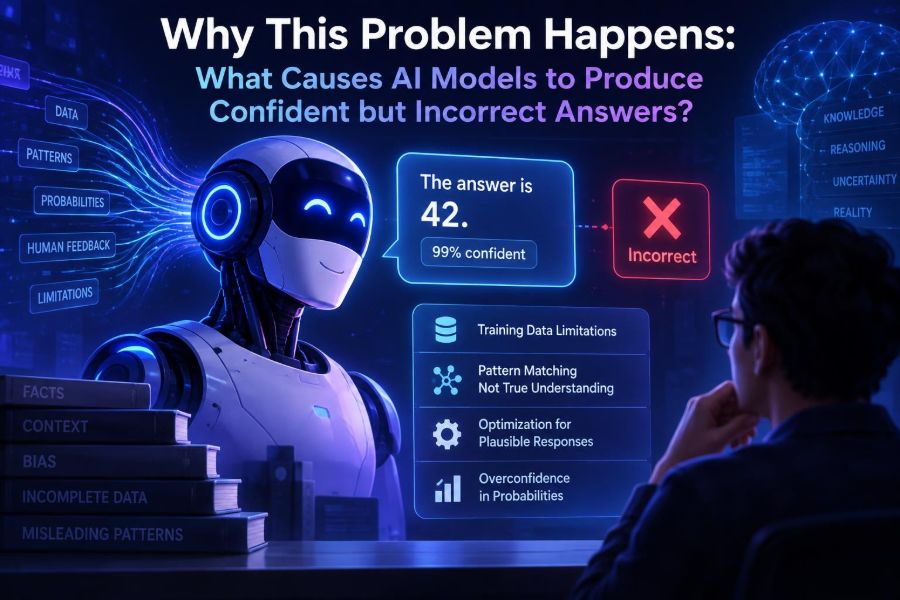

AI assistants can draft code, summarize research, explain complex topics, and turn rough ideas into useful first drafts. Yet they can also state a wrong date, cite a nonexistent paper, misread a spreadsheet, or confidently explain an API parameter that does not exist.
This matters now because polished language is easy to mistake for reliable knowledge. As AI moves from experimentation into customer support, software development, content production, education, and business decisions, knowing when to trust an answer is a practical skill—not just an academic concern.
These failures are often called hallucinations, but that label can hide the mechanics. A model is not trying to deceive you or experiencing reality incorrectly. It is producing a plausible continuation from patterns learned during training and information supplied in the current conversation.
After reading, you will be able to recognize the main causes of confident mistakes, design prompts and workflows that reduce them, build simple validation into AI features, and decide when a human or trusted source must make the final call.
🧠 1. What “Confident but Incorrect” Actually Means
A confident incorrect answer is a response that sounds specific, coherent, and certain while containing false, unsupported, outdated, or irrelevant claims. The issue can range from a tiny factual error to a completely fabricated explanation.
Fluency is not evidence. A response can have excellent grammar, persuasive structure, and technical vocabulary while still being unreliable.
- Fabrication: inventing citations, product features, events, or people.
- Distortion: blending real facts into a wrong conclusion.
- Misapplication: giving valid information for the wrong context.
- Overconfidence: presenting uncertainty as settled fact.
🎯 2. The Core Objective: Predicting Useful-Looking Text
Most language models are trained to predict likely next pieces of text, often called tokens, based on the text that came before. This training objective creates an extraordinary ability to write and reason across patterns, but it does not automatically create a built-in fact-checking system.
If a question resembles many examples in training data, the model may generate an answer shaped like those examples. When its knowledge is incomplete, conflicting, or absent, a plausible pattern can win over an accurate one.
Think of the model as an exceptionally capable pattern-completion engine. It can reason with information, but it needs the right evidence, constraints, and verification process to be reliably grounded.
📚 3. Training Data Is Broad, Not a Perfect Reference Library
Training data contains enormous variation in quality. It can include accurate educational material alongside stale documentation, rumors, duplicated claims, debates, fiction, incomplete pages, and contradictory explanations.
Models learn statistical relationships from this material; they do not preserve every source as a searchable, verified record. A fact that appears frequently may be more likely to surface, but frequency is not a guarantee of truth.
Training also has a cutoff. Information after that point may be missing unless the system is connected to current, approved data sources. Even then, retrieval can fail or retrieve misleading material.
🧩 4. Missing Context Encourages the Model to Fill Gaps
Ambiguous prompts force a model to infer what the user means. If it cannot ask a clarifying question—or is prompted to answer immediately—it may choose a likely interpretation and invent details that make the response feel complete.
For example, “Why did the deployment fail?” lacks the error message, environment, version, command, and recent changes. An answer may describe common causes, but it cannot diagnose the actual incident without evidence.
Bad prompt:
Why did my deployment fail?

Better prompt:
Analyze this deployment failure. Do not guess beyond the logs.
Environment: containerized Python web service
Recent change: added a database migration
Error log:
[paste log]

Return:
1. Evidence from the log
2. Most likely causes, ranked
3. A safe next diagnostic command
4. What cannot be concluded yet
The better prompt does not merely provide more data. It explicitly prevents unsupported certainty.
🗂️ 5. Context Windows Have Limits
Every model has a finite amount of conversation, document, or code it can consider at once. Long threads can cause earlier instructions, details, or caveats to receive less attention or be omitted from the usable context.
This is especially risky when analyzing lengthy contracts, repositories, meeting transcripts, or incident histories. A model can give a polished summary that misses a critical clause buried deep in the source.
- Split large inputs into labeled sections.
- Ask for extraction before interpretation.
- Request quotes or source locations for major conclusions.
- Use a final pass that compares the answer against the original requirements.
🔍 6. Retrieval Can Fail Even When You Provide a Knowledge Base
Retrieval-augmented generation, often shortened to RAG, gives a model selected documents at answer time. It can substantially improve freshness and traceability, but it is not a magic truth layer.
A retrieval system can select the wrong chunk, miss the most relevant page, return an outdated policy, or pull fragments that lose their qualifying context. Then the model may confidently synthesize an answer from incomplete evidence.
| Failure point | What happens | Useful safeguard |
|---|---|---|
| Query mismatch | The search wording misses relevant documents. | Rewrite queries and use metadata filters. |
| Weak chunking | A key condition is separated from its rule. | Chunk by meaningful sections, not arbitrary length alone. |
| Stale source | An old document outranks a newer one. | Store dates, owners, and document status. |
| Unsupported synthesis | The answer goes beyond retrieved evidence. | Require citations and allow “not found.” |
🎲 7. Sampling Settings Can Make Errors More Likely
Models often generate text by sampling among possible next tokens. Higher creativity-oriented settings can increase variety, but they can also increase the chance that a less-supported continuation is selected.
For a fictional story, diversity is useful. For a compliance answer, database query, financial calculation, or production command, consistency matters more.
- Use lower randomness for factual extraction and structured outputs.
- Use higher randomness for brainstorming, then validate the results.
- Run important prompts more than once when variation itself is informative.
- Do not mistake repeated wording for independent verification.
Exact controls differ by provider and can change, so check the official documentation for the model platform you use.
🗣️ 8. Human Feedback Can Reward Style as Well as Truth
Many assistants are refined to be helpful, clear, safe, and agreeable. Those goals improve usability, but they can create pressure to provide an answer even when the evidence is weak.
People often prefer a direct, complete response over “I do not know.” If evaluation rewards apparent helpfulness more than well-calibrated uncertainty, the system may learn to sound decisive.
A strong AI workflow therefore makes uncertainty useful. Ask the model to identify what it knows, what it infers, and what must be checked.
⚖️ 9. Reasoning Errors Happen Without Any Missing Fact
A model can have the relevant facts and still combine them incorrectly. Multi-step arithmetic, conditional logic, causality, legal interpretation, and code execution all create opportunities for a small early error to cascade.
Language models can describe a reasoning process convincingly, but a written explanation is not proof that each operation was correctly performed. For precise tasks, use appropriate tools such as calculators, test runners, database queries, compilers, or rule engines.
Prompt for a calculation workflow:
Solve the problem using the supplied calculator tool.
Show the formula, tool inputs, and final units.
If a required value is missing, stop and ask for it.
Do not estimate unless I explicitly request an estimate.
💻 10. Code Hallucinations Are Often Interface Hallucinations
Generated code may look idiomatic while referencing nonexistent library methods, obsolete parameters, invented configuration keys, or incompatible package behavior. This often happens when the model recognizes a familiar API pattern but lacks the exact version-specific documentation.
Treat AI-generated code as a draft that must enter normal engineering practice: linting, tests, dependency review, and security checks.
def validate_generated_change(run_tests, run_linter, scan_dependencies):
    results = {
        "tests": run_tests(),
        "lint": run_linter(),
        "dependencies": scan_dependencies(),
    }
    return results

# The AI can suggest a patch; automated checks decide whether it is safe to merge.- Give the model the exact language, framework, and dependency constraints.
- Paste the relevant function signatures or official documentation excerpt.
- Ask it to name assumptions before writing the patch.
- Never deploy generated infrastructure or security code without review.
🧾 11. Citations Can Be Fabricated or Misused
A citation-like format is easy for a model to generate. A realistic author name, publication title, date, and identifier do not prove that the source exists or supports the claim.
Even genuine citations can be misleading when they are irrelevant, quoted out of context, or used to support a stronger conclusion than the source makes. Verify the underlying source, not only the citation string.
For every factual claim, return this format:
- Claim:
- Evidence provided in this conversation:
- Source title or document ID:
- Exact supporting passage:
- Confidence: high, medium, or low

If no supporting passage is available, write: Unsupported.
🧪 12. Build Answers Around Evidence, Not Just Prompts
The most reliable pattern is to change the task from “answer this question” to “answer only from approved evidence.” This is especially valuable for support bots, internal search, policy assistants, and research workflows.
- Collect trusted, current source material.
- Retrieve the smallest set of relevant passages.
- Ask the model to extract facts from those passages.
- Ask it to compose an answer with traceable support.
- Validate the answer before sending it to a user.
If evidence is absent, the intended output should be a request for clarification, an escalation path, or an explicit “I could not verify this.”
🛠️ 13. Use a Prompt Contract for High-Stakes Questions
Prompting cannot guarantee correctness, but it can make failure modes visible and reduce unnecessary guessing. A useful prompt contract defines sources, scope, output format, uncertainty behavior, and stop conditions.
You are an evidence-based assistant.
Use only the source material below.
If the source does not answer the question, say “Insufficient evidence.”
Separate direct facts from inferences.
For each recommendation, state the supporting evidence.
Do not invent dates, names, citations, settings, or policies.

Question: [question]
Approved sources: [paste sources]
Common mistake: asking for “a confident expert answer.” Ask for an accurate, qualified answer instead. Confidence is a presentation style; evidence is the goal.
🔁 14. Add a Critic Pass, but Do Not Call It Proof
A second model pass can catch contradictions, unsupported claims, missing requirements, and suspiciously specific details. It works best when the critic receives the source evidence and a narrow checklist.
However, two model outputs are not independent authorities. They may share the same blind spots or repeat the same plausible mistake. Use a critic pass as a filter, then validate important claims externally.
Review the draft against the approved sources.
Return a table with:
1. Claim
2. Supported / unsupported / contradicted
3. Evidence passage
4. Required correction
5. Risk if left uncorrected

Do not rewrite the draft until the review is complete.
📏 15. Measure Reliability on Your Own Tasks
General benchmarks can be useful signals, but they do not tell you whether a system works for your document collection, customer language, codebase, risk profile, or workflow. Build a small evaluation set from real tasks.
- Include straightforward questions and deliberately ambiguous ones.
- Add cases where the correct answer is “not enough information.”
- Test stale-document, conflicting-document, and missing-document scenarios.
- Have domain experts label factual accuracy, completeness, citation support, and harmful advice.
- Track failure categories rather than relying on one average score.
Evaluate after changes to prompts, data ingestion, retrieval settings, model selection, or tool integrations.
🚦 16. Match Verification to the Cost of Being Wrong
Not every AI output needs the same scrutiny. A brainstormed headline can be reviewed quickly. Medical, legal, financial, security, employment, and safety-sensitive guidance require stronger controls and qualified human review.
| Use case | Suggested verification level | Safe AI role |
|---|---|---|
| Creative ideation | Light editorial review | Generate options and variations. |
| Internal documentation | Source checks and owner review | Draft, summarize, and locate gaps. |
| Software changes | Tests, review, and staged deployment | Propose code and explain trade-offs. |
| High-impact decisions | Expert review and auditable evidence | Assist research, not make the final decision. |
🔒 17. Privacy and Responsible Use Matter During Verification
Verification often means sharing documents, logs, customer tickets, source code, or personal data with an AI system. Before doing so, understand your organization’s policy, the tool’s data handling terms, retention options, access controls, and approved environments.
Remove secrets, credentials, personal identifiers, and confidential material unless the service and your permissions explicitly support that use. A more accurate answer is not worth exposing sensitive information.
- Redact tokens, passwords, account numbers, and private keys.
- Use least-privilege access for retrieval systems and connected tools.
- Log citations and decisions without logging unnecessary personal data.
- Provide users a way to correct harmful or inaccurate outputs.
🧭 18. Know When to Stop Asking the Model
AI is a poor substitute for direct observation, authoritative records, or a qualified professional when the stakes are high. Stop and verify when an answer contains surprising specificity, has no source, conflicts with known facts, or could cause harm if wrong.
Useful escalation options include checking primary documentation, running a test, querying the original database, consulting a subject-matter expert, or asking the user for missing context. The best outcome is sometimes a pause, not a generated answer.
✅ 19. Quick-Start Checklist
- Define whether the task needs creativity, factual recall, analysis, or a decision.
- Provide the relevant context and name the approved sources.
- Tell the model to label uncertainty and avoid unsupported claims.
- Request evidence passages, not just citations.
- Use lower-variation settings for extraction and structured factual work.
- Test generated code, calculations, queries, and commands with real tools.
- Use retrieval with source freshness, permissions, and chunk quality in mind.
- Run a focused critic pass for consequential outputs.
- Escalate high-impact advice to a qualified human reviewer.
- Protect sensitive data throughout the workflow.
Confident AI answers become safer when you treat them as evidence-guided drafts to verify, not authority to accept automatically. 🤖🔎✅