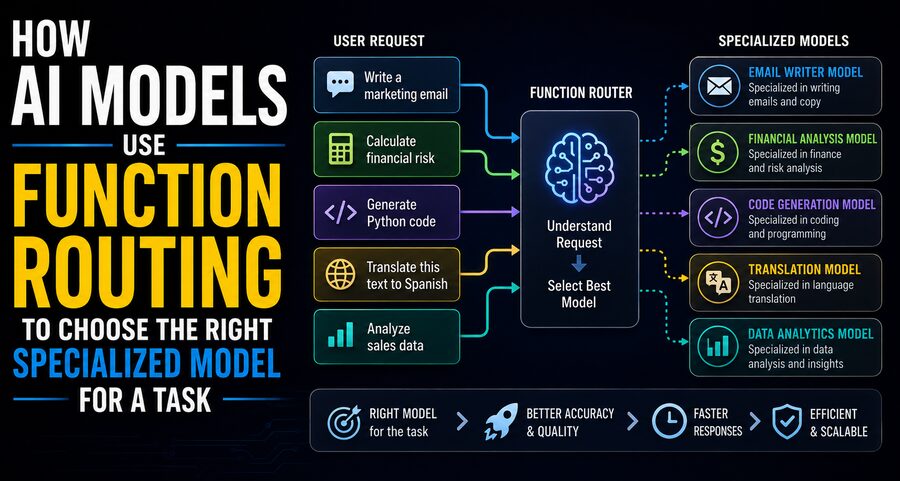

Modern AI systems do not always rely on one giant model to handle every possible request.
A single user might ask an AI assistant to summarize a contract, analyze a spreadsheet, generate an image, write code, identify an object in a photo, search a database, or solve a mathematical problem. These tasks are very different, and the model that performs best on one task may not be the best choice for another.
This is where function routing, model routing, and specialized model selection become important. 🧠🔀
Instead of sending every request through the same computational path, an AI system can first determine what kind of task is being requested. It can then route that request to the most appropriate model, tool, function, or subsystem.
Conceptually, the process looks like this:
User Request → Router → Specialized Model or Tool → Result
The router acts like an intelligent dispatcher. Its job is not necessarily to solve the entire problem itself. Instead, it decides which component should solve it.
This architecture can improve speed, lower computing costs, increase reliability, and allow AI products to combine many specialized capabilities behind one simple interface. 🚀
🧩 1. Why One Model Is Not Always Ideal for Everything
AI models have different strengths.
A small language model may respond extremely quickly and cheaply to simple questions.
A much larger reasoning model may be better at difficult planning or mathematical analysis.
A vision model may be needed to interpret images.
A speech recognition model may convert audio into text.
An image-generation model may create visual content.
A database tool may be far more reliable than a language model for retrieving an exact customer record.
Trying to make one model perform all these jobs can be inefficient.
Instead, AI systems can combine several specialized components and decide dynamically which one to use.
This is similar to how a hospital does not send every patient to the same specialist. 🏥
A receptionist or triage system first determines whether someone needs a cardiologist, radiologist, surgeon, or general physician.
AI routing performs a similar role for computational tasks.
🔀 2. What Is Function Routing?
Function routing is the process of selecting an external function or tool based on the meaning of a user’s request.
Suppose an assistant has access to these functions:
get_weather()search_products()calculate_tax()create_calendar_event()query_database()
If the user asks:
“What will the weather be in Tokyo tomorrow?”
the language model does not need to invent a weather forecast.
Instead, the routing system recognizes that this request belongs to the weather function.
It may produce an internal instruction similar to:
Use get_weather for Tokyo and requested date.
The function retrieves the required information, and the language model then turns the result into a natural-language response. 🌦️
The user sees one seamless conversation even though several software components may have participated.
🧠 3. Model Routing Is a Closely Related Idea
Function routing sends requests to tools.
Model routing sends requests to different AI models.
For example, an AI platform might have:
- A small fast model
- A large reasoning model
- A coding model
- A vision model
- A mathematical model
- A translation model
A router examines the request and decides which model should handle it.
A simple greeting might go to the smallest, fastest model:
“Hello!”
A difficult optimization problem might go to a more capable reasoning model:
“Find the minimum-cost allocation under these 18 constraints.”
An uploaded photograph may require a vision-enabled model.
The system therefore avoids using expensive computation when it is unnecessary while preserving stronger capabilities for difficult problems. ⚡
🏷️ 4. The Router First Classifies the Task
At the heart of routing is usually some form of task classification.
The system tries to understand the intent of the incoming request.
It may classify requests into categories such as:
- General conversation
- Coding
- Mathematics
- Image understanding
- Search
- Translation
- Data analysis
- Document processing
- Tool execution
This classification can be performed in several ways.
A simple system may use deterministic rules.
A more sophisticated system may use a machine-learning classifier.
Another AI architecture may ask a language model itself to select the correct function or model.
In practice, many systems combine several techniques.
📜 5. Rule-Based Routing Is the Simplest Approach
Some routing decisions can be made using straightforward rules.
For example:
If file type = image → vision model
If file type = audio → speech model
If request requires calculator → calculator tool
Rules are useful because they are:
- Predictable
- Fast
- Easy to audit
- Cheap to execute
However, language is often ambiguous.
A user might write:
“Can you figure out how much this loan really costs me?”
The request does not explicitly say “calculator.”
Yet the system may need mathematical computation.
Pure keyword matching can therefore fail on more subtle requests.
This is where learned routing becomes valuable. 🧠
🤖 6. A Language Model Can Act as the Router
A language model itself can be trained or prompted to select the correct tool.
Suppose the system provides descriptions of several available functions:
Weather function: Retrieves current and forecast weather.
Calculator function: Performs precise numerical calculations.
Calendar function: Creates and updates calendar events.
The model receives both the user’s request and descriptions of the available functions.
It then determines which function best matches the request.
For example:
“Schedule a project review for Friday at 3 PM.”
The model identifies calendar creation as the appropriate function.
This method is powerful because language models understand semantic meaning rather than merely matching keywords.
📦 7. Function Schemas Tell the Model How Tools Work
Functions often have structured definitions called schemas.
A calendar function might require fields such as:
title
start_time
end_time
location
The AI model must extract those values from the user’s natural-language request.
For example:
“Set up lunch with Priya next Tuesday at noon at Central Café.”
The model converts that into structured arguments such as:
title = "Lunch with Priya"
start_time = "Tuesday 12:00"
location = "Central Café"
The routing system then sends those arguments to the calendar function.
This is a crucial idea in modern AI systems: natural language becomes structured function input. 🗣️➡️⚙️
🎯 8. Confidence Scores Can Influence Routing
Routers do not always know the correct path with complete certainty.
A routing model may assign scores to several possible destinations.
For example:
- General language model: 0.20
- Coding model: 0.72
- Math model: 0.08
The system may choose the coding model because it has the highest confidence.
However, designers can also establish thresholds.
If confidence is too low, the request might be:
- Sent to a more capable general model
- Evaluated by a second router
- Handled through fallback logic
- Sent through multiple candidate paths
Confidence-aware routing helps reduce incorrect tool selection. 🎯
⚡ 9. Routing Can Reduce Computational Cost
Large AI models can require substantial computational resources.
Using the largest model for every request may therefore be inefficient.
Suppose 70% of user requests are simple questions.
A smaller model might handle those requests almost as well while consuming far fewer resources.
A routing system might use:
Simple task → small model
Moderate task → standard model
Complex reasoning task → large model
This is sometimes called cascaded inference.
Instead of paying the maximum computational cost for every request, the system allocates resources according to task difficulty.
This can significantly improve the economics of operating AI services. 💰
🚀 10. Routing Can Also Improve Speed
Smaller specialized models are often faster.
If a user asks a simple classification question, sending it to a huge general-purpose model may introduce unnecessary latency.
A router can send the request directly to a lightweight model designed for that task.
Similarly, mathematical calculations may be executed instantly by a deterministic calculator rather than requiring a language model to reason through arithmetic token by token.
The result can be a faster user experience.
Routing therefore helps balance:
Quality + Cost + Latency
These three factors are central to production AI engineering.
🧠 11. Specialized Models Can Outperform General Models
A general model may know a little about many tasks.
A specialized model can be optimized for one domain.
Examples include models trained specifically for:
- Medical imaging
- Legal document classification
- Code generation
- Fraud detection
- Speech recognition
- Product recommendation
- Scientific chemistry
If a router accurately identifies the task, it can send the request to a model with deeper domain-specific performance.
This can produce better results than forcing a single general-purpose model to handle every situation.
🔧 12. Tools Can Be Better Than Models for Deterministic Tasks
Not every problem should be solved with an AI model.
Suppose a user asks:
“What is 4,879 × 6,221?”
A calculator function can return an exact answer.
Likewise, if the user asks for the balance of a specific bank account, the correct source is a database—not a language model’s memory.
Good routing systems therefore distinguish between tasks requiring:
- Language generation
- External retrieval
- Calculation
- Database access
- Code execution
- Specialized inference
This helps reduce hallucination and improves factual reliability. ✅
🌐 13. Routing to Search and Retrieval Systems
Some questions depend on information outside the AI model’s training data.
For example:
“What is the current stock price?”
A model should not rely on remembered historical information.
A router can identify that live data is required and send the request to a search or market-data function.
The returned information is then incorporated into the answer.
This architecture is closely related to retrieval-augmented generation, or RAG.
Routing determines when retrieval is needed, while the language model uses the retrieved material to construct the final response.
🗃️ 14. Routing Can Select Different Knowledge Bases
An enterprise assistant may have access to several internal databases.
For example:
- HR policies
- Product documentation
- Customer records
- Legal contracts
- Engineering knowledge
- Financial reports
A router can determine which information source is relevant.
A question about vacation policy might go to the HR knowledge base.
A question about API authentication may go to developer documentation.
A customer-support question might query the CRM.
This prevents unnecessary searching across unrelated information and can improve both speed and relevance. 🏢
🧪 15. Multi-Stage Routing Can Handle Complex Requests
Some requests require more than one specialized component.
Consider:
“Analyze this sales spreadsheet and create a chart summarizing quarterly revenue.”
The system may need to:
- Read the spreadsheet.
- Analyze numeric data.
- Generate a chart.
- Explain the result.
Different tools may handle each stage.
The routing system can create a sequence:
Spreadsheet Parser → Data Analysis → Chart Generator → Language Model
This is sometimes described as an agentic workflow or tool chain.
The AI is not selecting just one destination. It is coordinating several specialized steps. 🔗
🧭 16. Routers Can Work Hierarchically
Large AI systems may use multiple routing layers.
For example:
Layer 1: Determine modality.
- Text
- Image
- Audio
- Document
Layer 2: Determine task.
- Search
- Analysis
- Generation
- Extraction
Layer 3: Select specific tool or model.
This hierarchical structure can simplify routing.
Rather than asking one classifier to choose among hundreds of destinations, the system narrows possibilities gradually.
It works much like navigating a decision tree. 🌳
🧩 17. Mixture-of-Experts Models Use Routing Internally
Routing can also happen inside a neural network itself.
A notable architecture is called a Mixture of Experts, or MoE.
Instead of activating every part of the neural network for every input, an MoE model contains multiple specialized expert subnetworks.
A routing component determines which experts should process each token or representation.
For example, only a few experts may be activated out of many available experts.
This is known as sparse activation.
The benefit is that the model can contain a very large total number of parameters while using only a subset of them for each computation. 🧠⚡
🔀 18. Expert Routing Happens at a Fine-Grained Level
In function routing, an entire user request might be sent to one tool.
In Mixture-of-Experts routing, decisions can happen at a much finer level.
Different tokens may be routed to different experts.
A mathematical expression may activate experts that have become good at mathematical patterns.
Programming syntax might activate different experts.
Importantly, these specializations are often learned automatically rather than manually assigned.
The routing network learns which experts tend to reduce prediction error for different inputs.
📈 19. Routing Must Avoid Overloading One Expert
Mixture-of-Experts systems face an interesting problem.
Suppose the router discovers one expert that performs well for many inputs.
It might send too many tokens to that expert.
This creates computational imbalance.
Some experts become overloaded while others remain idle.
Training methods therefore often include load-balancing objectives that encourage traffic to be distributed more evenly.
This demonstrates that routing is not simply about accuracy.
It must also consider resource allocation. ⚖️
🚨 20. Incorrect Routing Can Produce Bad Results
Routing systems can fail.
A request may be misunderstood and sent to the wrong tool.
For example:
“Convert this file to a table.”
The router might send it to a text summarizer instead of a document extraction tool.
Or a difficult reasoning question may be incorrectly routed to a lightweight model that cannot solve it reliably.
Errors can result from:
- Ambiguous language
- Poor function descriptions
- Weak classification models
- Overlapping tool capabilities
- Missing context
- Incorrect confidence thresholds
Routing quality therefore becomes a major part of overall AI quality.
🔁 21. Fallback Strategies Improve Reliability
Production systems often include fallback mechanisms.
Suppose a small model attempts a task but produces low confidence.
The system can escalate the request to a stronger model.
A simplified cascade might be:
Small Model → Medium Model → Large Model
Each stage is used only if the previous one appears insufficient.
Another fallback strategy is tool verification.
For example, if a database query fails, the system may try an alternative retrieval method.
Fallback architectures improve reliability while preserving efficiency for easy requests.
🧪 22. Routers Must Be Evaluated Separately
It is not enough to test only the final AI model.
The routing system itself needs evaluation.
Important metrics can include:
- Routing accuracy
- Tool-call success rate
- Model-selection accuracy
- Average cost per request
- Latency
- Fallback rate
- Failure rate
- User satisfaction
Engineers may create benchmark datasets containing thousands of requests labeled with the ideal destination.
The router’s choices can then be compared with those labels.
This makes routing performance measurable rather than subjective. 📊
🔐 23. Permissions Can Affect Routing
Enterprise systems may restrict which functions a user can access.
For example, an employee might be permitted to query HR policies but not payroll records.
Another user might be allowed to create support tickets but not delete customer data.
Routing therefore sometimes includes an authorization layer.
The system must ask not only:
“Which tool can perform this task?”
but also:
“Is this user allowed to use that tool?”
This is particularly important when AI agents can perform real actions rather than merely provide information. 🔐
⚠️ 24. High-Risk Actions May Require Confirmation
Some functions have consequences.
Creating a draft email is low risk.
Sending money, deleting records, or changing infrastructure is much more consequential.
A routing system may therefore categorize actions by risk.
A high-risk workflow might require:
- Tool selection.
- Parameter validation.
- User confirmation.
- Authorization check.
- Execution.
- Audit logging.
This turns routing into part of a broader safety architecture. 🛡️
📚 25. Tool Descriptions Matter More Than They Seem
A language model chooses tools partly based on their descriptions.
Poorly described functions can cause routing errors.
Consider two tools:
search_documents()
find_information()
If both descriptions are vague, the router may struggle.
Clearer definitions help:
search_internal_contracts: Searches signed company contracts by customer, date, or clause.
search_product_manuals: Searches technical product documentation and troubleshooting guides.
The clearer the distinction, the easier routing becomes.
Good function design therefore includes careful naming, descriptions, argument schemas, and error messages. 🧰
🧠 26. Context Influences Routing Decisions
A user’s latest message may not contain enough information by itself.
Consider this conversation:
User: “I’m planning a trip to Rome.”
User: “What’s the weather like there next week?”
The phrase “there” refers to Rome.
A routing system that ignores conversation history may not know which location to send to the weather function.
Therefore, routing frequently depends on conversational context.
The system may need to extract relevant information from earlier turns before selecting and calling a tool.
This makes routing a context-understanding problem as well as a classification problem.
💻 27. Code-Oriented Systems May Route at Multiple Levels
An AI coding assistant might route different requests differently.
For example:
“Explain this function.” → language model
“Run these tests.” → code execution environment
“Search for where this class is used.” → repository search
“Check dependency versions.” → package metadata tool
The user experiences one assistant, but many specialized functions may operate underneath it.
This modularity makes complex AI products easier to extend.
New capabilities can sometimes be added simply by registering additional tools with the router.
🔬 28. Scientific AI Can Benefit From Specialized Routing
Scientific workflows are another strong example.
A researcher might ask an AI system to:
- Search published literature
- Analyze experimental data
- Predict molecular properties
- Run statistical tests
- Visualize results
Different specialized systems may be ideal for each stage.
A router can coordinate these resources while maintaining a unified conversational interface.
This allows AI products to become orchestration layers over powerful domain-specific tools. 🔬🤖
🌍 29. Routing Helps AI Systems Scale Functionally
A major advantage of routing is that an AI product does not need to rebuild everything inside one model.
Imagine an assistant that gains new capabilities over time.
It may begin with:
- Text generation
Then add:
- Search
- Image generation
- Code execution
- Spreadsheets
- Calendar access
- Database queries
- Maps
- Scientific tools
The routing layer allows all these capabilities to coexist behind one user interface.
As new tools are added, the AI becomes more capable without requiring one monolithic model to learn every operation internally. 🌐
⚖️ 30. The Best Router Balances Several Objectives
Choosing the “best” model is not always about maximum accuracy.
The router may need to balance:
Quality — Will this model solve the task correctly?
Speed — How quickly can it respond?
Cost — How expensive is the computation?
Availability — Is the model currently overloaded?
Privacy — Can sensitive data be sent to this system?
Capability — Does it support the required modality or tool?
Risk — Is additional verification required?
Routing is therefore a constrained optimization problem.
The ideal path may change depending on both the task and the operating environment. 🧮
🏁 Conclusion
Function routing allows modern AI systems to behave less like one universal model and more like an intelligent team of specialists.
When a request arrives, a routing layer examines its meaning, context, required capabilities, and sometimes its difficulty or risk.
It then decides whether the request should go to:
- A general language model
- A specialized reasoning model
- A vision system
- A coding model
- A calculator
- A search engine
- A database
- An external business function
- A sequence of multiple tools
In Mixture-of-Experts architectures, a similar idea can even operate internally, where different parts of a neural network are selectively activated for different inputs. 🧠🔀
Good routing improves efficiency because simple requests do not need the most expensive model.
It improves reliability because deterministic tools can handle tasks such as calculation or data retrieval.
It improves extensibility because new capabilities can be added as additional tools or models.
And it improves user experience because all of this complexity can remain hidden behind a single conversational interface.
The central principle is simple:
Do not ask one component to do everything. First understand the task, then send it to the component best equipped to solve it. 🤖⚙️🚀
That routing layer is increasingly becoming one of the most important pieces of modern AI system architecture.