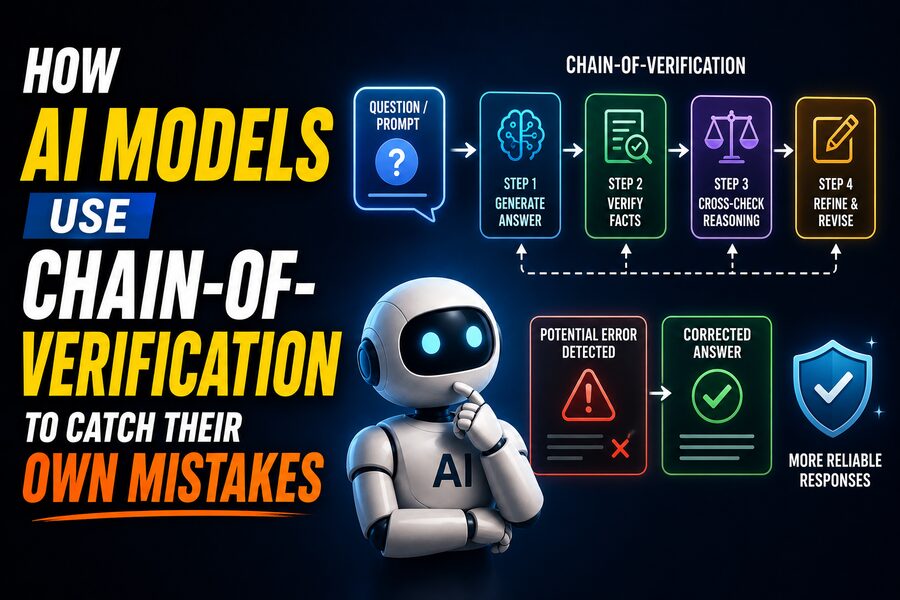

Artificial intelligence models can produce remarkably fluent answers, but fluency is not the same as correctness. A response may sound confident while containing a wrong date, an inconsistent calculation, a fabricated citation, or a conclusion that does not actually follow from the evidence. 🧠⚠️
To reduce these kinds of errors, AI systems can use a family of techniques often described as verification-based reasoning. One well-known approach is Chain-of-Verification, sometimes abbreviated as CoVe.
The basic idea is straightforward:
Generate an initial answer, identify claims that should be checked, verify those claims independently, and then revise the final response using the verification results. 🔍✅
Instead of treating the first generated answer as final, the system creates a second opportunity to detect mistakes.
This does not make an AI model infallible. Verification itself can fail, especially if the model relies only on its own imperfect knowledge. But when designed carefully—particularly when combined with external tools, trusted databases, calculators, code execution, or retrieval systems—verification can substantially improve reliability.
🧠 Why AI Models Make Confident Mistakes
Large language models generate text by predicting likely sequences of tokens based on patterns learned during training.
This allows them to write naturally about an enormous range of subjects.
However, the model is not simply retrieving perfectly verified facts from a database.
It can make several kinds of errors:
- 📅 Incorrect dates
- 🔢 Arithmetic mistakes
- 👤 Misattributed names
- 📚 Fabricated references
- 🔄 Contradictory statements
- 🧩 Missing logical steps
- 🌍 Incorrect factual details
- 📊 Misread statistics
One reason these errors can be difficult to notice is that the same language-generation ability that produces correct explanations can also produce plausible-sounding incorrect ones.
Verification techniques attempt to separate answer generation from answer checking.
🔍 What Is Chain-of-Verification?
Chain-of-Verification is a structured process in which an AI system does not immediately trust its initial response.
A simplified workflow looks like this:
1. Generate an initial answer
⬇️
2. Identify claims that may require verification
⬇️
3. Create targeted verification questions
⬇️
4. Check those questions independently
⬇️
5. Compare the results with the original answer
⬇️
6. Produce a corrected final answer
The important concept is that verification is treated as a distinct stage rather than as a vague instruction to “be more careful.”
This structure can help the model focus specifically on potentially weak parts of its response. 🎯
📝 Step 1: Produce a Draft Answer
Suppose an AI is asked:
“Which planet has the shortest day in the Solar System?”
The model might initially answer:
“Jupiter has the shortest day, rotating once roughly every 10 hours.”
That answer may be correct, but a verification-oriented system does not necessarily stop there.
It treats the statement as a draft containing claims that can be checked.
For example:
- Is Jupiter really the fastest-rotating planet?
- What is its approximate rotational period?
- Is there another planet with a shorter day?
This transforms one answer into several specific factual questions.
❓ Step 2: Generate Verification Questions
The next stage is to identify the factual dependencies inside the answer.
For a more complicated statement, such as:
“The Eiffel Tower opened in 1889 for the World’s Fair and was the world’s tallest structure at the time.”
the system might separate this into several verification targets:
- Did the Eiffel Tower open in 1889?
- Was it constructed for the 1889 Exposition Universelle?
- Was it the tallest human-made structure at that time?
Breaking claims apart is useful because a sentence can contain both correct and incorrect information.
Instead of judging the entire sentence as one unit, the system verifies each important component individually. 🧩
🧪 Step 3: Verify Claims Independently
This is one of the most important aspects of the technique.
If the AI simply rereads its original answer and asks itself whether it “looks right,” it may repeat the same mistake.
A stronger design attempts to make the verification step as independent as possible.
Verification might use:
- Trusted documents 📚
- Search or retrieval systems 🔎
- Databases 🗄️
- Calculators 🧮
- Code execution 💻
- Scientific references 🔬
- Structured APIs
- Separate model passes
The more independent and authoritative the verification source, the more useful the check becomes.
For numerical claims, a calculator may be much more reliable than asking the language model to mentally recompute the same expression.
🧮 Example: Catching an Arithmetic Error
Imagine an AI initially says:
“A product discounted from $240 to $180 received a 20% discount.”
That sounds plausible, but it is incorrect.
The reduction is:
240 − 180 = 60
The percentage discount is:
60 ÷ 240 × 100 = 25%
A verification process could create the question:
“What percentage decrease takes $240 to $180?”
Using a calculator or independent computation reveals the correct result.
The final response can then be revised to:
“The discount is 25%.”
This demonstrates why separating generation from verification can catch mistakes that slip through an initial response. 🔢✅
🔄 Why a Second Pass Can Help
When a model generates an answer, it is optimizing for producing a coherent continuation.
During verification, the task changes.
Instead of asking:
“What is the answer?”
the system asks:
“Which claims in this answer could be wrong, and how can they be tested?”
That shift in objective can improve performance.
The model becomes a critic rather than merely a generator.
This is similar to human writing.
An author may overlook an error while drafting but spot it immediately when proofreading with a different goal in mind. ✍️🔍
⚖️ Verification Is Not the Same as Confidence
An AI model might assign high confidence to an incorrect statement.
Therefore, simply asking:
“Are you sure?”
is weaker than performing actual verification.
Good verification focuses on evidence.
For example:
Weak approach:
“Does this answer seem correct?”
Stronger approach:
“What source or calculation establishes each key factual claim?”
The second approach forces the system to test the answer rather than merely repeat its confidence.
🌐 Retrieval Makes Verification Stronger
Verification becomes much more powerful when an AI model can access trusted external information.
Suppose a user asks about a scientific discovery.
The model produces an initial answer containing:
- Discovery date
- Researchers’ names
- Journal title
- Experimental result
A retrieval system can independently search relevant documents and verify each fact.
If the retrieved evidence conflicts with the draft, the answer can be corrected.
This architecture is often closely related to retrieval-augmented generation, or RAG.
A possible workflow is:
Generate → retrieve evidence → compare → revise
This is generally stronger than relying entirely on model memory. 📚🤖
📚 Catching Fabricated Citations
One particularly important application involves citations.
Language models can sometimes generate references that look realistic but do not actually exist.
For example, a model might invent:
- A plausible paper title
- A realistic journal name
- Author names
- Publication year
- DOI
A verification stage can check whether the cited source is actually present in a trusted scholarly database or retrieved document set.
If the citation cannot be confirmed, the system can remove it or clearly state that it could not be verified.
This is much safer than presenting a convincing but nonexistent source as fact. 🚫📖
📊 Checking Consistency Across an Answer
Verification is not limited to external facts.
It can also detect internal contradictions.
Suppose a report says:
Revenue increased from $8 million to $10 million, representing 30% growth.
Later, it says:
The company grew by 25%.
The numerical change from 8 to 10 is:
(10 − 8) ÷ 8 = 25%
A consistency check can identify that the 30% figure conflicts with both the numbers and the later statement.
This type of validation is useful in financial analysis, business reports, and technical writing. 📈
🧠 Verification Questions Should Be Targeted
Not every sentence requires equal scrutiny.
A verification system should prioritize claims that are:
- Specific
- Numerical
- Easily falsifiable
- High-impact
- Time-sensitive
- Unusual
- Central to the conclusion
For example, in the statement:
“Marie Curie won Nobel Prizes in Physics and Chemistry.”
the specific fields and number of prizes are important factual claims.
The phrase:
“She was an influential scientist.”
is broader and less suited to binary verification.
Targeted verification reduces unnecessary work.
🚦 Risk-Based Verification
Some applications require stronger checking than others.
For a casual question about movie trivia, lightweight verification may be enough.
For areas such as:
- Medicine 🏥
- Law ⚖️
- Finance 💰
- Engineering 🏗️
- Cybersecurity 🔐
- Scientific research 🔬
mistakes can have serious consequences.
In these domains, systems may use stronger safeguards such as:
- Multiple independent sources
- Structured calculations
- Domain-specific databases
- Human review
- Explicit uncertainty reporting
Verification intensity should match the potential cost of being wrong.
🤝 Using Multiple Models or Agents
Another strategy is to separate the roles of generator and verifier.
For example:
Model A: Draft the answer.
Model B: Critique factual claims.
Model C: Check numerical calculations.
Model D: Compare the answer with retrieved evidence.
The final system then reconciles the results.
This is sometimes described as a multi-agent or ensemble approach.
The advantage is that independent components may catch different kinds of mistakes.
However, several AI systems trained on similar data can still share the same misconceptions, so independence is not guaranteed. 🧠🧠
🧮 Tool-Based Verification
Certain claims are much better checked with specialized tools than with language generation.
Examples include:
Mathematics
Use a calculator or symbolic mathematics engine.
Code
Run the program and inspect the output.
Dates
Check an authoritative timeline or database.
Geographic data
Use a mapping or geographic information source.
Financial data
Use structured market or accounting data.
Scientific claims
Check peer-reviewed literature or trusted datasets.
This illustrates an important principle:
The best verifier may not be another language model.
Sometimes the correct tool provides much stronger evidence. 🛠️
💻 Verifying Programming Answers
Suppose an AI writes a function that should sort a list.
The code may look correct but contain an edge-case bug.
A verification workflow can:
- Generate the code.
- Run unit tests.
- Test empty input.
- Test duplicate values.
- Test large inputs.
- Compare output against expected results.
- Revise the code if tests fail.
Here, verification is concrete.
The code either passes or fails specific tests.
AI coding tools become significantly more reliable when generation is paired with execution and testing. 🧪💻
🔢 Numerical Self-Checks
AI-generated analyses frequently contain calculations.
Verification can recompute those calculations independently.
Suppose the model says:
“A company grew revenue from $4.2 million to $5.1 million, an increase of 18%.”
A separate check computes:
(5.1 − 4.2) ÷ 4.2 × 100 ≈ 21.4%
The discrepancy can be flagged before the final answer is shown.
Automating such checks can eliminate many simple but damaging mistakes. 📊
🧭 Checking Whether the Conclusion Follows
Some errors are logical rather than factual.
Imagine the evidence says:
Website traffic increased 15% after a redesign.
The AI concludes:
“Therefore, the redesign caused the company to become more profitable.”
That conclusion does not necessarily follow.
Traffic may have increased without conversions or profit improving.
A verification pass can ask:
“Does the evidence provided actually support this conclusion?”
This helps distinguish:
- Correlation from causation
- Evidence from speculation
- Observation from interpretation
Such reasoning checks are particularly important in analytical writing.
🧩 Decomposing Complex Claims
The larger a claim, the harder it is to verify directly.
Suppose an AI says:
“Electric vehicles always produce fewer lifetime emissions than gasoline vehicles.”
That statement depends on many variables:
- Electricity generation mix
- Battery manufacturing
- Vehicle size
- Lifetime mileage
- Fuel efficiency
- Battery lifespan
A strong verifier decomposes the broad claim into smaller assumptions rather than accepting or rejecting it as one block.
This process makes uncertainty visible. 🔍
🔁 Iterative Verification
Verification can happen more than once.
A system might follow:
Draft
⬇️
Verify facts
⬇️
Revise
⬇️
Check calculations
⬇️
Revise
⬇️
Check final consistency
⬇️
Answer
Each stage addresses a different error category.
However, repeated verification has a cost.
It consumes additional computation, increases latency, and may still introduce new mistakes.
The number of checks therefore needs to be balanced against the importance of the task.
💰 Verification Has a Computational Cost
A simple AI response might require one model call.
A verification-based response may require:
- Initial generation
- Claim extraction
- Verification questions
- Retrieval
- Additional model evaluation
- Final rewriting
This can multiply the computational workload.
For consumer applications where response speed matters, running a full verification pipeline on every trivial question may be inefficient.
A practical system may verify only when:
- The answer contains many factual claims
- The user requests citations
- The topic is high-risk
- Confidence is low
- The answer contains complex calculations
This is called selective verification.
⚠️ Verification Can Still Be Wrong
Chain-of-Verification is not a guarantee of truth.
Several failure modes remain.
🔄 Repeating the Same Misconception
If both the original answer and verifier rely on the same incorrect learned information, the error may survive.
📚 Bad Sources
Retrieved information may itself be inaccurate.
🧩 Incomplete Questions
The system may fail to identify the most important claim to verify.
🌀 New Errors During Revision
A corrected answer can accidentally introduce another mistake.
⚖️ Conflicting Evidence
Different sources may disagree.
A robust system must therefore treat verification as error reduction, not perfect proof.
📏 Measuring Verification Quality
Researchers can evaluate verification systems by examining whether they improve metrics such as:
- Factual accuracy
- Citation correctness
- Numerical accuracy
- Contradiction rate
- Hallucination frequency
- Calibration
- Task completion accuracy
A good verifier should not merely change answers.
It should make incorrect answers more likely to become correct while avoiding unnecessary changes to already correct responses.
This distinction is important.
A verifier that constantly rewrites correct answers could actually reduce overall reliability.
🧠 Verification and Uncertainty
Sometimes the correct output is not a definitive answer.
If reliable evidence is unavailable or conflicting, the system should communicate uncertainty.
For example:
“The available sources disagree on the exact figure, so I cannot verify a single value confidently.”
This can be better than manufacturing precision.
An effective verification system therefore improves not only correctness but also calibration—the relationship between confidence and actual evidence. 🎯
🛡️ Human Review Still Matters
For important decisions, automated verification should often supplement rather than replace expert review.
Examples include:
- Medical diagnosis
- Legal advice
- Structural design
- Major financial decisions
- Safety-critical engineering
AI can check calculations, summarize evidence, identify inconsistencies, and flag uncertain claims.
A qualified professional can then evaluate the broader context.
The combination can be stronger than either one alone. 👩⚕️🤝🤖
🔬 Chain-of-Verification in Research Workflows
Researchers can use verification-oriented AI systems to:
- Check extracted facts
- Compare summaries with original papers
- Validate citations
- Recalculate reported percentages
- Identify unsupported claims
For example, an AI summarizing a paper might initially claim:
“The study included 5,000 participants.”
A verification step can inspect the original methods section.
If the actual sample size was 500, the summary can be corrected before publication.
This type of grounded verification is especially valuable because even a small numerical error can distort the interpretation of a study. 🔬📚
📰 Fact-Checking Generated Content
Verification pipelines can also support journalism and editorial work.
An article draft may contain dozens of factual claims involving:
- Dates
- Locations
- Names
- Statistics
- Quotations
- Historical events
An AI-assisted fact-checker can extract those claims and compare them against reliable sources.
Human editors can then focus attention on disputed or uncertain items.
The result is not fully automatic truth verification, but a more efficient checking process. 📰✅
🏢 Business Applications
Companies can use verification mechanisms in AI-generated:
- Financial summaries
- Sales reports
- Customer communications
- Compliance documents
- Operational dashboards
- Market research
For example, a sales-analysis AI may claim:
“Region West had the highest quarterly growth.”
A verification query can directly compare the regional growth values in the source database.
If Region North actually performed better, the final report can be corrected automatically.
This is much safer than allowing generated commentary to operate independently of structured business data.
🧠 Verification vs. Simple Repetition
A crucial distinction is that verification should introduce new evidence or a new test.
If the process is:
Generate answer → Ask the same model to repeat the answer
little has been gained.
Stronger verification changes the task.
Examples include:
Generate numerical result → recompute with calculator
Generate citation → search database
Generate code → execute tests
Generate summary → compare against source document
Generate claim → ask targeted falsification question
The more independent the test, the more useful the verification stage becomes.
🔍 Falsification Can Be Powerful
A particularly useful verification strategy is to actively look for reasons the draft might be wrong.
Instead of asking:
“Can I confirm this statement?”
ask:
“What evidence would contradict this statement?”
This reduces confirmation bias.
For example, if the draft says:
“All major browsers support feature X.”
the verifier can search specifically for browsers that do not support it.
Finding one counterexample is enough to disprove the universal claim.
This adversarial style of checking can be highly effective. ⚔️
🧩 Verification as a Software Architecture
In production AI systems, Chain-of-Verification is often better understood not as one special prompt but as an architecture.
A reliable application might contain:
- A generation model
- A claim extractor
- A retrieval engine
- Structured tools
- A verifier
- A confidence evaluator
- A final response generator
Each component handles a different part of reliability.
This modular approach allows developers to improve verification without retraining the entire language model.
🚀 How Future AI Systems May Verify More Effectively
Future AI systems are likely to combine several verification technologies:
- Live retrieval 🌐
- Structured databases 🗄️
- Automatic code execution 💻
- Mathematical solvers 🧮
- Citation validation 📚
- Multiple independent models 🤖
- Domain-specific validators 🧪
- Provenance tracking 🔗
The system might automatically recognize that a claim is numerical, send it to a calculator, identify that another claim is historical, check a trusted source, and then reconcile all results before responding.
Verification may increasingly become a built-in layer between generation and user-facing output.
🎯 The Central Lesson
The most important idea behind Chain-of-Verification is that the first answer should not always be trusted simply because it sounds convincing.
A reliable AI system can treat its draft as a hypothesis.
Then it asks:
- Which parts are factual?
- Which parts are uncertain?
- Which claims can be independently tested?
- Does the evidence support the conclusion?
- Are the numbers consistent?
- Are the citations real?
- Does anything contradict the draft?
Only after those checks does it construct the final response.
That process resembles how careful humans work in science, engineering, journalism, and analysis. 🔍
🏁 Final Thoughts
Chain-of-Verification helps AI systems reduce mistakes by separating answer generation from answer validation.
Instead of producing a response in one pass, the system can generate a draft, identify potentially fragile claims, verify them using independent questions or external tools, and then revise the answer based on what those checks reveal.
The approach can catch:
- Arithmetic mistakes 🔢
- Contradictions 🔄
- Fabricated citations 📚
- Incorrect dates 📅
- Unsupported conclusions ⚠️
- Misread source material 🔍
Its effectiveness depends heavily on the quality of the verification process.
A model checking itself using the same uncertain information may still preserve errors. Verification becomes much stronger when it uses independent evidence, structured tools, calculators, code execution, trustworthy documents, or multiple sources.
The deeper lesson is simple:
Good AI should not merely generate answers—it should also test whether those answers deserve to be trusted. 🤖✅
As AI systems become responsible for more complex business, scientific, technical, and analytical tasks, verification layers will likely become increasingly important. The future of reliable AI may depend not only on models becoming better at answering questions, but also on systems becoming better at challenging, checking, and correcting the answers they generate. 🔍🧠✨