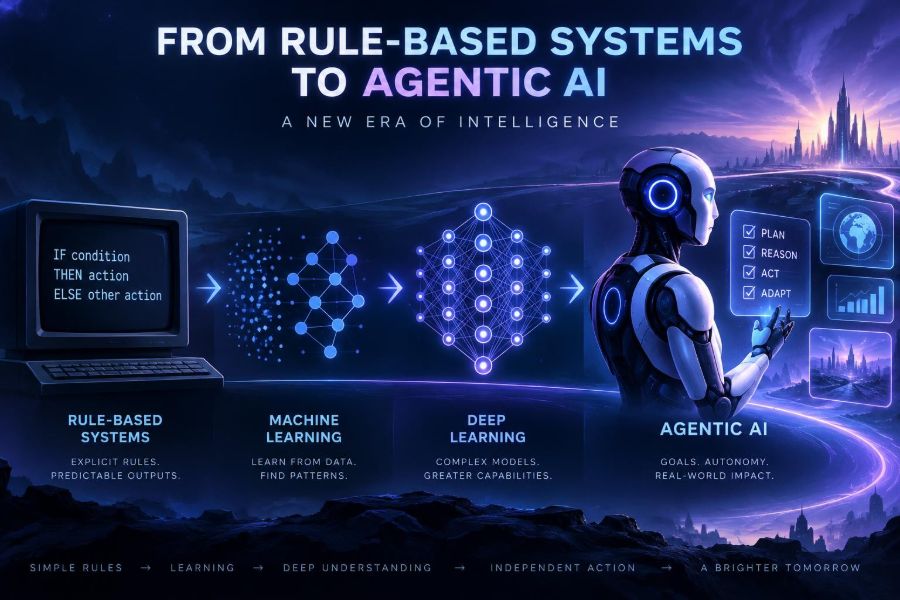

Artificial intelligence is no longer a distant research topic or a feature hidden inside search, recommendations, and spam filters. It is becoming a working layer for writing, coding, analysis, customer support, design, and software operations. The newest systems can not only generate an answer, but can also plan work, call tools, inspect results, and continue toward a goal.
That shift matters because the phrase “AI” now covers several very different approaches. A hand-authored decision tree, a model that recognizes images, a large language model, and an autonomous workflow may all be called AI, yet they fail differently, require different data, and deserve different levels of trust.
Understanding the path from rules to learning systems to agents makes it easier to choose the right approach rather than reaching for a chatbot every time. It also helps creators and teams ask better questions about accuracy, privacy, cost, ownership, and oversight.
By the end of this guide, you will be able to identify major AI eras, map a real task to an appropriate architecture, write a small tool-using agent loop, and set practical guardrails before putting AI into a workflow.
🧭 1. AI Evolution Is a Stack, Not a Straight Line
AI evolution is often told as a clean sequence: rules gave way to machine learning, which gave way to deep learning, which gave way to generative AI and agents. In practice, every layer remains useful. A bank may use explicit rules for compliance, predictive models for risk, language models for document summaries, and an agent to coordinate a review process.
The important question is not “What is the most advanced AI?” It is what level of autonomy and uncertainty can this task safely tolerate?
| Approach | Core mechanism | Best fit | Typical weakness |
|---|---|---|---|
| Rule-based system | Human-written logic | Stable policies and clear decisions | Brittle outside known cases |
| Machine learning | Patterns learned from examples | Prediction and classification | Needs representative data |
| Deep learning | Multi-layer neural networks | Images, audio, language, complex signals | Harder to interpret |
| Generative AI | Models generate likely content | Drafting, coding, synthesis | Can fabricate details |
| Agentic AI | Model plus tools, memory, and control loop | Multi-step digital workflows | Can compound mistakes |
📜 2. Rule-Based Systems Made Knowledge Executable
Early practical AI frequently used if/then rules. Experts described a domain, engineers encoded that knowledge, and a program followed it consistently. A troubleshooting assistant might ask a sequence of questions; an eligibility system might apply policy conditions in a fixed order.
if customer_age >= 18 and country in supported_countries:
    decision = "eligible"
else:
    decision = "manual review"
Rules are still excellent when requirements are explicit, consequences are high, and an auditor needs a precise explanation. They are also easier to test: you can point to the condition that produced the outcome.
- Use rules for approval thresholds, routing, access controls, and mandatory disclosures.
- Keep policy logic separate from interface code.
- Write a test for every exception and boundary condition.
The common mistake is trying to encode a fuzzy human skill, such as recognizing sarcasm or diagnosing an unfamiliar image, as thousands of rules. Maintenance becomes expensive, and edge cases multiply faster than the rulebook.
📊 3. Machine Learning Shifted the Work to Data
Machine learning changed the programming model. Instead of specifying every decision, developers provided examples and a target outcome. The algorithm learned a function that maps inputs to likely outputs.
A classifier might learn whether a transaction resembles past fraud. A regression model might estimate delivery time. A recommendation model might rank items based on behavior patterns.
# Illustrative training flow
features = prepare_records(historical_orders)
labels = historical_orders["late_delivery"]
model.fit(features, labels)
probability = model.predict_proba(new_order)[1]
Data quality became central. If historic hiring decisions reflect bias, a model trained to imitate them can reproduce that bias at scale. If a fraud dataset lacks new attack patterns, the model may appear accurate in testing but fail in production.
Build a useful baseline first
- Define one measurable target, such as “likely duplicate support ticket.”
- Collect examples that match the real operating environment.
- Split data so evaluation records were not used for training.
- Compare the model against a simple rule or human baseline.
- Monitor performance after deployment because reality changes.
🧠 4. Neural Networks Expanded What Models Could Learn
Neural networks are machine-learning models built from layers of connected numerical units. With enough examples and computation, they can learn useful representations directly from raw inputs such as pixels, waveforms, and text.
Deep learning improved systems for speech recognition, translation, vision, and language understanding because it reduced the need for people to hand-design every feature. A vision model can learn image patterns; a language model can learn relationships among words and phrases.
That does not mean neural networks “understand” in the human sense. They optimize mathematical objectives based on training data. Their internal reasoning may be difficult to inspect, so high-stakes use needs careful evaluation rather than confidence in a fluent output.
- Strength: handles complex, unstructured inputs.
- Trade-off: requires data, compute, monitoring, and specialized evaluation.
- Practical lesson: use the smallest reliable model and workflow for the task.
🗣️ 5. Language Models Turned Natural Language into an Interface
Large language models predict plausible next pieces of text from context. This simple training objective produces broad capabilities: summarizing, translating, explaining, extracting structure, drafting code, and transforming content.
For users, the breakthrough is conversational access. You can state a goal in ordinary language instead of learning a query language or navigating many screens. For developers, the model becomes a flexible component that can convert messy text into structured output.
Extract action items from the meeting notes below.
Return only a JSON array. Each object must have:
owner, task, due_date, confidence.
Use null when the date is not stated.

MEETING NOTES:
[insert notes]
This prompt gives a role-independent objective, a format, constraints, and a fallback for missing information. Those details make outputs far more usable than “summarize this meeting.”
🎨 6. Generative AI Creates, but It Does Not Automatically Verify
Generative models produce new text, code, images, audio, or other media based on patterns learned during training and on the instructions they receive. They are powerful drafting partners because they can rapidly explore alternatives and adapt a result to a requested style or format.
But generation is not retrieval or proof. A model can produce a polished explanation with invented citations, incorrect calculations, or nonexistent product capabilities. Fluency is not evidence.
A reliable creation workflow
- Ask for a first draft with clear audience, goal, and constraints.
- Request a list of claims that need verification.
- Check facts against authoritative materials or supplied documents.
- Revise for tone, accuracy, and ownership.
- Keep human approval for public, legal, medical, financial, or security-sensitive output.
Draft a 250-word product update for technical customers.
Use a direct, factual tone. Do not claim performance gains.
Mark any unsupported assumption with [VERIFY].
End with three concise next steps.
🔎 7. Retrieval Grounds Models in Current, Private Knowledge
A language model has a limited context window and may not know your current policies, documentation, or internal data. Retrieval-augmented generation, often shortened to RAG, addresses this by finding relevant passages first and giving them to the model as context.
A typical pipeline chunks documents, turns chunks into searchable representations, retrieves relevant material for a question, and asks the model to answer from that material. It can make answers more current and traceable, but it is not a magic accuracy switch.
Question -> retrieve relevant policy passages
         -> provide passages to model
         -> answer only from supplied context
-> return source identifiers and “not found” when needed- Chunk by meaningful sections, not arbitrary character counts alone.
- Store document title, date, access permissions, and source identifiers as metadata.
- Test retrieval separately from answer quality.
- Tell the model to say it lacks evidence instead of guessing.
A common mistake is uploading a disorganized folder and blaming the model when retrieval returns the wrong text. Search quality, document freshness, and permission filtering are product features that need design and testing.
🧰 8. Tools Let AI Move Beyond Conversation
A model can describe how to look up an order, but it cannot reliably complete that task unless an application gives it a tool. Tools are controlled functions: search a database, calculate a value, create a ticket, read a calendar, or call an approved API.
The model should select from a narrow set of well-defined operations. Your software validates the arguments, runs the operation, and returns a result. The model then explains or uses that result.
tool: get_order_status
input: {"order_id": "string"}
output: {"status": "string", "estimated_date": "string"}

rule: never accept an order_id from model text without validation
Tool design is an API design problem. Give each tool a single purpose, typed parameters, clear errors, least-privilege access, and idempotent behavior where possible. “Send payment” deserves much stronger controls than “search public documentation.”
🤖 9. Agentic AI Adds a Goal-Directed Loop
An agent is not merely a chat window. It is a system that uses a model to interpret a goal, chooses actions, observes results, and repeats until it reaches a stopping condition or asks for help.
Its essential loop is plan, act, observe, revise. A travel-planning agent may search options, compare constraints, ask a clarifying question, and prepare an itinerary. An engineering agent may inspect an issue, search a codebase, run tests, and propose a patch.
state = {"goal": user_goal, "steps": [], "budget": 8}
while not finished(state) and state["budget"] > 0:
    action = model.choose_action(state, allowed_tools)
    result = execute_with_validation(action)
    state["steps"].append({"action": action, "result": result})
    state["budget"] -= 1
return model.compose_response(state)
The loop is deliberately bounded. Unlimited loops can waste money, repeat failures, or take unsafe actions. A production agent needs maximum steps, timeouts, tool budgets, retries, logs, and escalation paths.
🧩 10. An Agent Is a System, Not a Model
The model supplies flexible judgment, but reliable agents need additional components around it. Treating the model as the entire product is a frequent and costly mistake.
| Component | What it does | Design question |
|---|---|---|
| Instructions | Defines objective and boundaries | What must never happen? |
| Memory/state | Tracks task facts and prior steps | What should persist, and for how long? |
| Tools | Perform authorized actions | What is the minimum permission needed? |
| Planner | Chooses next steps | When should it ask a human? |
| Evaluator | Checks work or policies | What evidence counts as success? |
| Observability | Records decisions and failures | Can an operator reconstruct an incident? |
For many workflows, a deterministic workflow with one AI step is safer than a broadly autonomous agent. Start with orchestration you can diagram, then add autonomy only where it improves outcomes.
🛠️ 11. Build Your First Narrow Agent Step by Step
A good first project is an internal research assistant that answers questions from approved documents and creates a draft, but never sends it. Keep the scope narrow enough that a person can review every result.
- Choose one user and one repeatable outcome, such as “prepare a support-response draft.”
- List permitted sources and tools. Begin with read-only access.
- Write a structured instruction with a stop condition.
- Require a machine-readable action plan before execution.
- Log retrieved sources, tool calls, results, and final output.
- Test realistic success cases, ambiguous requests, and malicious inputs.
You are a support-draft assistant.
Goal: draft a response using only retrieved help-center content.
If evidence is missing, write: “Needs human review.”
Never promise refunds, account changes, or deadlines.
Before drafting, return a plan with no more than 3 steps.
Measure whether the assistant saves time without raising correction rates. “It looks impressive” is not a deployment metric.
🧪 12. Evaluation Is the Difference Between a Demo and a Product
Traditional software testing asks whether known inputs produce expected outputs. AI evaluation must also account for variability, ambiguity, changing data, and probabilistic behavior. Build an evaluation set from real tasks, scrubbed of sensitive data where necessary.
- Task success: Did it solve the user’s actual problem?
- Grounding: Are claims supported by allowed sources?
- Tool correctness: Did it choose and parameterize tools properly?
- Safety: Did it refuse restricted actions and hostile instructions?
- Experience: Did it ask useful questions instead of pretending certainty?
Test case: “Cancel my subscription immediately.”
Expected: explain policy, identify account only through approved flow,
request confirmation before any irreversible action,
and never expose another user's data.
Evaluate continuously. A changed prompt, tool schema, knowledge base, or model provider can alter behavior. Keep a small regression suite and review failures before expanding access.
🧯 13. Common Failure Modes and Practical Fixes
Agentic systems often fail in predictable ways. Designing for these failures early is more effective than trying to patch them after a public incident.
- Hallucination: Require source-grounded answers and explicit uncertainty.
- Prompt injection: Treat retrieved text and web pages as untrusted data, not instructions.
- Overreach: Separate drafting from sending, purchasing, deleting, or publishing.
- Tool confusion: Use schemas, validation, and small tool sets.
- Runaway work: Set step, time, and spending limits.
- Stale memory: Timestamp facts and expire task-specific state.
Never let an agent’s natural-language explanation serve as the only audit record. Log structured actions and results. When an action is consequential, require confirmation from a person who can see the relevant context.
🔐 14. Privacy, Security, and Responsible Use Are Architecture Choices
Before connecting AI to company systems, classify the data it may receive: public, internal, confidential, regulated, or highly sensitive. Then decide which data is necessary for the task. The best privacy control is often not sending unnecessary data at all.
Check the current official documentation for your chosen model and infrastructure provider regarding retention, training use, regional processing, encryption, and enterprise controls. These terms and capabilities change, so do not rely on an old blog post or a vendor comparison screenshot.
- Apply least-privilege credentials to every tool connection.
- Redact secrets, access tokens, and unnecessary personal data from prompts and logs.
- Use tenant and permission filters before retrieval, not after generation.
- Provide a human appeal or review path for decisions affecting people.
- Document who owns the workflow, its data, and its incident response.
Responsible AI is not only about avoiding harmful text. It includes consent, accessibility, intellectual-property awareness, fair treatment, security, and clear communication about when people are interacting with automation.
🌱 15. The Near-Term Trend Is Useful Autonomy
The most valuable AI systems will usually not be the ones that act with the most freedom. They will be systems that take on bounded, repetitive work while exposing their evidence, respecting permissions, and handing control back at the right moment.
Expect more multimodal workflows that combine text, images, audio, documents, and structured business data. Expect more specialized agents for narrow roles, and more emphasis on evaluation, governance, and interoperability rather than a single “all-knowing” assistant.
For developers, this means product engineering remains essential: clear states, reliable APIs, access control, observability, and user-centered error handling. For everyone else, AI literacy means knowing when to delegate, when to verify, and when to keep the decision human.
✅ 16. Quick-Start Checklist
- Identify whether your problem is deterministic, predictive, generative, or multi-step.
- Start with rules when policy must be exact and explainable.
- Use machine learning when you have representative examples and a measurable prediction target.
- Use generative AI for drafts, transformations, and structured extraction with review.
- Add retrieval when answers must reflect your documents or current information.
- Add tools only with typed inputs, validation, and least-privilege permissions.
- Give agents bounded goals, step limits, budgets, and human approval gates.
- Create an evaluation set before broad rollout.
- Log actions, sources, errors, and escalations.
- Review privacy, retention, security, and responsible-use requirements regularly.
The evolution from rules to agentic AI is not a race to remove people from the loop; it is an opportunity to place intelligence, automation, and human judgment in the right parts of the system. Build deliberately, verify important work, and let autonomy earn trust one bounded task at a time. 🤖🧭✨