
Modern artificial intelligence models can be remarkably capable, but their performance often comes with a cost. Large neural networks may contain billions of parameters, require powerful GPUs, consume substantial memory, and take considerable time and energy to run. These requirements can make advanced AI difficult to deploy on smartphones, embedded devices, edge computers, or high-traffic online services.
One technique engineers use to address this problem is knowledge distillation. 🧪🤖
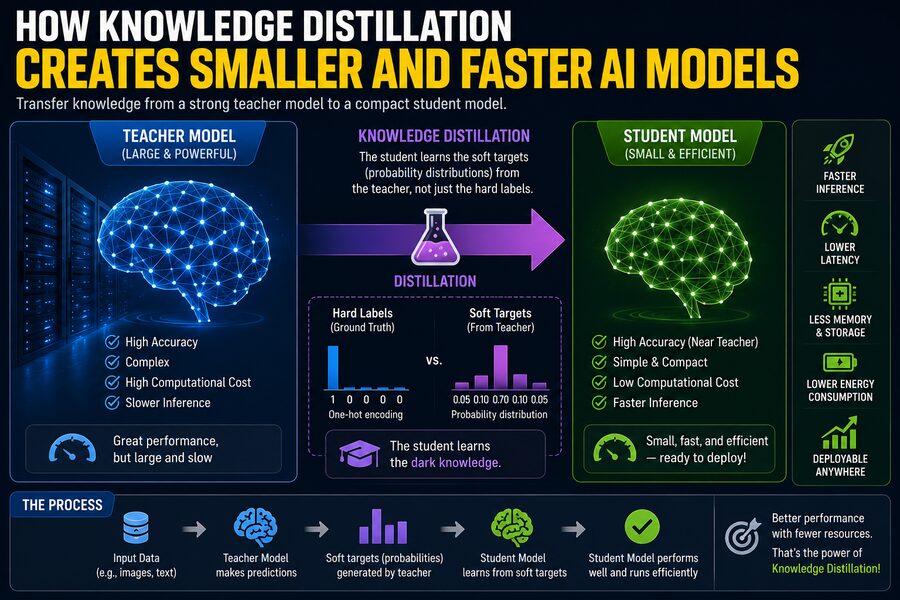
Knowledge distillation is a machine-learning method in which a large, capable model—called the teacher—helps train a smaller model—called the student. Instead of forcing the smaller model to learn only from the original training labels, engineers allow it to learn from the teacher’s predictions and, in some approaches, its intermediate representations.
The goal is to transfer as much useful behavior as possible from the large model into a much smaller network.
If successful, the student model can retain much of the teacher’s accuracy while requiring less memory, less computation, lower energy consumption, and shorter inference time.
🎓 The Teacher-and-Student Idea
The central concept behind knowledge distillation is surprisingly intuitive.
Imagine an experienced professor teaching a student.
The student could learn only by reading a textbook and checking whether answers are right or wrong. But learning may be much more effective if the professor also explains:
Which alternatives are almost correct
Which concepts are closely related
Where common mistakes occur
How confident the professor is in an answer
Knowledge distillation gives an AI model a similar advantage.
The large teacher model has already learned complicated relationships from large amounts of training data.
The smaller student model attempts to imitate this behavior.
Instead of receiving only a hard label such as:
Image = Cat
the student might receive the teacher’s probability distribution:
Cat: 0.82
Tiger: 0.10
Dog: 0.05
Fox: 0.03
This richer information tells the student much more about how the teacher views the example.
🏷️ Hard Labels vs. Soft Targets
Traditional supervised learning often uses hard labels.
If an image contains a dog, the training target might be:
Dog = 1
and every other category:
0
This says which class is correct but tells the model very little about relationships among the incorrect possibilities.
A teacher model, however, produces probabilities across many categories.
These are sometimes called soft targets or soft labels.
For example:
Car: 70%
Truck: 20%
Bus: 8%
Bicycle: 2%
The teacher is effectively saying:
“This is probably a car, but it shares some characteristics with trucks and buses.”
That information can help a smaller model learn richer decision boundaries than it would obtain from hard labels alone.
🌡️ What Is Temperature in Knowledge Distillation?
Knowledge distillation often uses a parameter called temperature.
The teacher model usually produces raw output values called logits before converting them into probabilities with a softmax function.
Normally, one class may receive a probability close to 1 while the others become extremely small.
That distribution may hide useful relationships between classes.
Temperature modifies the softmax calculation so the probability distribution becomes softer.
A simplified temperature-adjusted softmax is:
pᵢ = exp(zᵢ / T) / Σ exp(zⱼ / T)
where:
zᵢ is a model logit
T is the temperature
pᵢ is the resulting probability
When T = 1, the normal softmax behavior is obtained.
When T > 1, the output probabilities become less sharply concentrated.
For example, a normal prediction might be:
Cat: 99%
Tiger: 0.6%
Dog: 0.3%
Fox: 0.1%
After applying a higher temperature, the distribution might become more informative:
Cat: 65%
Tiger: 20%
Dog: 10%
Fox: 5%
The student can now see how the teacher ranks the alternatives.
This hidden information is sometimes informally described as dark knowledge. 🌑🧠
🔍 Why Soft Predictions Contain Useful Knowledge
Suppose two photographs are both labeled airplane.
One photograph shows a passenger jet.
Another shows a small propeller aircraft.
The official training label treats them identically.
A sophisticated teacher model might assign different probabilities to related classes, revealing subtle relationships it has learned.
The passenger jet might resemble:
Airplane
Airliner
Transportation vehicle
while the propeller aircraft might share features with:
Airplane
Glider
Small aircraft
These probability patterns communicate knowledge that the basic label does not contain.
The student learns not just what answer is correct, but also something about the structure of the teacher’s learned representation.
🧮 How the Student Model Is Trained
A distilled student is commonly trained using a combination of two objectives.
One objective measures how well the student predicts the correct labels.
The other measures how closely the student’s probability distribution matches the teacher’s output.
Conceptually:
Total Loss = Label Loss + Distillation Loss
A weighting factor determines how much importance is given to each component.
The label loss keeps the student connected to the ground truth.
The distillation loss encourages the student to imitate the teacher.
Engineers tune this balance based on the application and available data.
📉 Why the Student Can Be Much Smaller
A natural question is:
If the teacher needed a huge network to learn the task, how can a smaller model imitate it?
One reason is that the teacher has already completed much of the difficult learning process.
Training directly from raw labeled examples requires discovering complex patterns from scratch.
The teacher’s predictions provide additional guidance about those patterns.
The student does not need to reproduce every internal mechanism of the teacher. It only needs enough capacity to approximate the teacher’s useful input-output behavior for the target task.
A teacher may therefore act like a compressed source of learned information.
⚡ Faster Inference
A smaller model usually requires fewer mathematical operations for each prediction.
This can significantly reduce inference latency.
Suppose a large model requires 300 milliseconds to process a request while a distilled model requires only 50 milliseconds.
That difference can be critical for:
Voice assistants
Search engines
Recommendation systems
Robotics
Real-time vision
Interactive AI applications
Faster inference improves user experience and allows computing infrastructure to handle more requests.
💾 Lower Memory Requirements
Large models require memory to store their parameters and intermediate calculations.
Reducing model size can make deployment possible on hardware that could not otherwise support the teacher.
For example, a large server model might require many gigabytes of accelerator memory.
A distilled student might require only a fraction of that amount.
This is especially valuable for:
📱 Smartphones
⌚ Wearables
🚗 Vehicles
🤖 Robots
📷 Smart cameras
🛰️ Edge devices
The model can operate locally instead of constantly sending data to a remote cloud server.
🔋 Lower Energy Consumption
Smaller AI models can also require less electrical energy.
Every matrix multiplication, memory access, and data transfer consumes power.
For a single prediction, the difference might seem small.
At enormous scale, however, it becomes important.
A cloud service serving hundreds of millions of AI requests can save substantial computing resources by using a student model that requires fewer operations.
On battery-powered devices, efficient models can also extend operating time. 🔋
☁️ Reducing Cloud Inference Costs
AI inference can be expensive because servers may require powerful GPUs or specialized accelerators.
If a distilled model can handle the same workload using fewer computational resources, the cost per request may fall.
For a commercial AI service, this can translate into:
Fewer required accelerators
Higher requests per server
Lower power consumption
Reduced cooling requirements
Lower infrastructure costs
Knowledge distillation can therefore be both a technical optimization and a business optimization.
📱 Bringing AI to Edge Devices
Edge computing processes information near where it is generated.
Examples include:
A smartphone recognizing speech
A camera detecting objects
A vehicle analyzing road conditions
A factory sensor identifying equipment faults
Sending every piece of data to a cloud server may introduce latency, bandwidth costs, or privacy concerns.
A distilled model can sometimes run directly on the device.
This enables faster responses and reduces dependence on network connectivity.
🔐 Privacy Advantages of Local Models
Smaller models can indirectly improve privacy when they enable local inference.
Suppose a voice-processing system can run directly on a phone instead of uploading audio to a server.
Sensitive information may remain on the device.
Similarly, an industrial camera could analyze video locally and transmit only detected events rather than sending continuous footage.
Knowledge distillation itself is not a privacy technology, but its ability to produce compact models can make privacy-preserving deployment architectures more practical.
🧠 Response-Based Distillation
One common form of knowledge distillation is response-based distillation.
Here, the student primarily learns from the teacher’s final outputs.
For a classification model, this means matching the teacher’s class probabilities.
For a language model, it can mean learning from the teacher’s probability distribution over possible next tokens.
Response-based distillation is conceptually simple and widely applicable.
However, the teacher contains more information than only its final output.
This motivates other techniques.
🧩 Feature-Based Distillation
In feature-based distillation, the student attempts to imitate internal representations produced by the teacher.
A neural network transforms data through many layers.
Earlier layers may learn simple features, while deeper layers learn increasingly abstract patterns.
For an image model, intermediate features might represent:
Edges → Shapes → Object parts → Complete objects
A student can be trained to produce representations similar to selected teacher layers.
This transfers knowledge about how the teacher organizes information internally.
Because teacher and student architectures may have different dimensions, additional transformation layers are sometimes required to make their representations comparable.
🔗 Relation-Based Distillation
Another approach focuses on relationships among examples, features, or network components.
Instead of copying one representation directly, the student learns relationships learned by the teacher.
For example, the teacher may understand that two images are highly similar even if their raw pixels differ substantially.
Relation-based distillation can encourage the student to preserve such structural relationships.
This can be useful when teacher and student architectures are very different.
🗣️ Knowledge Distillation for Language Models
Knowledge distillation is increasingly relevant to large language models (LLMs).
A very capable teacher model can generate:
Example responses
Reasoning demonstrations
Explanations
Summaries
Synthetic training data
Preferred responses
A smaller language model can then be trained using these outputs.
This allows some behaviors of a larger model to be transferred into a model that is cheaper and faster to deploy.
However, language-model distillation is more complex than simply copying next-token probabilities.
The quality and diversity of teacher-generated training examples matter greatly.
📚 Sequence-Level Distillation
For tasks involving generated sequences, engineers sometimes use sequence-level knowledge distillation.
Instead of matching every probability produced by the teacher, the teacher generates complete output sequences.
For translation, for example:
Input: English sentence
Teacher output: High-quality French translation
The student is trained using the teacher-generated translation as a target.
This can simplify the learning problem because the student is exposed to consistent high-quality outputs generated by the teacher.
🤖 Distilling Specialized AI Models
A large general-purpose AI model may have capabilities across many domains.
An organization may need only one narrow function.
For example:
Customer-support classification
Document extraction
Product categorization
Medical-image segmentation
Defect detection
Sentiment analysis
A smaller student can be distilled specifically for the target application.
Because the student does not need all of the teacher’s general capabilities, it can potentially be much smaller.
This is one reason task-specific models remain valuable even as general models become increasingly powerful.
📊 Teacher Accuracy Matters
A student cannot reliably learn knowledge the teacher does not possess.
If the teacher repeatedly makes incorrect predictions, those errors may be transferred to the student.
This is why teacher quality is important.
However, the largest possible teacher is not automatically the best teacher.
If the teacher is dramatically more complex than the student, its outputs may sometimes be difficult for the smaller network to imitate effectively.
Researchers therefore study how teacher size, architecture, calibration, and training strategy affect distillation performance.
👨🏫 Teacher Assistants
An interesting variation introduces a model between the teacher and student.
Suppose the models are:
Huge teacher → Medium assistant → Small student
The medium model first learns from the large teacher.
The small model then learns from the medium assistant.
This approach can sometimes make knowledge transfer easier when there is a very large capacity gap between teacher and student.
It resembles education: an intermediate explanation may sometimes make an advanced concept easier for a beginner to understand.
👥 Ensemble Distillation
The teacher does not have to be one model.
Several models can form a teacher ensemble.
Their predictions are combined, and the student learns from the ensemble.
For example:
Teacher A + Teacher B + Teacher C → Student
Ensembles often achieve high accuracy because different models make different mistakes.
But running many models simultaneously can be computationally expensive.
Distillation can compress some of the ensemble’s combined behavior into one smaller model.
🔄 Self-Distillation
In self-distillation, the teacher and student may have the same or closely related architectures.
A model trained in one stage becomes the teacher for another version of itself.
Surprisingly, this can sometimes improve generalization even when the student is not substantially smaller.
Self-distillation demonstrates that distillation is not only a compression technique—it can also function as a training strategy.
⚙️ Distillation vs. Pruning
Knowledge distillation is one of several techniques used to make AI models more efficient.
Another is pruning.
Pruning removes parameters or connections that contribute relatively little to the model.
Conceptually:
Large model → Remove unnecessary weights → Smaller sparse model
Knowledge distillation takes a different approach:
Large teacher → Train new smaller student
The methods can also be combined.
A student model may be distilled and then pruned further.
🔢 Distillation vs. Quantization
Quantization reduces the numerical precision used to store and calculate model parameters.
For example, a model may move from:
32-bit floating point → 8-bit integers
or even lower precision in suitable applications.
This can reduce memory use and speed up computation on compatible hardware.
Knowledge distillation reduces the complexity or size of the model itself, while quantization changes how its numbers are represented.
Again, these approaches are complementary:
Distillation + Pruning + Quantization
can sometimes produce highly efficient models.
🏎️ Accuracy vs. Efficiency
Compression usually involves trade-offs.
A student with one-tenth the size of the teacher may not match every capability perfectly.
Engineers therefore evaluate several metrics:
Accuracy
Latency
Memory usage
Throughput
Energy consumption
Model size
The best student is not necessarily the smallest possible model.
It is the model that provides the best balance for the deployment environment.
For a cloud search system, throughput may be crucial.
For a smartphone, battery consumption and memory may matter more.
For a safety-critical system, accuracy may dominate all other concerns.
📉 When Distillation Loses Information
A small model has limited capacity.
If the teacher performs thousands of sophisticated tasks, an extremely compact student may simply be unable to represent all of those behaviors.
Some knowledge will be lost.
This can appear as:
Lower accuracy
Poorer handling of unusual inputs
Reduced reasoning ability
Less robust generalization
Distillation therefore does not magically eliminate the relationship between model capacity and capability.
It provides a better way to use limited capacity.
🧪 Distillation Requires Representative Data
The student usually learns by observing the teacher on a training dataset.
If this dataset does not represent the situations encountered after deployment, the student may fail to reproduce important teacher behaviors.
Suppose an autonomous vision teacher recognizes many weather conditions, but the distillation dataset contains almost no nighttime scenes.
The student may not learn the teacher’s nighttime behavior adequately.
Data selection is therefore a critical part of successful distillation.
🧬 Synthetic Data From the Teacher
Large models can sometimes generate additional training examples.
This is especially useful when labeled data is scarce.
A teacher language model might create:
Questions
Answers
Explanations
Dialogues
Specialized examples
The student can then learn from this synthetic dataset.
This approach can significantly expand training material, although synthetic data must be checked for errors, biases, and lack of diversity.
🎯 Distillation for Classification
Classification is one of the classic distillation applications.
Suppose a teacher image classifier achieves excellent accuracy but is too large for a mobile device.
Engineers create a smaller network.
During training, the student receives both:
True image labels + teacher probability distributions
The student attempts to match both.
After training, only the student needs to be deployed.
The teacher can remain in the development environment.
This is important: knowledge distillation usually does not require the teacher to run during normal student inference.
That is where much of the performance benefit comes from.
🎥 Distillation for Computer Vision
Computer-vision systems often need to run with strict latency limits.
Applications include:
Object detection
Image classification
Facial landmark detection
Industrial inspection
Autonomous robotics
Large vision networks may perform extremely well but require powerful accelerators.
Distillation can transfer their behavior into compact models suitable for cameras, drones, robots, or mobile processors. 📷🤖
🎙️ Speech Recognition and Audio Processing
Speech systems also benefit from compression.
Large acoustic models may provide excellent transcription quality but consume too much processing power for local deployment.
A distilled speech model can reduce:
Memory requirements
Recognition latency
Battery consumption
This makes offline or near-real-time speech recognition more practical on consumer electronics.
🚗 Knowledge Distillation in Automotive AI
Vehicles increasingly contain AI systems for:
Driver monitoring
Object recognition
Voice interaction
Road-sign detection
Sensor processing
Automotive processors must operate within strict power, cost, and thermal limits.
A huge research model may therefore be unsuitable for production hardware.
Distillation allows engineers to use large models during development and smaller models inside the vehicle.
🏭 Industrial Edge AI
Factories may contain thousands of sensors and cameras.
Sending all data to remote servers can be expensive and slow.
Compact models can run directly on industrial equipment.
A distilled model might detect:
Surface defects
Machine anomalies
Safety hazards
Equipment wear
Local inference allows extremely fast decisions and reduces network requirements.
🔥 Thermal Benefits
Model efficiency also influences hardware temperature.
Large numbers of computational operations generate heat.
On smartphones, robots, and embedded devices, excessive thermal output may cause processors to reduce their clock speed.
This is known as thermal throttling.
A smaller distilled model can reduce sustained computational demand and help devices remain within their thermal limits.
⏱️ Latency Matters in Real-Time AI
Imagine a robot moving through a warehouse.
Its vision system must detect obstacles quickly.
A model with excellent accuracy but a 500-millisecond delay may be unsuitable.
A slightly less accurate distilled model responding in 30 milliseconds could be much more useful.
Real-world AI engineering therefore involves more than maximizing benchmark accuracy.
The system must meet operational constraints.
Knowledge distillation helps engineers move closer to those constraints without discarding the benefit of large teacher models.
🖥️ Hardware-Aware Distillation
Not every model architecture runs equally well on every processor.
A theoretically small student might perform poorly on a specific accelerator if it uses operations that hardware cannot execute efficiently.
Engineers can therefore design hardware-aware students.
The architecture may be selected specifically for:
Mobile CPUs
GPUs
Neural processing units
Edge accelerators
Distillation then transfers teacher knowledge into a model optimized for that hardware.
This can produce larger practical speedups than minimizing parameter count alone.
📊 Measuring Successful Distillation
A distilled model should be evaluated across more than accuracy.
Engineers may compare teacher and student using:
Model size: How many parameters or megabytes?
Latency: How long does one prediction take?
Throughput: How many predictions can be processed per second?
Memory: How much RAM or accelerator memory is required?
Energy: How much power does inference consume?
Quality: How much performance was retained?
An ideal result might look like:
Teacher → 98% accuracy, 1 billion parameters
Student → 96.5% accuracy, 100 million parameters
If the student is dramatically faster and cheaper, a small accuracy reduction may be worthwhile.
Whether that trade-off is acceptable depends on the application.
⚠️ Limitations of Knowledge Distillation
Knowledge distillation is powerful, but it is not guaranteed to work perfectly.
Challenges include:
Choosing the correct temperature
Balancing losses
Selecting a suitable student architecture
Obtaining representative training data
Preventing teacher errors from transferring
Preserving rare capabilities
Matching complex intermediate representations
Distillation also requires access to the teacher’s outputs and often substantial training compute.
The method reduces deployment cost, but creating the student still involves an additional training process.
🛡️ Distillation and Model Safety
When a large model is compressed, engineers should verify that important safety behavior survives the transfer.
A student may preserve average benchmark performance while behaving differently on rare or unusual cases.
Evaluation should therefore include:
Edge cases
Robustness tests
Safety-sensitive examples
Distribution shifts
Adversarial conditions where relevant
For high-risk applications, efficiency should not be pursued without verifying that important safeguards remain effective.
🌍 Why Knowledge Distillation Matters
AI systems are becoming increasingly capable, but simply making every model larger is not practical for every deployment.
Data centers have infrastructure limits.
Edge devices have strict power budgets.
Applications have latency requirements.
Organizations have operating costs.
Knowledge distillation provides a bridge between cutting-edge model capability and practical deployment.
A very large model can serve as an expensive teacher during development, while a compact student performs the real-world workload.
This allows organizations to benefit from advances in large models without always paying the full computational cost during every prediction.
✨ Conclusion
Knowledge distillation creates smaller and faster AI models by transferring useful behavior from a powerful teacher model to a more compact student model. 🎓🤖
Instead of training the student only with hard labels, engineers can expose it to the teacher’s richer probability distributions, intermediate representations, generated examples, or complete output sequences.
These signals reveal information about relationships and patterns that ordinary labels may not capture.
The student is then optimized to imitate the teacher while fitting within a much smaller computational budget.
The resulting model may require:
💾 Less memory
⚡ Fewer computations
⏱️ Lower inference latency
🔋 Less electrical energy
💰 Lower deployment costs
Knowledge distillation can also be combined with techniques such as quantization and pruning to create even more efficient AI systems.
The student will not always preserve every capability of its teacher, so engineers must carefully evaluate the trade-off between model quality and efficiency.
Ultimately, knowledge distillation demonstrates an important principle in modern AI engineering: the most powerful model used to discover knowledge does not always need to be the model used to deliver the final service.
By letting large models teach smaller ones, engineers can transform computationally expensive AI into models that are practical for phones, vehicles, robots, edge devices, and large-scale cloud services—bringing sophisticated intelligence to environments where the original model would simply be too large or too slow. 🚀🧠