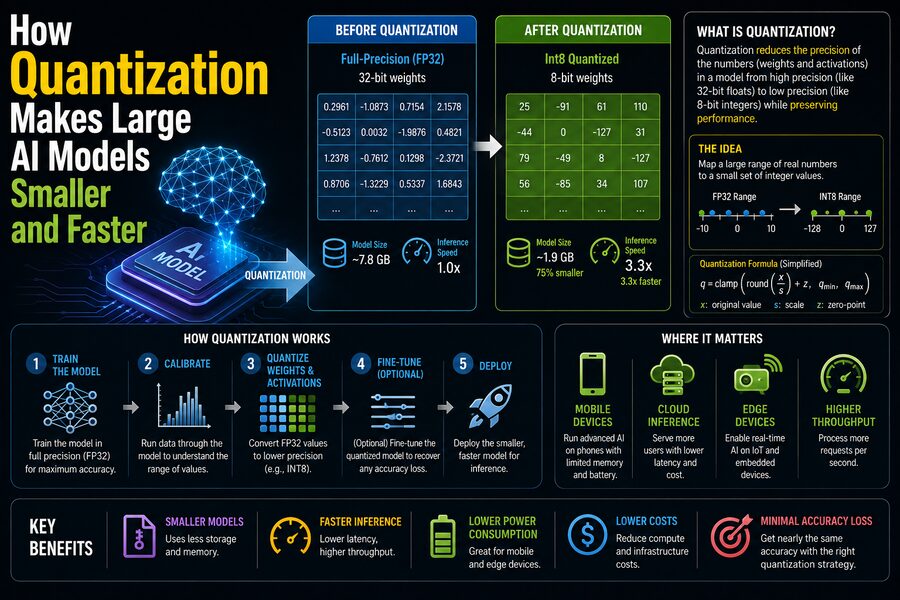

Large artificial intelligence models can contain billions—or even hundreds of billions—of numerical parameters. These parameters are the learned values that allow a neural network to recognize patterns, generate text, interpret images, translate languages, or perform other intelligent tasks.
The problem is that storing and processing so many numbers requires enormous amounts of memory and computational power. 💾⚡
A model with billions of parameters may need powerful GPUs simply to fit into memory. Moving those parameters between memory and processors can consume large amounts of bandwidth, and performing calculations with high-precision numbers can be expensive.
One of the most important techniques for reducing these costs is called quantization.
Quantization represents model weights and, sometimes, intermediate values using fewer bits. Instead of storing every parameter as a 32-bit floating-point number, engineers may represent it using 16 bits, 8 bits, 4 bits, or even fewer.
That simple change can dramatically reduce a model’s memory footprint and often make inference faster. 🚀
The challenge is doing this without significantly damaging the model’s accuracy.
🧠 What Is Quantization?
Quantization is the process of mapping numerical values from a high-precision representation to a lower-precision representation.
Imagine a model weight stored as a 32-bit floating-point value:
0.13784621
A quantized version might approximate it using a much smaller integer representation.
Instead of preserving every tiny decimal detail, the system stores the nearest value available in a limited set of possible numbers.
This is similar to reducing the resolution of an image.
A photograph containing millions of possible colors can sometimes be represented using a smaller color palette while still looking almost identical to a person.
Quantization does something conceptually similar with neural-network numbers. 🎨➡️🔢
💾 Why AI Models Need So Much Memory
Consider a model with:
7 billion parameters
If every parameter is stored using 32-bit floating point, each one requires:
32 bits = 4 bytes
The raw parameter storage is therefore approximately:
7 billion × 4 bytes = 28 GB
That is just for the model weights.
Additional memory may be needed for:
- Activations
- Temporary computation buffers
- Attention caches
- Runtime libraries
- Model metadata
Now quantize those same parameters to 8 bits.
Each parameter requires only:
1 byte
The raw weight storage falls to approximately:
7 GB.
At 4 bits, it can theoretically drop toward:
3.5 GB.
That reduction can determine whether a model needs a large data-center GPU or can run on a much smaller device. 📉
🔢 Common Numerical Formats in AI
AI systems use several numerical representations.
FP32 — 32-Bit Floating Point
Traditionally common in neural-network training.
It provides high numerical precision but requires substantial memory.
FP16 — 16-Bit Floating Point
Uses roughly half the memory of FP32 and is widely supported by modern accelerators.
BF16 — Brain Floating Point
Another 16-bit format designed to preserve a large numerical range while using fewer precision bits.
INT8 — 8-Bit Integer
Frequently used for inference quantization.
It can significantly reduce model size and accelerate supported computations.
INT4 — 4-Bit Integer
Increasingly used for large language models because it provides very large memory savings.
The lower the precision becomes, the more carefully engineers must manage approximation errors.
📏 How Values Are Mapped Into Fewer Bits
Suppose a group of model weights ranges from:
−1.0 to +1.0
An 8-bit signed integer can represent a limited range of integer values.
Quantization uses a conversion relationship that maps floating-point values into those integer levels.
A simplified version might look like:
Quantized Value ≈ Round(Real Value / Scale)
The scale determines how much real numerical range each integer step represents.
When the model performs calculations, the integer values can later be interpreted using that scale.
Some quantization systems also use a zero point, which helps align integer zero with a particular real-valued number.
Together, scale and zero point allow a limited integer range to approximate a larger set of floating-point values.
🎯 Quantization Introduces Approximation Error
Suppose a real model weight is:
0.137
but the nearest available quantized level corresponds to:
0.125
The difference is called quantization error.
Each individual difference may be tiny, but a neural network can contain billions of parameters.
If quantization is performed poorly, these errors can accumulate and reduce model quality.
Possible effects include:
📉 Lower classification accuracy
📝 Worse text generation
🧠 Reduced reasoning performance
🔍 Less precise predictions
🖼️ Lower image quality
The goal is therefore not simply to use fewer bits.
It is to use fewer bits while preserving the important numerical structure of the model.
⚡ Why Quantization Can Make Models Faster
Smaller model weights help performance for several reasons.
1️⃣ Less Memory Must Be Read
Modern AI inference is often limited by memory bandwidth.
A processor may spend a significant amount of time waiting for model weights to be transferred from memory.
If weights shrink from 16 bits to 4 bits, much less data must be moved.
That can substantially increase throughput.
2️⃣ More Data Fits Into Cache
Processors contain fast cache memory.
Smaller weights increase the amount of model data that can remain inside these faster memory layers.
This can reduce trips to slower external memory.
3️⃣ Specialized Hardware Can Perform More Integer Operations
Many CPUs, GPUs, NPUs, and AI accelerators include specialized instructions for low-precision arithmetic.
An accelerator may be able to perform many INT8 or INT4 operations in parallel where fewer FP32 calculations would fit.
That can increase inference speed significantly. ⚡
🧮 Quantization Does Not Always Mean Every Calculation Uses Integers
A quantized model can use mixed numerical formats.
For example:
Weights: INT4
Activations: FP16
Accumulation: FP32
This is known broadly as mixed-precision computation.
Different parts of a neural network have different sensitivity to numerical precision.
Engineers can therefore keep sensitive calculations at higher precision while compressing less sensitive values.
This often produces a better balance between performance and accuracy.
🏋️ Training vs. Inference
Quantization is particularly common during inference, when a trained model is used to make predictions.
Training is more numerically demanding because the system must calculate gradients and repeatedly update weights.
High precision can be more important during this process.
A typical workflow may therefore be:
Train model at FP32/BF16/FP16 → quantize model → deploy for inference
This allows training to retain the precision it needs while deployment benefits from a smaller, faster representation.
🛠️ Post-Training Quantization
One of the simplest approaches is Post-Training Quantization, often abbreviated PTQ.
The model is first trained normally.
After training is complete, its numerical values are converted into lower-precision representations.
This is attractive because it does not require retraining the model from scratch.
A simplified process is:
Train model normally 🏋️
⬇️
Analyze weight ranges 🔍
⬇️
Choose quantization parameters 📐
⬇️
Convert weights to INT8 or INT4 🔢
⬇️
Evaluate quality ✅
PTQ can work extremely well for many models, especially when 8-bit precision is used.
🧪 Calibration Data Improves Quantization
When activations are also quantized, engineers often use a small representative dataset called a calibration dataset.
The model runs on these example inputs.
Engineers observe the numerical ranges of activations inside the network.
This helps determine appropriate quantization scales.
If the calibration data accurately represents real usage, the quantized model is more likely to preserve important behavior.
Poor calibration can lead to excessive clipping or wasted numerical range.
✂️ What Is Clipping?
Imagine most activation values lie between:
−2 and +2
but a few unusual values reach:
+100
If the quantizer reserves its entire range for −100 to +100, most normal values may be represented very coarsely.
Engineers may instead choose to clip extreme outliers.
Values above a threshold are restricted to the maximum representable level.
This sacrifices exact representation of rare extreme values in exchange for much finer resolution across the range where most values occur.
Choosing good clipping thresholds is an important part of quantization design.
🧠 Quantization-Aware Training
Some models lose too much accuracy when quantized after training.
In that case, engineers can use Quantization-Aware Training, or QAT.
During training, the model simulates the effects of reduced precision.
The forward pass behaves approximately as if values were quantized.
The optimization process then learns weights that are more tolerant of quantization error.
A simplified process is:
Training begins
⬇️
Fake quantization is inserted
⬇️
Model experiences rounding effects
⬇️
Weights adapt during training
⬇️
Final low-precision model is exported
QAT generally requires more effort than PTQ, but it can preserve accuracy better at aggressive precision levels. 🎯
📦 Weight-Only Quantization
Large language models are often quantized using weight-only quantization.
In this approach:
- Model weights use low precision
- Activations may remain in FP16 or BF16
This is attractive because the model weights usually dominate memory consumption.
Suppose a 13-billion-parameter model is stored in FP16.
Its raw weights require roughly:
26 GB
Quantizing the weights to 4 bits can reduce this dramatically.
The model may then fit onto hardware that could never store the original representation.
This has made weight-only quantization particularly important for running large language models locally. 💻
🧩 Per-Tensor vs. Per-Channel Quantization
One important design choice is how many values share the same quantization scale.
📦 Per-Tensor Quantization
An entire tensor uses one scale.
This is simple and efficient.
However, some channels may have very different value ranges, reducing precision.
📊 Per-Channel Quantization
Different channels receive their own scales.
This can represent weights more accurately because each channel adapts to its local numerical range.
The tradeoff is slightly greater complexity and storage overhead.
Per-channel quantization is often valuable when model accuracy is sensitive to weight distribution.
🧱 Group-Wise Quantization
Large language models frequently use a middle ground known as group-wise quantization.
Instead of assigning one scale to an entire tensor or one scale to each individual channel, weights are divided into groups.
For example:
128 weights → one shared scale
Then the next 128 weights use another scale.
Smaller groups usually improve numerical accuracy but require more scale metadata.
Larger groups reduce overhead but may increase quantization error.
This creates another engineering tradeoff between compression and model quality.
🚨 Outliers Are a Major Challenge
Neural-network values are not always distributed evenly.
Some weights or activations can be much larger than the rest.
These outliers create problems because a few extreme values can determine the quantization scale for an entire group.
Then ordinary values are squeezed into a small fraction of the available numerical levels.
Modern quantization methods often include special techniques to handle these outliers.
Some preserve sensitive values at higher precision.
Others transform or rescale the model so outliers become easier to represent.
Handling outliers effectively can make the difference between a good 4-bit model and one with badly degraded performance.
🤖 Why Large Language Models Can Survive Low Precision
It may seem surprising that a model with billions of carefully learned floating-point values can still work after many of them are heavily approximated.
One reason is redundancy.
Large neural networks contain enormous numbers of parameters, and many individual weights do not require perfect numerical precision.
The model’s behavior is distributed across large collections of values.
Changing one weight slightly often has little effect.
However, not all parameters are equally insensitive.
Certain layers, channels, or values can be especially important.
Advanced quantization methods therefore try to identify and protect the most sensitive parts of the network.
🧠 Some Layers Can Stay at Higher Precision
A model does not have to use the same bit width everywhere.
For example:
Most layers: INT4
Sensitive layers: INT8
Normalization and accumulation: FP16
This is sometimes called mixed-bit quantization.
The strategy provides aggressive compression while preserving higher precision where it matters most.
In practice, the ideal configuration depends on:
- Model architecture
- Hardware
- Accuracy requirements
- Memory budget
- Target latency
💻 Quantization Enables Local AI
One of the biggest practical impacts of quantization is that it allows larger models to run on consumer hardware.
Without compression, a model might require:
🖥️ Multiple GPUs
🏢 Data-center infrastructure
💾 Large amounts of VRAM
After 4-bit quantization, the same model may fit on:
💻 A laptop
🖥️ A desktop GPU
📱 A powerful mobile device
🧠 An edge AI accelerator
This improves privacy because data may not need to leave the device.
It can also reduce cloud costs and allow AI applications to function without continuous internet connectivity.
📱 Quantization Is Essential for Mobile AI
Phones and embedded devices operate under strict limitations.
They have:
🔋 Limited battery power
🌡️ Tight thermal limits
💾 Limited memory
⚡ Limited compute budgets
Running large FP32 neural networks would often be impractical.
Quantized models can reduce memory access, energy consumption, and computation.
That is why mobile AI frequently uses INT8 and other low-precision formats for tasks such as:
📷 Image enhancement
🎙️ Speech recognition
⌨️ Text prediction
🧠 On-device language processing
🔍 Object detection
Quantization helps bring AI from data centers onto everyday devices.
🏢 Quantization Reduces Cloud Infrastructure Costs
Consider a company serving millions of model requests.
If one model requires a large GPU with 80 GB of memory, only a limited number of model instances may fit on each machine.
If quantization cuts model memory significantly, the company may fit more inference workers onto the same hardware.
This can reduce:
💰 Cost per request
⚡ Energy consumption
🏢 Number of servers
🌡️ Cooling requirements
📦 Infrastructure footprint
At large scale, even modest efficiency gains can translate into substantial savings.
⚡ Quantization Can Improve Throughput
Imagine a server answering chatbot requests.
If one unquantized model can generate responses for:
100 users simultaneously
a smaller quantized version might support significantly more, depending on hardware and workload.
That means improved throughput.
Throughput measures how much work a system can process per unit of time.
For AI services, this might mean:
- More tokens generated per second
- More images processed per second
- More requests handled per GPU
Higher throughput lowers infrastructure cost and can improve scalability.
⏱️ Latency Can Also Improve
Another performance metric is latency.
Latency measures how long one request takes.
Quantization can reduce latency when:
- Memory transfers dominate runtime
- Hardware has strong low-precision support
- Quantized kernels are optimized
However, quantization does not guarantee faster execution in every environment.
If hardware lacks efficient INT4 support, extra unpacking or conversion operations may reduce the expected benefit.
The actual result depends heavily on software kernels and hardware architecture.
🧠 Hardware Support Matters
A 4-bit model is not automatically fast simply because it is small.
The processor must be able to execute the required low-precision operations efficiently.
Modern AI accelerators may include specialized units for:
- INT8 matrix multiplication
- INT4 arithmetic
- FP8 computation
- Mixed-precision accumulation
When the model’s quantization format matches native hardware capabilities, performance can improve dramatically.
When the format is poorly supported, compression may save memory without delivering the same speed advantage.
📦 Quantization Also Reduces Model Download Size
AI models are often distributed over networks.
A full-precision model might require tens or hundreds of gigabytes.
Smaller quantized models are easier to:
⬇️ Download
☁️ Store
🔄 Update
📱 Deploy
🌍 Distribute globally
This is particularly important for edge devices and consumer applications where large downloads are inconvenient or impossible.
🧮 A Simple Size Comparison
Consider a hypothetical model containing:
10 billion parameters
Approximate raw weight sizes are:
FP32: 40 GB
FP16/BF16: 20 GB
INT8: 10 GB
INT4: 5 GB
Additional metadata and runtime requirements mean real file sizes may differ.
Still, the basic relationship is clear:
Reducing bits per parameter dramatically reduces storage requirements.
Moving from FP16 to INT4 can theoretically cut raw weight memory by about 75%.
🗃️ Quantization Helps With KV Cache Pressure Too—Sometimes
Large language models store intermediate attention information known as the key-value cache, or KV cache, while generating text.
The KV cache grows with context length and the number of active users.
In some systems, it can consume a large amount of memory.
Quantizing parts of the KV cache can reduce this burden.
That can allow:
📜 Longer contexts
👥 More simultaneous users
💾 Lower memory consumption
However, KV-cache quantization requires careful evaluation because excessive precision reduction can harm generation quality.
🔬 Quantization Must Be Evaluated, Not Assumed
After quantization, engineers need to test the model.
A smaller model is only useful if it still performs its intended task well enough.
Evaluation might include:
📊 Benchmark accuracy
🧠 Reasoning tests
📝 Text-generation quality
🔍 Retrieval performance
🧪 Domain-specific tests
⏱️ Latency measurements
💾 Memory usage
⚡ Throughput
Different applications tolerate different levels of degradation.
A casual chatbot may accept a tiny quality loss in exchange for large cost savings.
A safety-critical medical or industrial system may require much stricter validation.
📉 Perplexity Is Often Used for Language Models
One metric used when evaluating language models is perplexity.
Very roughly, perplexity measures how well the model predicts sequences of text.
If aggressive quantization causes perplexity to increase substantially, language modeling quality may have degraded.
However, perplexity alone is not enough.
Engineers also test real downstream tasks because some quantization artifacts may affect reasoning, code generation, or long-context performance differently.
⚠️ Quantization Can Hurt Small Models More
Large models sometimes tolerate aggressive quantization surprisingly well.
Smaller models may have less redundancy and can be more sensitive.
Similarly, certain specialized models may be highly sensitive to precision reductions in particular layers.
There is no universal rule that:
4-bit is always safe
or:
8-bit never hurts accuracy.
The correct approach is empirical testing.
🧠 Quantization and Fine-Tuning
Quantized models can also be used during parameter-efficient fine-tuning.
Instead of loading an enormous model entirely at high precision, engineers may keep the base model quantized and train a much smaller set of additional parameters.
This reduces memory requirements dramatically.
It allows developers to adapt large language models using hardware that would otherwise be unable to hold them.
This combination of quantization and parameter-efficient training has made customized AI models far more accessible. 🔧🤖
♻️ Quantization Is Part of a Larger Optimization Toolkit
Quantization is not the only way to make AI models smaller.
Other techniques include:
✂️ Pruning — removing unnecessary weights
🧪 Knowledge distillation — training a smaller model to imitate a larger one
🧩 Low-rank approximation — representing large matrices more compactly
🏗️ Efficient architecture design — building smaller models from the beginning
These approaches can sometimes be combined.
For example:
Distill model → prune model → quantize model
The final system may be dramatically smaller than the original.
🆚 Quantization vs. Pruning
Quantization reduces the precision of stored values.
Pruning removes some values entirely.
Imagine a neural-network matrix.
Quantization says:
“Keep all these numbers, but represent them using fewer bits.”
Pruning says:
“Some of these numbers are unimportant, so remove them.”
Both reduce computational demands, but they work differently.
Pruned models also need software and hardware that can efficiently exploit sparsity to realize maximum speed improvements.
🎓 Quantization vs. Knowledge Distillation
Knowledge distillation creates a new, smaller student model trained to imitate a larger teacher model.
Quantization usually keeps the same underlying network architecture while representing its values more efficiently.
A distilled model might have fewer layers or parameters.
A quantized model may retain the same parameter count but require fewer bits per parameter.
These techniques can complement each other.
🌱 Energy Efficiency Is an Important Benefit
AI computing consumes electrical energy.
Lower-precision arithmetic can reduce the amount of data moved and the energy required for calculations.
At massive scale, that can reduce:
⚡ Electricity consumption
🌡️ Heat generation
❄️ Cooling demand
🏢 Data-center infrastructure
Energy savings vary substantially depending on hardware and workload, but quantization is an important part of making AI inference more resource-efficient.
🔒 Local Quantized Models Can Improve Privacy
If a model is small enough to run locally, sensitive information can sometimes remain on the user’s device.
For example:
📄 Private documents
🎙️ Voice recordings
🏢 Corporate data
📝 Personal messages
may be processed without sending them to a remote server.
Quantization alone does not guarantee privacy, but it can make privacy-preserving local deployment technically practical.
🧩 A Practical Quantization Workflow
A typical engineering workflow might be:
1️⃣ Select the baseline model
Measure its original quality and hardware requirements.
2️⃣ Choose the target hardware
Determine which low-precision formats are efficiently supported.
3️⃣ Select a quantization approach
For example, INT8 PTQ or 4-bit weight-only quantization.
4️⃣ Calibrate if required
Use representative input data.
5️⃣ Quantize the model
Generate the compressed representation.
6️⃣ Benchmark quality
Compare against the original model.
7️⃣ Benchmark performance
Measure memory, throughput, latency, and power.
8️⃣ Adjust sensitive layers
Keep some parts at higher precision if needed.
9️⃣ Deploy and monitor
Watch for unexpected degradation on real workloads.
This turns quantization from a simple compression trick into a disciplined engineering process.
🚀 Why Quantization Matters for the Future of AI
As AI models continue to grow, efficiency becomes increasingly important.
Simply increasing model size without improving deployment efficiency can lead to enormous costs.
Quantization makes advanced models accessible to a wider range of hardware.
It can help AI run on:
📱 Smartphones
💻 Laptops
🚗 Vehicles
🤖 Robots
🏭 Industrial systems
☁️ Cloud servers
This broadens where intelligent systems can operate.
It also allows companies to serve more users with the same computational infrastructure.
✅ Conclusion
Quantization makes large AI models smaller and faster by reducing the numerical precision used to represent their parameters and, in some cases, their intermediate calculations.
Instead of storing every neural-network weight as a 32-bit or 16-bit floating-point number, engineers can often represent many values using 8-bit or 4-bit formats. 🔢📉
The result can be dramatic.
A model that originally requires tens of gigabytes of memory may shrink enough to fit on a consumer GPU or even an edge device. Smaller weights require less memory bandwidth, fit more effectively into caches, and can take advantage of specialized low-precision hardware.
However, the process introduces approximation error.
That is why successful quantization relies on techniques such as calibration, per-channel or group-wise scaling, outlier handling, mixed precision, post-training quantization, and quantization-aware training.
The core tradeoff is straightforward:
Use fewer bits → save memory and computation → carefully manage the resulting numerical error.
When that balance is achieved, quantization can preserve most of a model’s useful capability while dramatically reducing the resources needed to run it. 🤖⚡
This is why quantization has become one of the most important technologies behind efficient AI deployment.
It helps transform enormous models from systems that require specialized data-center hardware into practical tools that can run faster, cost less, consume less energy, and reach devices much closer to the people using them. 🚀💻📱