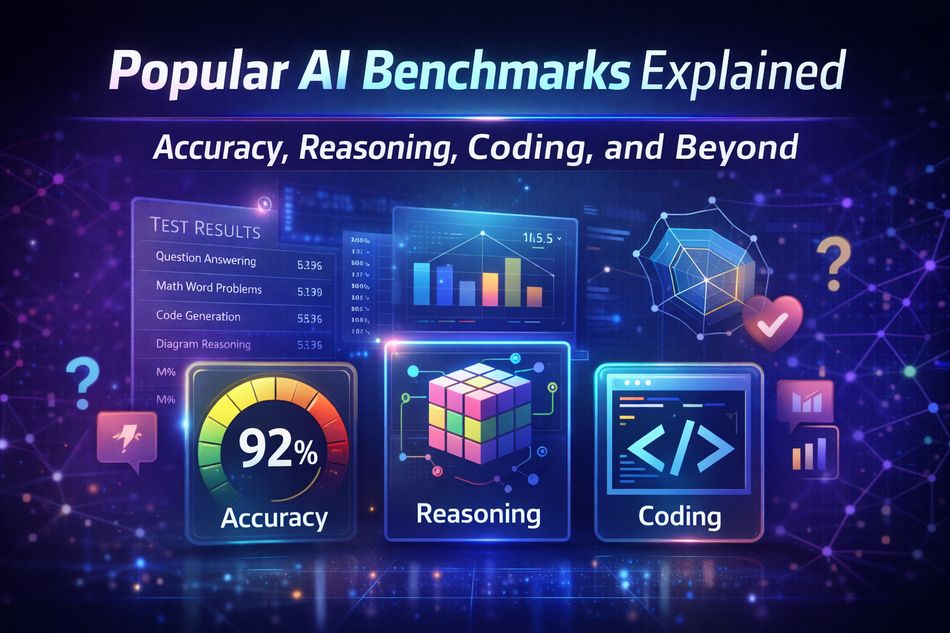

AI benchmarks are structured evaluations used to compare models on tasks such as reasoning, knowledge recall, coding, math, question answering, and instruction following. They are useful, but they are also incomplete. Understanding what benchmarks measure—and what they miss—is essential for anyone building or adopting AI systems.
Different benchmarks test different capabilities
No single benchmark can represent the whole field. Some tasks test factual or academic knowledge, some test reasoning, some focus on coding, and some try to measure broader behavior across many scenarios.
Useful categories
- Knowledge-heavy question answering benchmarks
- Reasoning and math benchmarks
- Coding and software engineering benchmarks
- Instruction-following and preference benchmarks
- Holistic frameworks such as HELM
How to read benchmark results
Always ask what the task actually measures, how representative it is, how clean the evaluation setup is, and whether the result matches your use case. A model strong at multiple-choice reasoning may still perform poorly in production support workflows.
Key Takeaways
- Start with the real user task, not the technology trend.
- Use structured workflows, examples, and evaluation criteria.
- Treat AI output as draft assistance unless verified.
- Choose tools and frameworks based on fit, not hype.
- Build habits of review, iteration, and grounded testing.
Further Reading
The most practical way to learn this topic is to move from theory into a small real project. Read the official documentation, test the ideas on a narrow use case, and review the results critically. That process will teach far more than passive consumption alone.