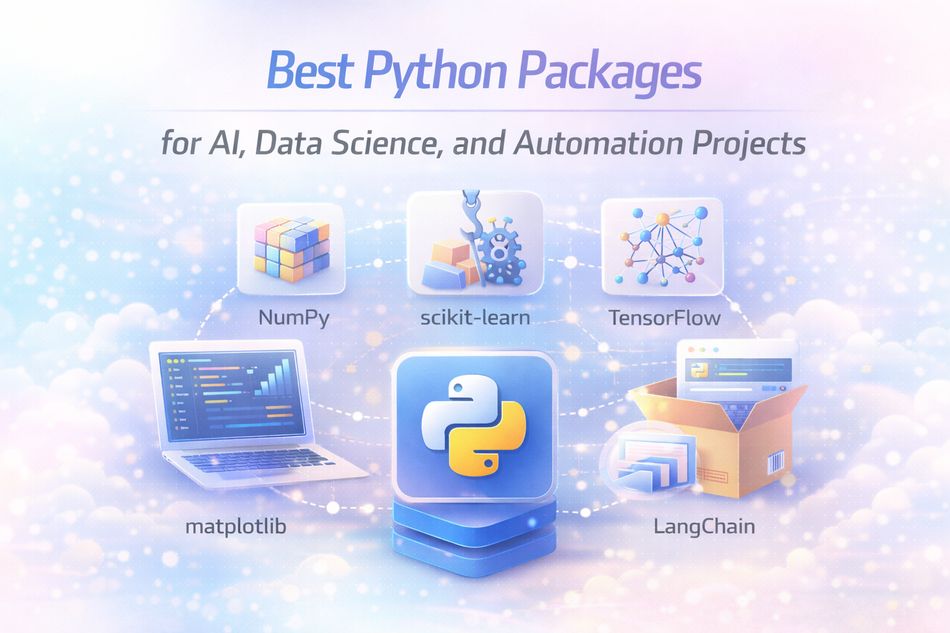

Python’s package ecosystem is one of the main reasons the language remains so productive. But using packages well involves more than running pip install. Developers need to understand package choice, dependency management, project structure, packaging standards, and distribution practices.
Different tasks, different package stacks
AI, data science, and automation are broad domains. Data manipulation, model training, inference serving, experiment tracking, workflow scheduling, and scripting each benefit from different tools.
Useful package families
- Numerical and dataframe libraries
- Visualization tools
- ML frameworks
- NLP and computer vision libraries
- API and web app frameworks
- Automation and scraping tools
- Packaging and reproducibility utilities
How to choose wisely
Pick packages that match your deployment reality. A local notebook project and a production inference service may need different trade-offs around size, speed, compatibility, and operational complexity.
Key Takeaways
- Start with the real user task, not the technology trend.
- Use structured workflows, examples, and evaluation criteria.
- Treat AI output as draft assistance unless verified.
- Choose tools and frameworks based on fit, not hype.
- Build habits of review, iteration, and grounded testing.
Further Reading
The most practical way to learn this topic is to move from theory into a small real project. Read the official documentation, test the ideas on a narrow use case, and review the results critically. That process will teach far more than passive consumption alone.