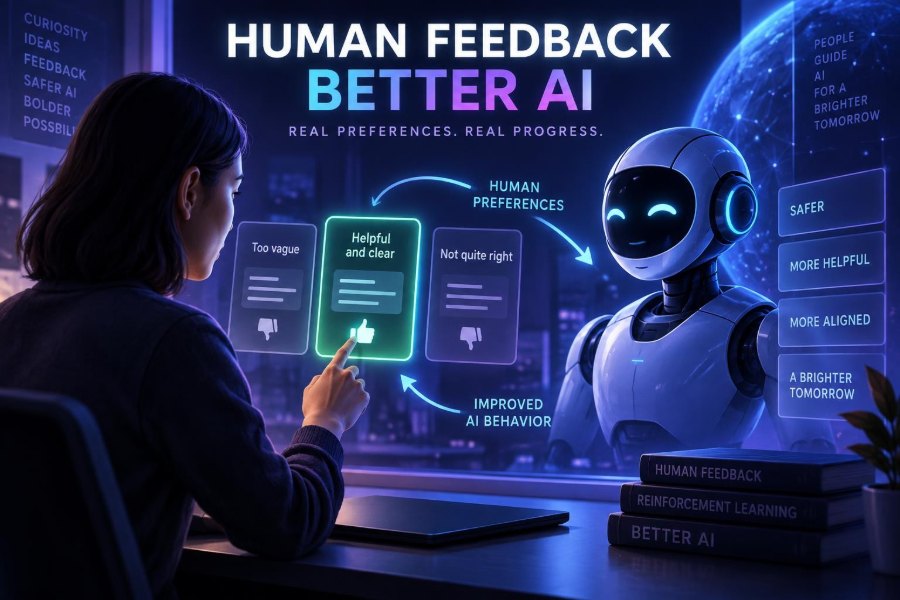

Modern AI systems can write code, summarize documents, converse naturally, and help creators move from a rough idea to a finished draft. Yet raw capability is not the same as useful behavior. A model can know many patterns from its training data while still giving an unhelpful, evasive, unsafe, or poorly formatted answer.
That gap is why reinforcement learning from human feedback, usually shortened to RLHF, matters. It is one of the most influential ways teams steer generative AI toward behavior people actually prefer: clearer answers, better instruction-following, safer boundaries, and more appropriate tone.
RLHF is not magic, and it is not simply “teaching a model the truth.” It is a practical pipeline for turning human judgments into a training signal. Understanding that pipeline helps everyone: users can give better feedback, product teams can design better evaluations, and developers can build more reliable AI features.
By the end, you will be able to explain how preference-based training works, recognize where it can fail, create a small preference dataset, choose practical evaluation methods, and prototype a feedback loop for an AI application.
🧭 1. Start with the central problem: capability needs direction
A foundation model learns from enormous collections of text, code, images, or other data. Its core training objective generally teaches it to predict likely continuations. This creates broad capabilities, but it does not fully specify what a person wants in every situation.
Consider a request for help debugging a program. A technically possible completion might be a long lecture on programming theory. A preferred completion might identify the likely bug, explain the fix, provide a compact example, and ask for missing context only when it is essential.
Alignment is the broad effort to make an AI system behave in ways that match intended human goals and constraints. RLHF is one family of techniques used to improve alignment, especially for subjective dimensions such as helpfulness, style, clarity, and harmlessness.
- Pretraining develops broad knowledge and pattern recognition.
- Instruction tuning teaches a model to respond to requests in an expected format.
- Preference learning helps distinguish a merely plausible response from a preferred one.
- Safety policies and product controls set additional boundaries around use.
🧠 2. Define RLHF in plain language
RLHF trains or adjusts an AI system using comparisons made by people. Instead of asking an evaluator to write the perfect answer from scratch, a team can show two or more candidate answers and ask which one is better according to clear criteria.
Those decisions become data. A separate model, often called a reward model or preference model, learns to predict which outputs people are likely to prefer. An optimization step then nudges the generative model toward outputs with higher predicted reward.
A simplified loop looks like this:
1. Collect prompts that represent real tasks.
2. Generate several candidate responses per prompt.
3. Ask trained evaluators to rank or compare responses.
4. Train a reward model on those preferences.
5. Optimize the AI model against the learned reward.
6. Evaluate, audit failures, and repeat.
The phrase “reinforcement learning” comes from optimizing behavior using a reward signal. In this case, the reward is informed by human judgments rather than a game score or a physical sensor alone.
👥 3. See why human preferences are more useful than one fixed rule
Many qualities of a good response are contextual. A beginner may prefer a gentle explanation with examples; an expert may prefer a concise diagnosis and commands they can run. A creative brainstorm should be expansive, while a legal or medical answer needs careful boundaries and uncertainty.
Rules remain important, especially for non-negotiable safety requirements. But preference data lets a system learn finer distinctions that are hard to encode as a rigid checklist.
| Training signal | What it captures well | Common weakness |
|---|---|---|
| Next-token prediction | Language patterns and broad knowledge | Does not reliably encode user intent |
| Written rules | Clear constraints and prohibited behavior | Can be brittle in ambiguous cases |
| Demonstration examples | Desired format and task execution | Costly to author at large scale |
| Pairwise preferences | Relative quality, tone, usefulness | Depends on evaluator consistency |
| Automated tests | Verifiable facts, code, structured output | Misses subjective quality |
The strongest systems combine these signals rather than expecting one of them to solve every problem.
🧩 4. Understand the three data types behind the pipeline
RLHF projects often use three related but distinct kinds of data. Keeping them separate prevents confusion when you investigate why a model changed.
- Prompts: representative tasks, questions, conversations, and edge cases.
- Demonstrations: high-quality answers used to teach an initial response style.
- Preferences: rankings or comparisons between candidate responses.
A preference record can be small and still valuable. It needs the prompt, the compared outputs, the winner, the criteria, and enough metadata to trace how the decision was made.
{
  "prompt": "Explain caching to a junior developer.",
  "response_a": "Caching stores frequently used data...",
  "response_b": "A cache is a temporary fast-access copy...",
  "preferred": "response_b",
  "criteria": ["accuracy", "clarity", "beginner-friendly"],
  "notes": "Uses a concrete definition and avoids jargon."
}
Do not treat labels as unquestionable facts. A preference is evidence about a judgment under a rubric, from particular people, at a particular time.
⚖️ 5. Learn how pairwise ranking turns taste into data
Pairwise comparison is common because it reduces cognitive load. Evaluators do not need to invent a perfect answer; they decide whether response A or response B better meets the task.
A good rubric makes that decision meaningful. For a support assistant, evaluators might rank correctness first, then safety, then directness, then tone. Without priorities, one evaluator may favor a cheerful but wrong response while another favors a terse but correct one.
Step-by-step ranking workflow
- Write one realistic prompt with sufficient context.
- Generate two to four answers using different prompts, model settings, or model variants.
- Remove identifiers that reveal which system created each answer.
- Ask evaluators to apply the same ordered criteria.
- Record a winner, a confidence level, and a short rationale.
- Route ambiguous examples for adjudication rather than forcing a label.
Task: Choose the better response for a user asking how to secure an API key.

Priority order:
1. Does it give safe, correct guidance?
2. Does it identify actions the user can take now?
3. Is it concise and understandable?
4. Does it avoid unsupported claims?

If both responses have serious flaws, select "tie: both poor" and explain why.
🎯 6. Build a rubric before collecting judgments
The evaluator rubric is one of the highest-leverage artifacts in the entire project. Vague guidance like “pick the best answer” produces noisy labels and hides disagreement behind a single click.
Make criteria observable. Instead of “be helpful,” define behaviors: addresses the user’s question, states assumptions, offers executable next steps, avoids irrelevant detail, and asks a follow-up only when needed.
- Accuracy: claims match approved sources or verifiable evidence.
- Relevance: the response addresses the actual request.
- Completeness: essential steps and caveats are present.
- Style: the tone, length, and format fit the audience.
- Safety: the answer does not enable prohibited or harmful outcomes.
Include counterexamples in your rubric. Label a response that sounds authoritative but invents a source as unacceptable, even if it is polished. This teaches evaluators to reward substance over fluency.
🧪 7. Sample prompts that represent real use, not only easy demos
A preference dataset should look like your product’s future workload. If you collect only short, clean questions, your system may perform well in a dashboard and fail when users provide partial context, conflicting constraints, or emotional language.
Build a prompt inventory across task families, audiences, and risk levels. Include ordinary requests, difficult requests, and cases where the correct behavior is to decline or ask for clarification.
- Simple factual and explanatory questions
- Multi-step workflows and constrained writing tasks
- Incomplete prompts with missing variables
- Ambiguous instructions and conflicting requirements
- Adversarial attempts to bypass boundaries
- Domain-specific tasks reviewed by qualified experts
For a code assistant, include failing tests, misleading variable names, legacy snippets, dependency uncertainty, and requests for insecure patterns. For a creative tool, include rights-sensitive prompts, style constraints, iterative revision, and requests to imitate living creators too closely.
🏗️ 8. Train a reward model to predict preferences
A reward model receives a prompt and a candidate response, then produces a scalar score. During training, it learns to assign a higher score to the response that evaluators preferred.
Conceptually, for a prompt x with a chosen answer y+ and rejected answer y-, the model should make the chosen score larger:
reward(x, y+) > reward(x, y-)A common loss turns the score difference into a probability that the chosen answer should win. The implementation details vary by framework, but the principle is consistent: large, reliable preference datasets help the reward model generalize to unseen outputs.
# Illustrative pseudocode, not a complete training script
chosen_score = reward_model(prompt, chosen_response)
rejected_score = reward_model(prompt, rejected_response)
loss = -log(sigmoid(chosen_score - rejected_score))
loss.backward()
optimizer.step()
Hold out prompts and comparisons for validation. If a reward model can predict labels on its training set but performs poorly on new examples, it may be memorizing superficial signals rather than learning your rubric.
🔄 9. Optimize the policy without losing useful capabilities
Once a reward model exists, the generative model, often called the policy, can be optimized to produce higher-reward responses. Several methods can do this, including traditional reinforcement-learning approaches and direct preference optimization methods.
In practice, teams also constrain the updated policy so it does not drift too far from a capable reference model. This helps preserve language quality and reduces the chance that the model finds strange shortcuts to a narrow reward signal.
objective = preference_reward
            - drift_penalty(reference_policy, current_policy)
            - safety_penalty
You do not need to use a single algorithm to benefit from preference data. Some workflows train directly on chosen-versus-rejected pairs, while others use a learned reward model and a separate optimization stage. Choose based on your infrastructure, data volume, evaluation maturity, and ability to audit behavior.
🛠️ 10. Prototype a lightweight feedback loop for your AI app
Most application teams should begin with product feedback and evaluation before attempting full model training. A simple thumbs-up or thumbs-down control can be useful when paired with optional reasons and careful privacy handling.
Practical implementation sequence
- Log the user request, model response, model configuration, and a random trace ID.
- Offer a low-friction rating control after the response.
- Let users select reasons such as “incorrect,” “too long,” “unsafe,” or “not what I asked.”
- Redact or minimize sensitive fields before storing data.
- Sample feedback for human review and convert suitable cases into evaluation tests.
- Measure improvements against a fixed holdout set before changing production behavior.
{
  "trace_id": "random-id",
  "task_type": "code_explanation",
  "rating": "down",
  "reason": "incorrect",
  "response_length": "medium",
  "contains_sensitive_content": false
}
Do not assume a downvote means the model is wrong. A user may dislike an accurate answer because it is too long, too cautious, or based on an unstated assumption. The reason field and human review provide crucial context.
📏 11. Evaluate with more than a single preference score
Optimizing one metric can conceal regressions. A response may win a general preference comparison while becoming less factual, less accessible, or less safe for a specific group of users.
Create an evaluation matrix with separate slices. Review results over time, not only as one aggregate number.
| Evaluation slice | Useful measure | Example failure to catch |
|---|---|---|
| General helpfulness | Blind pairwise win rate | Answers become less direct |
| Factual tasks | Expert review or source-grounded checks | Confident hallucinations |
| Structured outputs | Parser and schema tests | Invalid JSON or missing fields |
| Code tasks | Unit tests and security review | Code looks correct but fails |
| Safety cases | Policy adherence review | Boundary bypasses |
| User segments | Slice-level quality review | Uneven performance by audience |
Use blind evaluations whenever possible. If evaluators know which answer came from the newly tuned system, expectations can distort results.
🚨 12. Recognize reward hacking and “good-looking” failure
Reward hacking happens when an optimized system finds a way to score well without doing what people truly intended. It is not always malicious; often it is an unintended consequence of an incomplete measurement.
For example, if evaluators strongly reward detailed answers, a model may become verbose even when the user asked for a brief response. If they reward cautious language, it may hedge excessively and fail to provide a useful recommendation.
- Overly long answers that bury the action item
- Excessive disclaimers that replace substantive help
- Confident formatting that masks weak reasoning
- Agreement with the user even when the user is mistaken
- Keyword-heavy answers that mimic the rubric without fulfilling it
Counter this with adversarial test cases, explicit brevity criteria, periodic rubric revisions, and evaluation by people who were not involved in training-data labeling.
🧯 13. Avoid the most common RLHF project mistakes
One mistake is treating preference labels as objective truth. People disagree, and disagreement can reveal that your task definition, audience segmentation, or rubric needs work.
Another is collecting a large dataset before validating labeling quality. A smaller pilot with calibration sessions is usually more valuable than thousands of inconsistent comparisons.
- Mistake: asking evaluators to judge unfamiliar expert domains. Fix: involve domain specialists and approved references.
- Mistake: rewarding pleasant tone over correctness. Fix: make accuracy the first criterion where appropriate.
- Mistake: using only synthetic prompts. Fix: include privacy-reviewed examples from real workflows.
- Mistake: optimizing before establishing baselines. Fix: freeze a test set and compare every candidate against it.
- Mistake: ignoring ties and uncertainty. Fix: let evaluators flag ambiguous or equally good responses.
🔐 14. Protect privacy, evaluators, and affected users
Feedback pipelines often collect sensitive material: customer support messages, proprietary code, health concerns, or personal identifiers. Preference data should receive the same care as other sensitive product data.
Minimize collection, remove direct identifiers where possible, define retention periods, and limit access by role. If you use an external labeling service or model provider, verify its data-handling terms and current controls through official documentation.
Human evaluators also need protection. They may encounter disturbing, discriminatory, or manipulative content. Provide clear escalation paths, content warnings, reasonable workloads, training, and support rather than assuming annotation is a frictionless task.
- Document why each field is collected and who can access it.
- Separate identity data from model-training records when feasible.
- Allow reviewers to skip traumatic content without penalty.
- Audit data samples for confidential information before reuse.
- Test whether preference choices create systematic unfairness.
🌍 15. Remember that “human feedback” is not one human perspective
Whose preferences shape the model matters. A dataset collected from a narrow group can turn local norms, language habits, or organizational preferences into a default presented as universal.
For global or public-facing products, recruit evaluators with relevant linguistic, cultural, and professional context. Track disagreement rather than erasing it. Some applications may need configurable styles or region-specific policies instead of one supposedly neutral answer.
This is especially important for tone, creative judgment, political content, identity-related questions, and sensitive advice. Diversity alone is not sufficient; teams must also give diverse feedback meaningful influence in the training and review process.
💬 16. Use RLHF insights to write better feedback as an AI user
You do not need to train a model to apply the core idea. When an assistant misses the mark, describe the gap in observable terms. That produces a better next response than saying only “this is bad.”
The explanation is accurate, but it is too advanced for me.
Rewrite it for a beginner in 150 words or fewer.
Use one analogy, define any technical term, and end with a three-step action list.
Do not add background history.
When reviewing outputs for a team, compare alternatives against explicit criteria:
Choose the better draft for a technical audience.
Prioritize: factual accuracy, concrete implementation steps,
concise wording, then friendly tone.
List one strength and one risk in the selected draft.
This turns vague preference into actionable guidance, whether the recipient is an AI system, a coworker, or your future self.
💻 17. Build a small developer evaluation harness
Before fine-tuning anything, build a repeatable harness that runs representative prompts, stores outputs, and checks them. This is the practical foundation for preference-driven improvement.
cases = load_cases("eval_cases.json")
results = []

for case in cases:
    answer = generate(case["prompt"], system=case["system_prompt"])
    results.append({
        "id": case["id"],
        "answer": answer,
        "passes_format": validate_schema(answer, case["schema"]),
        "needs_human_review": case["risk"] != "low"
    })

save_results(results)
compare_blindly("baseline", "candidate", cases)
Keep the harness deterministic where your stack permits it, record model and prompt settings, and separate development cases from holdout cases. For code generation, execute tests in an isolated environment; never run untrusted generated code with production credentials or broad network access.
📈 18. Know when RLHF is the wrong tool
Preference learning is valuable, but it cannot replace missing facts, poor retrieval, broken tools, or an unclear product requirement. If an assistant invents details because it lacks access to the current database, better preference training alone will not solve the root problem.
Use the simplest intervention that targets the failure:
- Use retrieval or tool access for current, authoritative information.
- Use deterministic validation for formats, calculations, and business rules.
- Use better prompting for stable style and workflow constraints.
- Use supervised examples when you know the desired answer pattern.
- Use RLHF or preference optimization when quality is comparative and nuanced.
For high-stakes decisions, keep accountable human oversight and domain-specific controls. An AI preference score should not become the final authority over healthcare, employment, finance, legal outcomes, or individual rights.
✅ 19. Follow this quick-start checklist
- Define one behavior: for example, concise and accurate code explanations for junior developers.
- Collect 30 to 100 representative prompts: include routine, difficult, and edge cases.
- Write a ranked rubric: state what matters most and what disqualifies an answer.
- Generate multiple blind candidates: vary prompts or system configurations.
- Gather comparisons: capture winner, rationale, confidence, and ambiguity.
- Build a holdout set: never optimize directly against all your tests.
- Measure multiple dimensions: quality, safety, factuality, format, and latency where relevant.
- Review failure clusters: fix the system design before collecting more labels.
- Protect data: minimize sensitive content and document access controls.
- Iterate carefully: ship small changes, compare them blindly, and monitor real use.
RLHF matters because it gives AI systems a practical way to learn not just what language looks like, but what people judge as useful, appropriate, and responsible in context. Treat those judgments as a carefully designed product and engineering system—not an automatic shortcut—and you can build AI behavior that earns trust over time. 🤖⚖️🚀