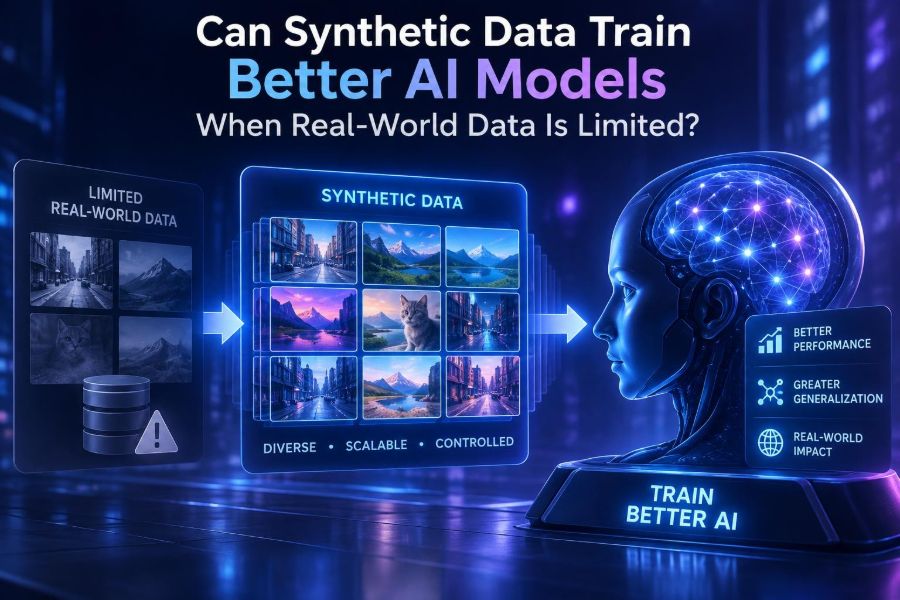

AI teams are running into a problem that bigger models cannot solve by themselves: high-quality real-world data is scarce, expensive, sensitive, imbalanced, or all four at once. A vision system may need rare manufacturing defects, a healthcare model may need protected patient records, and a support assistant may need edge cases that almost never appear in historical tickets.
Synthetic data offers a practical response. Instead of merely collecting what happened in the past, teams can create controlled examples of what a model needs to learn: unusual events, underrepresented users, difficult lighting conditions, adversarial inputs, and carefully varied scenarios.
But generated data is not automatically useful data. If a generator repeats the blind spots, stereotypes, formatting errors, or factual mistakes in its source material, a downstream model can become confidently wrong at scale.
This guide explains where synthetic data works, where it fails, and how to build a disciplined pipeline. By the end, you will be able to choose a generation approach, define coverage targets, validate quality, mix synthetic and real samples, and evaluate whether the new data actually improves your model.
🧪 1. Define Synthetic Data Before Deciding to Use It
Synthetic data is data created artificially to resemble, supplement, or systematically extend a real-world dataset. It can be produced by simulation software, rule-based generators, statistical methods, generative AI models, or combinations of these approaches.
It is not one thing. A rendered image of a warehouse is synthetic, but so is a fake transaction table, a simulated sensor trace, or an instruction-answer pair generated for language-model tuning.
| Type | What it creates | Useful example |
|---|---|---|
| Simulation | Events governed by a virtual environment | Robot camera scenes with known object positions |
| Rule-based generation | Records from templates and constraints | Valid test accounts and invoice cases |
| Generative modeling | New examples learned from a data distribution | Product-support conversations or tabular records |
| Augmentation | Transformed versions of existing examples | Blurred, rotated, or cropped training images |
The key distinction is purpose. Synthetic data is most valuable when it fills a defined gap, rather than when it simply makes a dataset larger.
📉 2. Recognize the Real-Data Bottleneck
Teams usually turn to synthetic data because collecting more reality is slow or impossible. Labeling specialists may be costly, consent may be restricted, rare outcomes may take years to observe, or data may live in isolated systems.
Start by writing down the bottleneck precisely. “We need more data” is too vague to guide generation. “We need 5,000 correctly labeled examples of damaged barcode labels under reflective lighting” is actionable.
- Access gap: data exists but is controlled by privacy, contracts, or security rules.
- Frequency gap: important events are rare, such as fraud, failure, or safety incidents.
- Coverage gap: the dataset misses environments, languages, devices, or user groups.
- Label gap: examples exist but reliable annotation is difficult.
- Iteration gap: developers need safe data immediately for tests and prototypes.
Different gaps need different methods. A simulator may address rare physical conditions; a constrained generator may be better for software test records; expert-authored scenarios may be safer for policy-sensitive text.
🎯 3. Turn a Vague Need Into a Coverage Specification
Before generating anything, define the conditions your production model must handle. This is a coverage specification: a compact list of variables, values, proportions, and outcomes that matter.
For a document-extraction model, variables might include document type, language, scan quality, font, layout complexity, handwritten fields, and redaction style. For a chatbot, they might include intent, tone, ambiguity, user expertise, policy boundary, and tool failure.
- List the model’s target task and prediction label.
- Identify input factors that can change performance.
- Split each factor into meaningful buckets.
- Mark buckets that are rare, high-risk, or absent in your data.
- Set a target count for each important combination.
Task: classify support requests
Target labels: billing, login, cancellation, technical issue
Priority coverage:
- informal language: 30%
- non-native phrasing: 20%
- multi-intent requests: 15%
- frustrated tone: 20%
- requests requiring escalation: 10%
- prompt-injection attempts: separate safety test set
This specification becomes the contract used to judge generated samples. Without it, generation tends to favor familiar, easy, and overly polished examples.
🏗️ 4. Choose the Right Generation Method
Match the generator to the structure of the problem. A language model can create varied text, but it cannot reliably model a physical camera pipeline. A simulator can provide perfect labels for geometry, but may not reproduce human language or commercial behavior.
- Use simulation for robotics, autonomous systems, industrial inspection, gaming, and sensor-heavy tasks.
- Use rules and constraints for structured data, validation testing, accounting flows, APIs, and known business logic.
- Use generative models for language, images, audio, and complex patterns where controlled variety matters.
- Use augmentation when realistic changes are known and labels should stay unchanged.
- Use experts to author seed scenarios for regulated, safety-critical, or domain-specific tasks.
Many effective pipelines are hybrid. For example, a team can simulate a scene, add camera artifacts through augmentation, and then have trained reviewers check a sample of labels.
🧭 5. Start With a Small, Testable Pilot
Do not generate millions of rows or images as a first move. Create a pilot set that targets one well-understood failure mode and compare it against a baseline.
A good pilot answers one narrow question: does adding generated examples for low-light images reduce errors on a real, held-out low-light test set? It does not try to prove that synthetic data solves every data problem.
- Freeze a real-world validation and test set before generation.
- Measure the baseline model by important slices, not just one overall score.
- Generate a modest set for one missing slice.
- Review quality and remove failures.
- Train with and without the new data.
- Compare results on untouched real-world data.
Keep a record of generator settings, prompt templates, source seeds, filters, reviewer decisions, and dataset versions. Reproducibility is essential when a data change affects model behavior.
🗣️ 6. Generate Text Data With Constraints, Not Just Creativity
Language models are useful for producing classification examples, retrieval questions, tool-use traces, summaries, and conversations. Their biggest strength is variation; their biggest risk is plausible nonsense.
Give the generator a role, an output schema, explicit constraints, and examples of unacceptable output. Ask it to expose uncertainty where appropriate rather than invent details.
You are creating training examples for a support-intent classifier.
Return one JSON-like record with fields: message, intent, complexity, rationale.

Allowed intents: billing, login, cancellation, technical_issue.
Create a realistic message about a failed password reset.
Constraints:
- 25 to 55 words
- Include one irrelevant detail
- Do not mention a company name
- Intent must be login
- The rationale must cite words in the message, not outside facts
- Do not include personal data, account numbers, or phone numbers.
Generate in batches with varying scenario parameters, then parse and validate the fields programmatically. For language-model tuning, store the prompt, model output, reviewer action, and the reason for rejection. Those records help improve the generator later.
🧾 7. Create Synthetic Tabular Data Without Breaking Reality
Tabular data often contains relationships that matter more than individual columns. A dataset can have realistic-looking names, dates, and amounts while still violating business rules: refunds before purchases, impossible ages, negative inventory, or outcomes that leak the label.
First write constraints that must always hold. Then check distributional properties that should approximately hold, such as category frequencies, missingness patterns, correlations, and seasonal behavior.
import pandas as pd

required = {"customer_id", "order_date", "amount", "status"}
assert required.issubset(synthetic.columns)
assert synthetic["amount"].ge(0).all()
assert synthetic["order_date"].notna().all()
assert set(synthetic["status"]).issubset({"paid", "refunded", "cancelled"})

# Check a simple business invariant
refunded = synthetic[synthetic["status"] == "refunded"]
assert refunded["amount"].gt(0).all()
Also watch for target leakage. If a synthetic feature is generated using the future outcome, the model can appear excellent in offline evaluation and fail immediately in production.
👁️ 8. Build Vision Data Around the Imaging Pipeline
For computer vision, synthetic images work best when the generation process reflects what a camera actually sees. Geometry, lighting, materials, lenses, motion blur, occlusion, background clutter, and sensor noise can all change the final prediction.
Rendering has a major advantage: it can produce labels that are prohibitively expensive to annotate in reality, including object masks, depth, pose, keypoints, and scene relationships. Yet perfectly clean renders may create a “synthetic look” that a model learns instead of the task.
- Vary camera position, focal behavior, exposure, and resolution.
- Vary object wear, size, orientation, and partial occlusion.
- Use realistic backgrounds and distractors, not empty studio scenes.
- Apply controlled corruption after rendering, such as compression or motion blur.
- Evaluate on real images from the exact environments that matter.
This gap between virtual and real data is called the sim-to-real gap. Randomization helps, but it is not a substitute for representative real-world evaluation.
🧬 9. Preserve Diversity and Avoid Mode Collapse
A generator may repeatedly produce only the most common or stereotypical forms of an example. In generative modeling, this tendency is often described as mode collapse: outputs look varied on the surface but cover only a narrow part of reality.
Measure diversity against your coverage specification. For text, inspect intent, length, vocabulary, structure, language variety, and difficulty. For images, inspect object combinations, poses, environments, illumination, and visual style. For tables, inspect categories and relationships across columns.
Use quotas deliberately. If 90% of your generated support messages are simple, polite, single-intent questions, adding more of them will usually reinforce the model’s existing comfort zone.
Scenario dimensions:
intent x user_tone x ambiguity x account_state

Generate at least 40 examples per approved cell.
Reject duplicate or near-duplicate outputs.
Flag cells with no expert-approved example.
Do not oversample a cell merely because it is easier to generate.
🔍 10. Validate Fidelity, Utility, and Novelty Separately
“Looks realistic” is not an adequate quality test. Evaluate synthetic data through three separate lenses.
| Question | What to inspect | Why it matters |
|---|---|---|
| Fidelity | Does it obey meaningful real-world patterns? | Prevents impossible or misleading examples |
| Utility | Does it improve the target task on real holdout data? | Tests the actual business value |
| Novelty | Is it distinct from training records and other outputs? | Reduces memorization and duplication risk |
Validation should combine automated tests and human review. Automated checks scale well for schemas, ranges, duplicates, and policy words. Domain reviewers catch subtler problems, such as a medically implausible sequence or a technically valid but unhelpful support response.
Never use the same generated data to define success and claim success. The final test set should be real, held out, and protected from generation prompts, fine-tuning sources, and manual leakage.
⚖️ 11. Balance Synthetic and Real Data Experimentally
More synthetic data is not necessarily better. A large synthetic set can overwhelm the signal from scarce real examples, especially when generated samples are smoother, cleaner, or more regular than production inputs.
Test mixtures rather than guessing. Train comparable models with real-only data, several real-plus-synthetic ratios, and optionally synthetic-first pretraining followed by real-data fine-tuning.
Experiment plan
A: 100% real data
B: 75% real / 25% synthetic
C: 50% real / 50% synthetic
D: 25% real / 75% synthetic
E: synthetic pretraining, then real-only fine-tuning

For every run, report overall performance and key slices.
In many cases, synthetic data is most effective as a targeted supplement. Use it to teach scarce patterns, then rely on authentic examples to anchor the model to the real deployment distribution.
📏 12. Evaluate the Slices That Can Hurt You
An average metric can hide an unacceptable failure mode. If a model performs well on common cases and badly on rare safety cases, the average may still look strong.
Define evaluation slices before training. Make them reflect users, environments, risk levels, input formats, and operational conditions that genuinely matter.
- New versus experienced users
- Common versus rare classes
- High-quality versus degraded inputs
- Short versus long requests
- Different languages or writing styles, where relevant
- Safe requests versus adversarial or policy-boundary requests
Track calibration as well as correctness when decisions depend on confidence. A model that knows when it is uncertain can be routed to a person or a safer fallback; a confidently wrong model is much harder to operate.
🛡️ 13. Protect Privacy, Intellectual Property, and People
Synthetic does not automatically mean anonymous, safe, or free of obligations. A generator trained on sensitive records may memorize rare examples, and a generated sample can still reveal identifiers, trade secrets, copyrighted material, or sensitive attributes.
Use data minimization from the start. Remove unnecessary identifiers before training a generator, restrict access to source data, and use privacy and security review appropriate to the domain.
- Search outputs for direct identifiers and sensitive strings.
- Test for near-duplicates against source records where permitted.
- Do not prompt a model to reconstruct named people, confidential conversations, or proprietary documents.
- Document provenance: source categories, generation method, filters, and intended use.
- Assess whether generated content reinforces harmful stereotypes or excludes groups.
For high-impact decisions in healthcare, finance, employment, education, public services, or safety systems, involve legal, privacy, security, and domain experts early. Synthetic data can reduce exposure, but it does not remove accountability.
🚫 14. Know When Synthetic Data Is the Wrong Tool
Synthetic data should not be used to manufacture evidence that a system works in the real world. If the task depends on nuanced human behavior, evolving events, or consequences that are not represented in the generator, real observation remains indispensable.
Be particularly cautious when labels themselves are uncertain. Generating more examples of a disputed or poorly defined label only scales the ambiguity.
Avoid synthetic-only claims when you need to demonstrate performance across real populations, real hardware, or real workflows. Use generated data for development, robustness testing, and gap filling, then validate in the environment where the system will operate.
🧯 15. Avoid These Common Failure Modes
Most synthetic-data projects fail through process errors, not because generation is inherently useless. The fixes are usually straightforward if teams look for them early.
- Mistake: generating before defining coverage. Fix it with a scenario matrix and quotas.
- Mistake: judging outputs only by appearance. Fix it with task utility tests on real holdouts.
- Mistake: using one generator prompt forever. Fix it by rotating templates and auditing output patterns.
- Mistake: ignoring duplicates. Fix it with exact and semantic similarity checks.
- Mistake: allowing label leakage. Fix it by reviewing every feature’s availability at prediction time.
- Mistake: replacing human review entirely. Fix it with risk-based sampling and expert sign-off.
- Mistake: mixing test and generation sources. Fix it with strict dataset lineage and access controls.
Another frequent trap is optimizing for a public benchmark while missing the operational objective. Build evaluations around real decisions, error costs, latency needs, and escalation paths.
🔄 16. Build a Repeatable Data Flywheel
The strongest strategy is not “generate once.” It is a feedback loop: deploy carefully, observe failures, classify them, generate targeted candidates, review them, retrain, and measure on protected real-world data.
- Log errors and low-confidence cases with appropriate privacy controls.
- Cluster failures by scenario rather than by individual example.
- Update the coverage specification with newly discovered gaps.
- Generate or simulate candidate examples for those gaps.
- Apply automated filters and targeted human review.
- Run controlled training experiments.
- Monitor performance after deployment and repeat.
This process makes synthetic data a learning instrument rather than a shortcut. It is especially useful in changing environments, where yesterday’s collected data may not represent tomorrow’s inputs.
✅ 17. Quick-Start Checklist
- Name one measurable real-data gap instead of asking for “more data.”
- Create a coverage specification with important variables, slices, and quotas.
- Protect a real, untouched test set before generating samples.
- Choose simulation, rules, augmentation, generative models, or a hybrid based on the task.
- Run a small pilot focused on one failure mode.
- Validate schema, constraints, diversity, novelty, and domain plausibility.
- Train multiple real-to-synthetic mixtures and compare them fairly.
- Report results by meaningful slices, not only an overall metric.
- Document provenance, review privacy risks, and audit for bias.
- Use production failures to guide the next generation cycle.
Synthetic data can train better AI models when it is designed to close specific gaps, tested against real-world outcomes, and governed as carefully as the real data it supplements. Treat it as a precision tool—not an unlimited substitute for reality—and it can make AI systems more robust, safer to develop, and faster to improve. 🤖📊🛠️