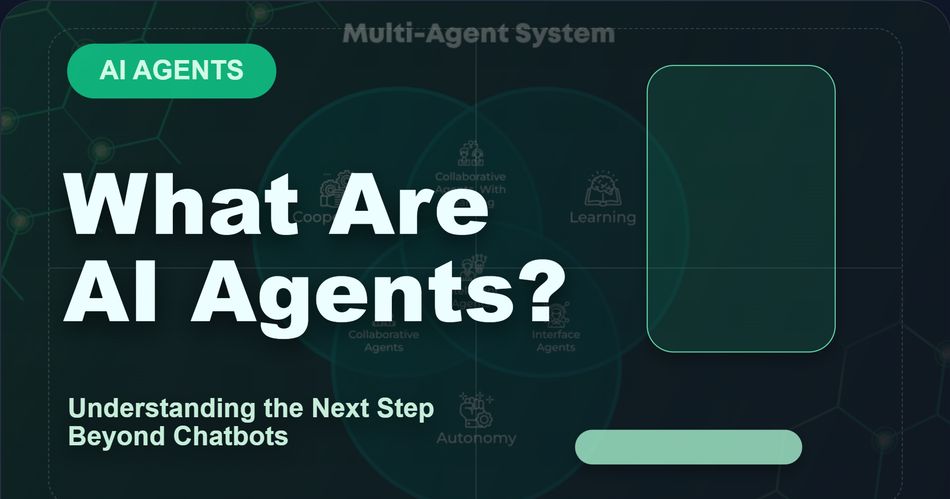

AI agents are systems that do more than answer a prompt. They can plan, decide which tools to use, gather information, execute sub-tasks, and sometimes act across multiple steps toward a goal. This makes agents a distinct category from ordinary chatbots, which primarily respond within a single conversational turn.
From chatbot to agent
A chatbot mainly reacts. An agent can pursue a goal over time. That difference sounds simple, but it changes system design significantly. Once a system can decompose a task, call tools, read results, and adapt its next action, it begins to look less like a static interface and more like a software worker.
Typical ingredients
- A language model for reasoning and language generation
- A goal or task description
- Memory or working state
- Tool access such as search, code execution, or APIs
- Control logic to loop, plan, and revise
Why agents matter
Agents matter because many real-world tasks are multi-step: research a topic, compare options, extract data, prepare a report, and recommend next steps. That workflow is difficult to compress into one answer. Agentic systems try to handle it through iterative action.
Key Takeaways
- Start with the real user task, not the technology trend.
- Use structured workflows, examples, and evaluation criteria.
- Treat AI output as draft assistance unless verified.
- Choose tools and frameworks based on fit, not hype.
- Build habits of review, iteration, and grounded testing.
Further Reading
The most practical way to learn this topic is to move from theory into a small real project. Read the official documentation, test the ideas on a narrow use case, and review the results critically. That process will teach far more than passive consumption alone.