
A customer-support team has a capable language model, but its first drafts use the wrong refund policy, miss the company’s preferred tone, and sometimes route technical questions to the wrong queue. The model is intelligent in a broad sense, yet it is not reliably useful in this particular business.
A legal operations group faces a similar problem. It wants to identify clause types in contracts and flag departures from its internal playbook, but general knowledge alone does not reveal how that organization defines an acceptable exception.
These are not simply prompting problems. Clear instructions, retrieval, workflow rules, and human review may help substantially, but some recurring tasks require the model to learn a narrower behavior from examples.
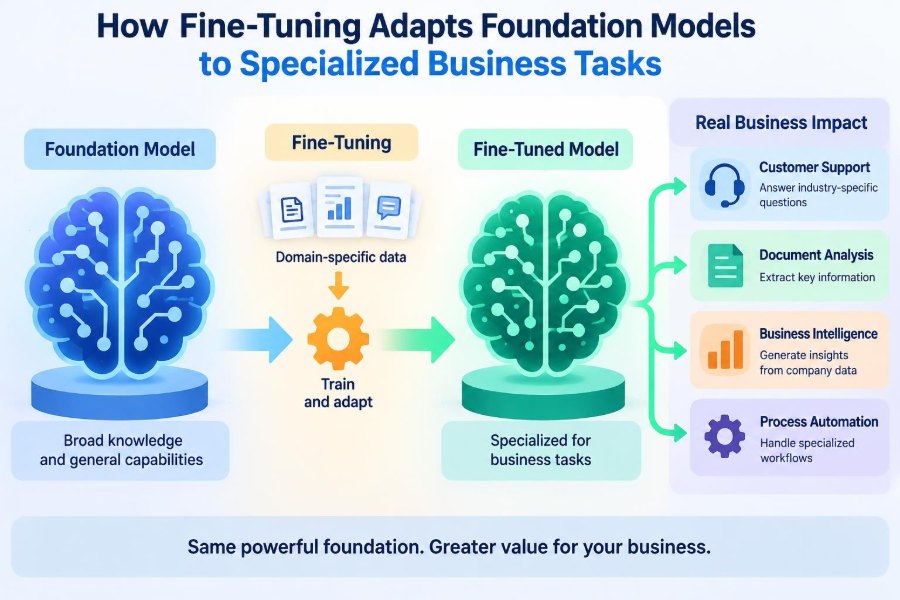
Fine-tuning is the process of adapting a pretrained foundation model by training it further on carefully selected task- or domain-specific data. Done well, it can turn broad capability into consistent business performance. Done carelessly, it can make a model narrower, less safe, and harder to trust.
🧠 1. Start with the foundation-model idea
A foundation model is trained on a very large and varied collection of data before any one organization uses it. It learns broad statistical patterns in language, code, images, audio, or several modalities.
That broad training gives the model reusable abilities: following common language, recognizing concepts, generating text, and completing familiar patterns. It does not automatically give it a company’s current procedures, confidential knowledge, or preferred decisions.
🎯 2. Define fine-tuning precisely
Fine-tuning continues training from an existing model rather than beginning from random parameters. The training examples show what useful inputs and outputs look like for a narrower objective.
For a text model, an example might pair a support request with a correctly formatted response. Across many examples, optimization adjusts model parameters so the desired response becomes more likely.
Fine-tuning is not the same as merely saving a prompt. It changes learned model behavior, whether by updating many parameters or a smaller added component.
🏢 3. Why businesses need specialization
Business tasks often contain local vocabulary, decision rules, formats, and risks. A general model may understand the words “priority incident,” but not an organization’s precise escalation threshold.
Specialization is especially valuable when the same task appears repeatedly and quality can be evaluated. Consistency matters in areas such as classification, extraction, document drafting, routing, and structured reporting.
- Internal support teams need approved terminology and actions.
- Finance workflows need stable fields and validation-friendly outputs.
- Engineering teams need code conventions and repository-specific patterns.
- Regulated teams need controlled language and review pathways.
🧩 4. Separate knowledge, behavior, and workflow
Many AI projects stall because they treat every deficiency as a fine-tuning problem. A useful diagnosis separates knowledge, behavior, and workflow.
Knowledge concerns facts the model needs, such as the latest product documentation. Behavior concerns how it should respond: concise versus detailed, formal versus conversational, or JSON rather than prose. Workflow concerns what systems, permissions, checks, and humans surround the model.
Fine-tuning is strongest for durable behavioral patterns. Frequently changing facts usually belong in a retrieval system, database, or tool rather than in the model’s weights.
🗺️ 5. Choose the right adaptation method
Fine-tuning is one option in a wider design space. The best solution is often a combination rather than a single technique.
| Approach | Best suited to | Main limitation |
|---|---|---|
| Prompting | Quick experimentation and clearly stated instructions | Can be inconsistent for nuanced, repeated tasks |
| Retrieval-augmented generation | Current, traceable, or private reference knowledge | Does not by itself guarantee desired style or decisions |
| Tool use and workflow rules | Calculations, database actions, approvals, validations | Requires integration and operational design |
| Fine-tuning | Stable task behavior, formats, and domain patterns | Needs high-quality data and monitoring |
A practical sequence is to establish a prompt-and-retrieval baseline first. Fine-tune only when the remaining gap is repeatable, important, and demonstrated by evidence.
🔎 6. Find a narrow, measurable use case
“Make our assistant smarter” is not a trainable objective. “Classify inbound claims into approved categories with a reason and confidence field” is much closer.
Good initial use cases have bounded inputs, recognizable correct outputs, enough representative examples, and a meaningful cost for inconsistency. They also have a clear owner who can decide what “good” means.
Start narrow because each added task can introduce conflicts. A model tuned for terse extraction may not also be the best model for warm, open-ended customer conversations.
📏 7. Write an operational success definition
Before collecting data, describe the exact output contract. Specify required fields, allowed categories, tone, length, refusal behavior, and when the model must defer to a person.
Define evaluation measures that reflect the work. Depending on the task, these may include exact field validity, category agreement, factual support, reviewer preference, or correct escalation.
Do not rely on a vague impression that examples “look better.” A business needs to know whether performance improved on cases the model did not train on.
📚 8. Build data from real work carefully
The most valuable training data often comes from completed business workflows: resolved tickets, reviewed documents, accepted reports, or expert decisions. Historical records are useful only if their quality and permissions have been examined.
Raw operational data can contain mistakes, obsolete practices, sensitive information, and inconsistent outcomes. Treat it as source material, not as automatically correct training truth.
Useful data sources
- Expert-created demonstrations of desired inputs and outputs.
- Approved historical work after quality review and de-identification.
- Edge cases designed from known failures and policy boundaries.
- Preference comparisons showing which of two outputs is better and why.
🧹 9. Clean data before it teaches the model
Training amplifies patterns. If examples contain confusing instructions, unprofessional language, broken formatting, or unsupported answers, a model can learn those flaws.
Remove duplicates where appropriate, normalize formats, resolve contradictory labels, and exclude records that should not be used. Preserve meaningful variation: real users do not all phrase requests the same way.
Data cleaning is not a minor preprocessing chore. It is part of defining the behavior the organization is choosing to automate. 🧹
🔐 10. Protect confidential and personal information
Business records may include personal data, credentials, financial details, health information, trade secrets, or privileged communications. A record being available internally does not automatically authorize its use for model training.
Organizations should establish lawful and policy-aligned handling, minimize data, restrict access, and use appropriate retention and deletion processes. Sensitive fields may need redaction, tokenization, substitution, or exclusion.
Also examine the model provider and deployment arrangement. Data handling commitments, isolation options, logging, and training-use policies can materially affect the risk decision.
🧪 11. Create a dataset split that tests reality
Training data teaches; validation data guides development choices; test data estimates performance on unseen cases. The test set should be protected from repeated tuning decisions.
Random splits are not always sufficient. If nearly identical customer threads appear in both training and test sets, scores may look strong while real-world generalization remains weak.
Consider splitting by customer, document, time period, product line, or issue type when those boundaries reflect deployment. Include difficult and infrequent cases deliberately.
📝 12. Format examples like the real task
Training examples should closely resemble production inputs and expected outputs. If users will provide a ticket plus account context, examples should reflect that structure without exposing unnecessary sensitive data.
For structured tasks, use consistent schemas. If the desired output is JSON, every example should demonstrate valid JSON with the intended keys, rather than mixing prose and several incompatible formats.
Input: "Customer cannot access account after password reset."
Output: {"category":"account_access","priority":"normal","action":"send_reset_troubleshooting"}
Examples should show not only successful answers but also safe boundaries: missing information, unsupported requests, and cases that require escalation.
🏷️ 13. Make labels meaningful and stable
A label is a compressed business decision. Labels such as “other” or “needs review” may be necessary, but overusing them hides distinctions the workflow needs.
Write short annotation guidelines with definitions, counterexamples, and tie-breaking rules. Ask multiple reviewers to label a sample when possible; disagreement reveals ambiguity in the task, not merely annotator error.
If experts cannot consistently decide between two categories, a model will struggle too. The remedy may be clearer policy or a redesigned taxonomy.
⚙️ 14. Understand what training changes
A model represents behavior through numerical parameters. During supervised fine-tuning, it produces an output for each example, compares that output with the target, and uses optimization to reduce the difference.
Over many batches, small updates shift the likelihood of patterns associated with desired answers. The process does not store rules in a human-readable policy manual, and it does not guarantee perfect recall of every example.
This matters because model behavior is probabilistic. Training improves tendencies; production controls are still needed for high-consequence actions.
🪶 15. Use parameter-efficient fine-tuning when appropriate
Full fine-tuning updates the original model’s parameters. It can be powerful, but it may require more compute, storage, and careful management.
Parameter-efficient fine-tuning updates a smaller set of added or selected parameters while keeping most of the base model unchanged. Adapter-style methods are common examples.
This approach can make it practical to maintain different specialized variants for different tasks. The choice depends on the model, platform, performance requirements, and deployment constraints.
🎛️ 16. Keep training settings disciplined
Training configuration affects outcomes: learning rate, batch size, number of passes through the data, sequence length, and regularization choices all matter. More training is not automatically better.
Excessive training on a small or narrow dataset can cause overfitting. The model may imitate training examples closely yet perform poorly on new wording, new customers, or nearby cases.
Use validation results to guide settings, record experiments, and keep a reproducible version of data, prompts, model configuration, and evaluation suite.
🧠 17. Watch for catastrophic forgetting
A heavily specialized model can lose some useful general capabilities after training. This phenomenon is often called catastrophic forgetting, though the degree varies by method and setup.
For example, a model intensively trained on terse internal classifications may become less responsive to broader instructions or less capable on uncommon requests. Evaluate both the intended task and critical baseline capabilities.
Smaller updates, diverse training data, parameter-efficient methods, or separate task-specific models may help preserve a better balance.
✅ 18. Evaluate more than one kind of correctness
A single score rarely captures business usefulness. A support response can be grammatically polished yet violate policy; a valid JSON object can classify the issue incorrectly.
Evaluation dimensions
- Task accuracy: Did it select the right class, extract the right fields, or complete the right transformation?
- Format reliability: Is the output parseable and compliant with the required schema?
- Groundedness: Are claims supported by supplied context or approved sources?
- Safety: Does it avoid prohibited advice, data exposure, and unsafe actions?
- Operational value: Does it reduce rework, improve routing, or help experts work faster?
👩⚖️ 19. Use expert review as a measurement tool
Automated metrics are useful for deterministic tasks, but many business judgments are contextual. Subject-matter experts can assess whether an answer is complete, policy-aligned, actionable, and appropriately cautious.
Make reviews structured. Give reviewers a rubric, blind them to which model produced each answer when feasible, and ask them to identify specific failure types.
Reviewer comments become valuable data for the next improvement cycle. They also reveal whether the process itself needs clarification rather than more model training.
🛡️ 20. Test safety, privacy, and adversarial inputs
A tuned model can still follow malicious instructions, produce biased outputs, leak sensitive context supplied in a session, or answer outside its intended scope. Specialized capability does not remove general model risks.
Test prompts that attempt to override rules, request restricted information, inject instructions through retrieved documents, or exploit ambiguous wording. Include cases where the correct answer is to decline, ask for clarification, or route to a human.
For consequential decisions, do not let a fine-tuned model become the only control. Combine it with access controls, deterministic checks, approval steps, and audit trails.
🔄 21. Combine fine-tuning with retrieval
Fine-tuning and retrieval solve different problems. Fine-tuning can teach the model how to interpret a request and present an answer; retrieval can supply the latest approved facts at the moment of use.
A policy assistant might be fine-tuned to produce a short decision summary with citations to supplied passages, while retrieval provides the current policy text. This is usually more maintainable than retraining whenever a policy changes.
Retrieved material must still be selected, permission-filtered, and presented carefully. A model should not treat every retrieved statement as unquestionable truth.
🔗 22. Add tools for actions and verification
Language models are poor substitutes for authoritative systems of record. If an answer requires a current balance, inventory count, calculation, or customer status, a controlled tool call can be more reliable than a generated guess.
Fine-tuning may help the model choose when and how to request a tool, but the surrounding application should validate arguments and permissions. The model should not directly bypass business controls.
A robust design often follows this pattern: interpret request, retrieve context, call approved tools if needed, validate results, generate a response, and log the event.
🚦 23. Set clear human-escalation boundaries
Not every task should be automated to the same degree. Escalate when confidence is low, information is incomplete, policy exceptions are involved, or an outcome could materially affect a person or organization.
Escalation works only if the human receives useful context. Send the original request, relevant retrieved material, the model’s proposed output, uncertainty signals where available, and a reason for review.
Designing handoffs is a business-process task, not an afterthought. A fast model that creates confusing review queues may increase total work.
📦 24. Deploy as a versioned product
A fine-tuned model should have a version, owner, intended-use statement, evaluation record, and rollback plan. The dataset and prompt template used with it should also be identifiable.
Roll out gradually when feasible. Compare its behavior with an existing process, limit early exposure, and ensure a safe fallback exists if quality drops.
Deployment includes user-interface design. Show users what the system can do, what it cannot do, and when its output requires verification.
📈 25. Monitor behavior after launch
Offline test performance is a starting point, not a permanent guarantee. Real inputs change as products, customer language, internal policies, and adversarial behavior change.
Monitor task outcomes, schema failures, escalation frequency, user corrections, latency, and recurring error categories. Review sampled interactions with appropriate privacy protections.
Watch for data drift: production inputs may differ from the examples used in training. A model can remain technically available while quietly becoming less useful. 📈
🔁 26. Improve through an evidence loop
When failures appear, classify them before retraining. Was the prompt unclear? Was a current fact missing? Did retrieval fail? Was a tool unavailable? Was the label ambiguous? Or did the model need a learned behavioral change?
Correct the smallest layer that solves the problem. Updating a retrieval document is often safer and faster than fine-tuning. Conversely, repeated format errors across many inputs may justify collecting better demonstrations and training again.
Keep a curated failure set. It is one of the best assets for measuring whether each new version genuinely improves.
💰 27. Account for the full cost
The cost of fine-tuning extends beyond a training run. It includes data discovery, expert labeling, privacy review, experimentation, evaluation, deployment, monitoring, and periodic maintenance.
There are also opportunity costs. A complex custom model may take longer to improve than a simpler retrieval or workflow change that addresses the actual business bottleneck.
Value should be judged against the whole process: quality, speed, risk reduction, employee experience, and the effort required to keep the system dependable.
⚖️ 28. Govern the model according to its impact
Governance should be proportional to the task. A model that formats internal meeting notes has different requirements from one that influences hiring, credit, medical, legal, or safety-related decisions.
Document intended use, prohibited use, accountable owners, data sources, known limitations, review requirements, and incident procedures. Involve legal, security, privacy, risk, and domain experts early when the use case warrants it.
Good governance is not merely paperwork. It makes decisions traceable and gives teams a way to stop, investigate, and correct harmful behavior.
🌱 29. Build organizational capability, not just a model
Successful adaptation depends on collaboration. Domain experts define quality, data teams prepare examples, engineers build the system, security teams protect it, and operations teams handle exceptions.
Teach employees to distinguish confident wording from verified correctness. Give them ways to report failures and improve prompts, knowledge sources, and workflows.
The durable advantage is often the organization’s ability to learn from its own work responsibly, rather than possession of one particular model version.
🏁 30. The core principle: specialize behavior, preserve control
Fine-tuning adapts a foundation model by teaching it stable patterns from high-quality examples. It is most useful when a business can clearly define a repeated task, collect trustworthy demonstrations, and evaluate results on realistic unseen cases.
It should not be treated as a way to embed every changing fact or to eliminate human judgment. Retrieval supplies current knowledge, tools provide authoritative actions, workflow controls manage risk, and people remain essential where context and accountability matter.
The goal is not to make a general model know everything about a business; it is to make a well-governed system perform a specific job reliably. 🎯🧠🚦