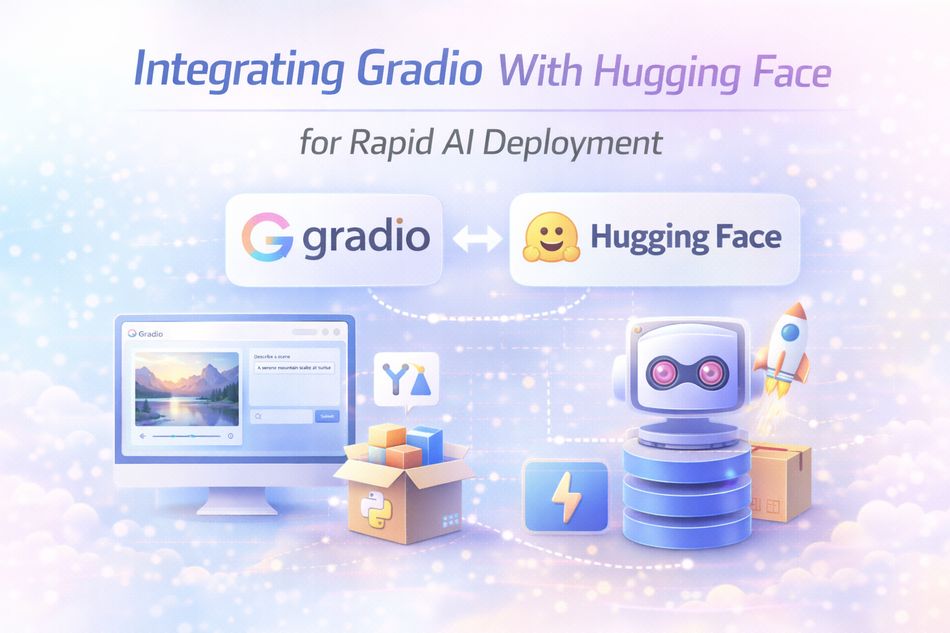

Gradio is an open-source Python package for building demos and web applications around machine learning models, APIs, and Python functions. Its popularity comes from how quickly developers can turn a model into an interactive interface with minimal frontend work.
Why the combination works
Hugging Face and Gradio fit naturally together because one side offers models and sharing infrastructure while the other offers easy interfaces. This makes it simple to move from a loaded model to a public or semi-public demo.
Typical integration flow
- Select or host a model
- Write inference logic in Python
- Wrap it with Gradio components
- Deploy to Hugging Face Spaces
- Iterate using user feedback
What this enables
Independent developers can validate ideas faster. Teams can show a proof of concept to stakeholders without building a full custom frontend. Educators can make ML concepts tangible through interactive examples.
Key Takeaways
- Start with the real user task, not the technology trend.
- Use structured workflows, examples, and evaluation criteria.
- Treat AI output as draft assistance unless verified.
- Choose tools and frameworks based on fit, not hype.
- Build habits of review, iteration, and grounded testing.
Further Reading
The most practical way to learn this topic is to move from theory into a small real project. Read the official documentation, test the ideas on a narrow use case, and review the results critically. That process will teach far more than passive consumption alone.