
Flask remains one of Python’s most approachable web frameworks. Officially described as a lightweight WSGI web application framework, it is designed to make getting started quick and easy while still being capable of scaling up to more complex applications.
Why structure matters
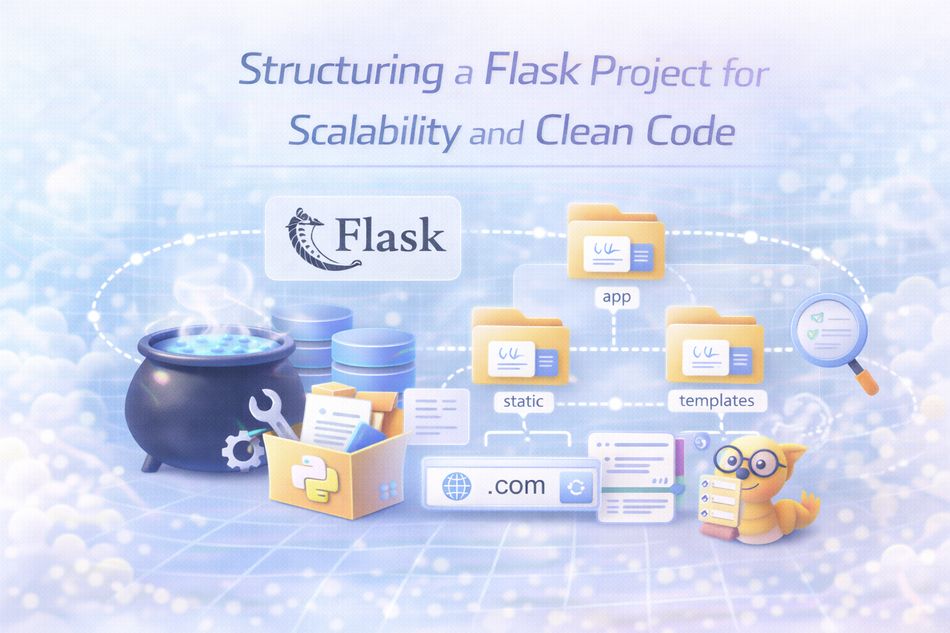
Flask’s simplicity can become messy if everything stays in one file. As soon as a project grows, developers should separate configuration, routes, templates, models, services, utilities, and tests.
Common structural ideas
- Application factory pattern
- Blueprints for modular routes
- Separate config classes for environments
- Dedicated services for business logic
- Tests that mirror the application layout
A clean-code mindset
The goal is not to copy a fashionable structure. The goal is to keep responsibilities clear. Route handlers should stay thin. Business logic should move into service layers. Reusable helpers should not be buried inside view functions.
Key Takeaways
- Start with the real user task, not the technology trend.
- Use structured workflows, examples, and evaluation criteria.
- Treat AI output as draft assistance unless verified.
- Choose tools and frameworks based on fit, not hype.
- Build habits of review, iteration, and grounded testing.
Further Reading
The most practical way to learn this topic is to move from theory into a small real project. Read the official documentation, test the ideas on a narrow use case, and review the results critically. That process will teach far more than passive consumption alone.