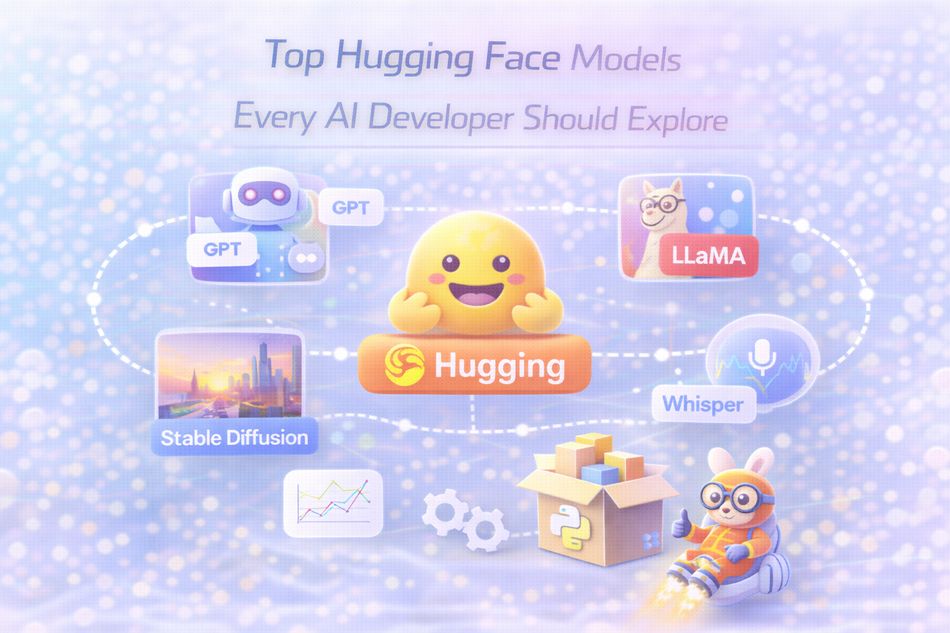

Hugging Face has become one of the central platforms in the open AI ecosystem. It is not just a model library. It is a broad collaboration hub for models, datasets, evaluation assets, demos, and deployment workflows, supported by tools such as Transformers, Datasets, the Hub, and Spaces.
How to think about model selection
The best model is not the one with the most hype. It is the one that matches your task, latency budget, hardware, licensing needs, and quality requirements. Hugging Face is valuable because it lets developers explore many options in one place and compare them more practically.
Categories worth exploring
- Encoder models for embeddings and classification
- Decoder or causal models for generation
- Sequence-to-sequence models for translation and summarization
- Vision models for image tasks
- Speech models for transcription and audio understanding
A practical evaluation mindset
Instead of searching for a universal top ten, start with your use case: sentiment analysis, summarization, retrieval, translation, OCR, speech, or image classification. Then evaluate candidate models on your own data or representative examples.
Key Takeaways
- Start with the real user task, not the technology trend.
- Use structured workflows, examples, and evaluation criteria.
- Treat AI output as draft assistance unless verified.
- Choose tools and frameworks based on fit, not hype.
- Build habits of review, iteration, and grounded testing.
Further Reading
The most practical way to learn this topic is to move from theory into a small real project. Read the official documentation, test the ideas on a narrow use case, and review the results critically. That process will teach far more than passive consumption alone.