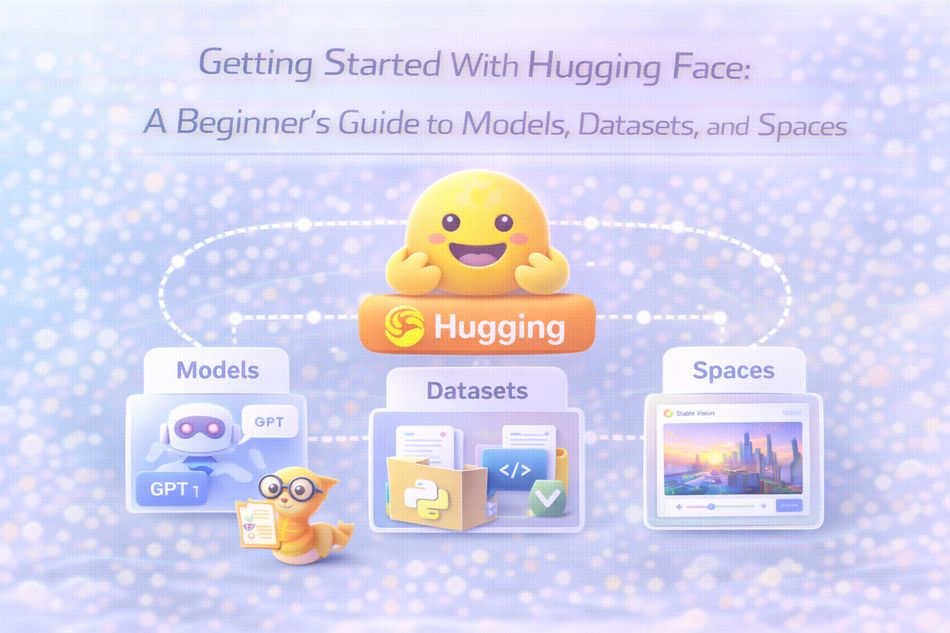

Hugging Face has become one of the central platforms in the open AI ecosystem. It is not just a model library. It is a broad collaboration hub for models, datasets, evaluation assets, demos, and deployment workflows, supported by tools such as Transformers, Datasets, the Hub, and Spaces.
The three pillars beginners should learn
- Models: reusable pretrained checkpoints hosted on the Hub.
- Datasets: structured datasets for training, fine-tuning, and evaluation.
- Spaces: sharable demo apps for showcasing and testing ML systems.
How the ecosystem fits together
A common beginner workflow is simple: discover a model on the Hub, load it with Transformers, test it on data, and then publish a demo in Spaces. This unifies experimentation and sharing in a single ecosystem.
The Hugging Face Hub also supports versioned collaboration, making it easier for teams to reproduce experiments and distribute models or datasets consistently.
A sensible learning path
- Create an account and browse tasks on the Hub
- Run a simple Transformers pipeline locally
- Load a small dataset with the Datasets library
- Build a minimal demo using Gradio or Streamlit
- Publish it to Spaces
Key Takeaways
- Start with the real user task, not the technology trend.
- Use structured workflows, examples, and evaluation criteria.
- Treat AI output as draft assistance unless verified.
- Choose tools and frameworks based on fit, not hype.
- Build habits of review, iteration, and grounded testing.
Further Reading
The most practical way to learn this topic is to move from theory into a small real project. Read the official documentation, test the ideas on a narrow use case, and review the results critically. That process will teach far more than passive consumption alone.