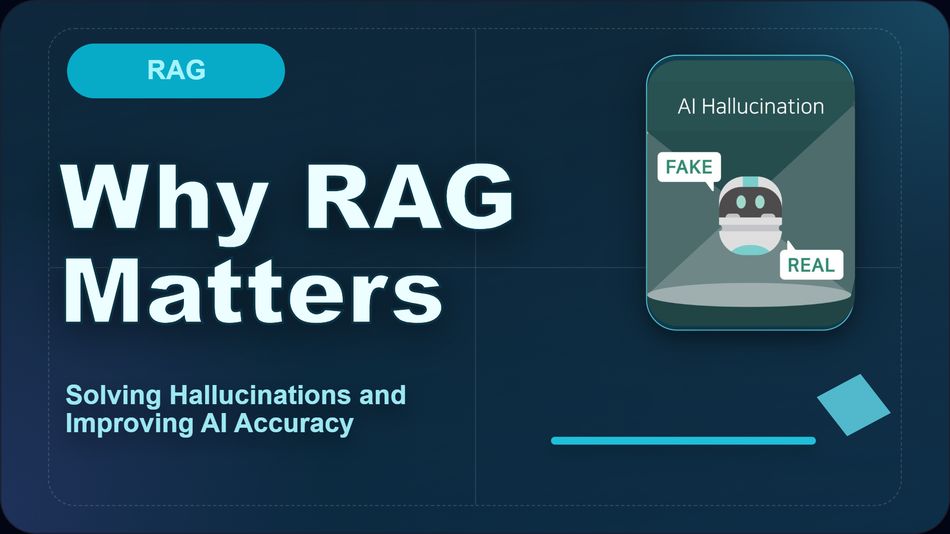

Retrieval-Augmented Generation, usually called RAG, is an approach in which a model answers questions using external retrieved information instead of relying only on what it memorized during pretraining. This has become one of the most important patterns in practical AI because it connects language models to current, domain-specific, or proprietary knowledge.
Hallucinations are often a context problem
A model hallucinates more easily when it lacks grounded context yet is still asked to answer confidently. RAG reduces this by supplying relevant evidence at answer time. Instead of forcing the model to rely only on memory, it gives the model something concrete to read before responding.
This is especially important when the knowledge is recent, proprietary, or niche. Product manuals, internal policies, medical guidelines, and legal procedures can change faster than model training cycles.
Accuracy gains in practice
RAG does not guarantee truth, but it often improves usefulness because the answer can be tied to retrieved evidence. This also enables citation-like behavior, where the system points the user toward the supporting chunk or document.
Why organizations adopt it
- Knowledge bases can be updated without retraining
- Answers can be grounded in internal documents
- Systems can be easier to audit
- Domain coverage becomes more controllable
- The approach is often cheaper and faster than full fine-tuning
Key Takeaways
- Start with the real user task, not the technology trend.
- Use structured workflows, examples, and evaluation criteria.
- Treat AI output as draft assistance unless verified.
- Choose tools and frameworks based on fit, not hype.
- Build habits of review, iteration, and grounded testing.
Further Reading
The most practical way to learn this topic is to move from theory into a small real project. Read the official documentation, test the ideas on a narrow use case, and review the results critically. That process will teach far more than passive consumption alone.